Jeju Citrus Prices 5% Lower Early in Shipping Season; Production Forecast to Rise 7.8%
- Input
- 2026-11-07 12:23:08
- Updated
- 2026-11-07 12:23:08
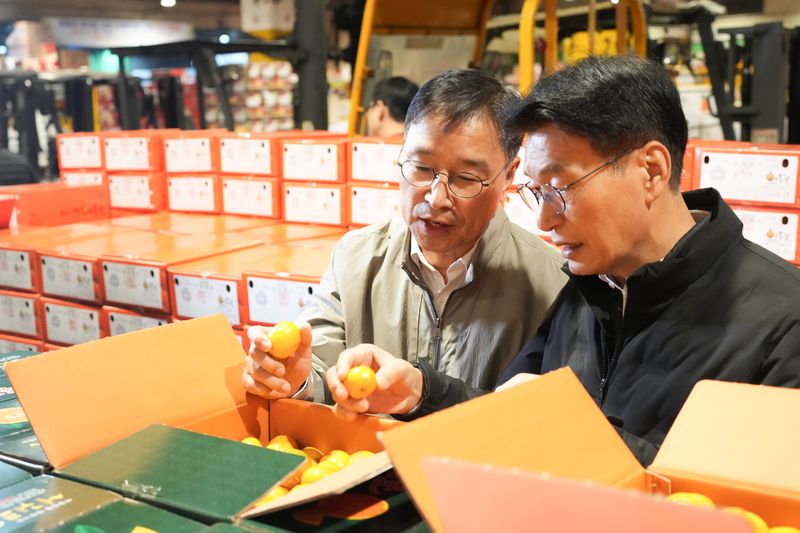
【Financial News Jeju = Jeong Yong-bok, reporter】 This year’s open-field Jeju citrus production is expected to increase 7.8% from last year, while the average trading price through the end of October was 5% lower than a year earlier. Wi Seong-gon, governor of Jeju Province, visited Seoul’s Garak Market to inspect citrus auctions and quality-control practices and ask the distribution industry to cooperate in stabilizing prices and expanding consumption.
According to Jeju Special Self-Governing Province on the 7th, Governor Wi visited the Garak Agricultural and Marine Products Wholesale Market in Seoul’s Songpa District the previous day and toured citrus auction sites run by five wholesale market corporations: Hanguk Cheonggwa, Donghwa Cheonggwa, Seoul Cheonggwa, Jungang Cheonggwa, and Nonghyup Garak Auction Market.
The Jeju Agricultural Research and Extension Services and the Citrus Observation and Research Committee estimate this year’s open-field citrus production at 443,300 tonnes, up 7.8% from last year.
As of October 29, the cumulative average trading price for open-field citrus was 9,778 won per 5 kg, 5% below the 10,297 won recorded over the same period last year. It was about 4% higher than the normal-year price of 9,446 won. Cumulative shipments over the same period totaled 27,037 tonnes, just 6.1% of the projected production.
With increased production coinciding with weak prices early in the season, quality control and shipment management have emerged as major challenges for this year’s citrus trade.
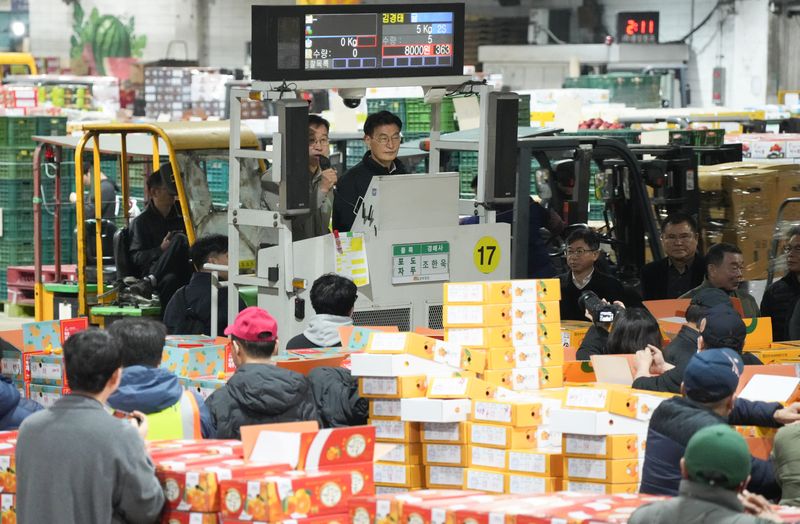
Garak Market distribution officials explained, “Prices for ultra-early-maturing citrus were higher than last year in early October, but fell in the latter half of the month as frequent rain and high temperatures led to fruit spoilage.”
Ultra-early-maturing citrus ripens earlier than regular early-season citrus and is the first variety shipped in autumn. It is prone to rot if exposed to high temperatures or excessive humidity after harvest, making careful sorting, storage, and transport management important.
Wholesale market corporation officials suggested, “To secure repeat purchases from consumers, citrus should be harvested when sufficiently ripe, and rotten fruit must be thoroughly removed.” They explained that quality control throughout the distribution process—from harvesting to grading, storage, and transport—affects price formation.
At the auction sites of each wholesale market corporation that day, Governor Wi introduced Jeju citrus and asked distribution representatives to cooperate in ensuring fair prices.
He then held a meeting in the conference room of Nonghyup Garak Auction Market, attended by Democratic Party lawmaker Moon Dae-rim; representatives of Nonghyup Economic Holdings’ Jeju headquarters, Jeju Nonghyup Joint Business Corporation, producer groups, wholesale market corporations, and associations of intermediate wholesalers; and others.
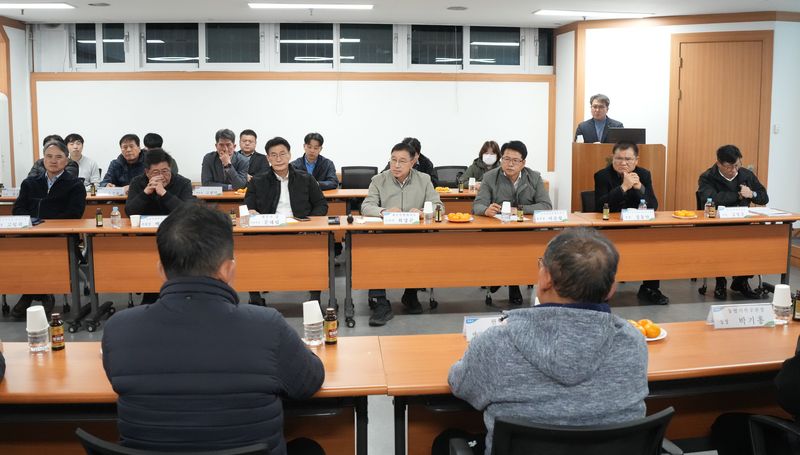
Governor Wi urged them, “Please lend your support so farmers can receive a fair price and consumers can enjoy delicious citrus.”
Jeju Province plans to pursue cultivar renewal in response to rot in ultra-early-maturing citrus caused by high temperatures and to expand its sapling distribution program starting next year. Cultivar renewal involves replacing existing citrus trees with different varieties or planting new trees to improve growing characteristics and quality.
Earlier, at a meeting on measures to stabilize open-field citrus prices on the 2nd, Jeju Province decided to prevent citrus with poor marketability from entering the market and to strengthen quality-based sorting and staggered shipments. The measures are intended to ease the concentration of shipments in particular periods and build consumer confidence.
At the meeting that day, lawmaker Moon Dae-rim also said, “Producers and the distribution industry need to cooperate so that Jeju citrus can fetch a fair price,” adding, “I will discuss with Jeju Province measures for institutional and budgetary support at the National Assembly level, based on views from the field.”
The key to stabilizing citrus prices this year is managing shipments in response to increased production and maintaining quality throughout distribution. Jeju Province plans to continue working with wholesale markets in major cities and promote cultivar renewal and consumption.
[email protected] Jeong Yong-bok Reporter