Jeju enters second round of race to attract public institutions: “Personnel, budgets and core functions must also be transferred”
- Input
- 2026-11-07 12:12:22
- Updated
- 2026-11-07 12:12:22
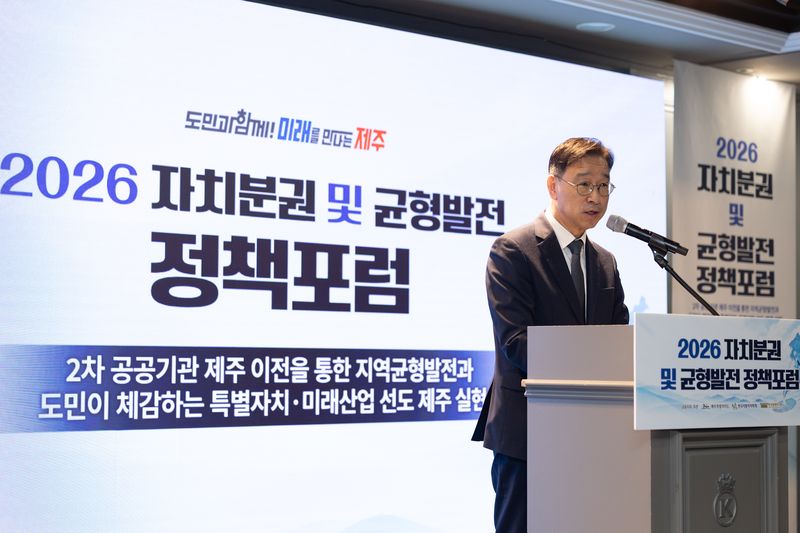
【Financial News Jeju = Reporter Jeong Yong-bok】 Ahead of the government’s second round of relocating public institutions to regions outside the capital area, Jeju Province has set out to attract the Korea Racing Authority, Korea Airports Corporation and Korea Institute of Energy Technology Evaluation and Planning. With the institutions to be relocated not yet finalized, the central issue in the campaign is whether Jeju can secure key personnel, budgets and R&D functions and connect them to local industries and youth employment.
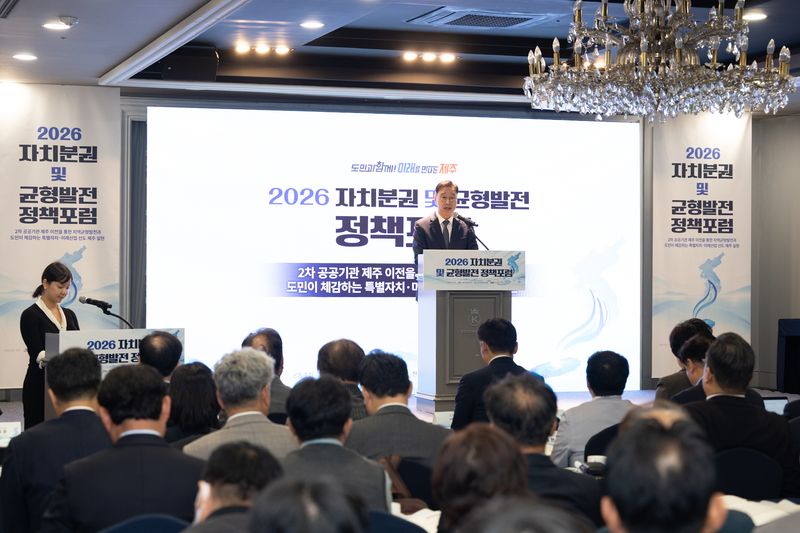
According to Jeju Special Self-Governing Province on the 7th, Jeju Governor Wi Seong-gon expressed interest in attracting the three institutions and presented a strategy for relocating public institutions in connection with local industries at the 2026 Policy Forum on Decentralization and Balanced Development, held the previous day at the Kensington Hotel Yeouido in Seoul.
Governor Wi said, “The second relocation of public institutions to Jeju should be an opportunity for local industries and talent to grow together,” adding, “We will connect the strengths of Jeju industries—including the horse industry, advanced air mobility and renewable energy—with the expertise of the institutions being relocated.”
The government announced five principles for the second round of public institution relocations to regions outside the capital area this past September. It is working to finalize the relocation plan in the fourth quarter of this year and begin moving the lead institutions in 2027. The approach emphasizes links between existing innovation cities and specialized local industries.
The Korea Racing Authority, which Jeju is seeking to attract, is connected to the horse industry and tourism; the Korea Airports Corporation to the aviation industry and urban air mobility (UAM); and the Korea Institute of Energy Technology Evaluation and Planning to renewable energy, green hydrogen and distributed energy industries.
At the forum, Ahn Young-hoon, a research fellow at the Korea Research Institute for Local Administration, analyzed the possibility of relocating six institutions to Jeju and ways to link them with local industries. In addition to the three institutions, they included the Next-Generation Numerical Weather Prediction Model Development Project Group, the Korea Marine Environment Management Corporation and the Korea Trade-Investment Promotion Agency (KOTRA).
Research fellow Ahn said, “The functions of each institution should be linked to the energy, aerospace, meteorology, marine and export industries, while research and certification capabilities in small satellites and biotechnology need to be strengthened.” He also proposed support measures that take into account the transportation and logistics costs and living conditions of island regions when selecting institutions for relocation.
In his keynote address, Yuk Dong-il, president of the Korea Research Institute for Local Administration, pointed out the limitations of the first round of public institution relocations. The share of local talent hired by institutions relocated to Jeju Innovation City rose from 15.1% in 2016 to 29.4% in 2021, but was still the lowest among the country’s 10 innovation cities as of 2021.
President Yuk said, “Relocating only the physical location of an institution in the second round could have a limited effect on the local economy.” He stressed that key personnel, budgets, business authority and R&D functions should be relocated together, and that joint research, hands-on training and employment links with local universities and companies should be expanded.
Another proposal was to use Jeju Innovation City in Seogwipo as the main hub while connecting it to areas specializing in industries across Jeju. Participants also said support for housing, education, health care and transportation should be strengthened to help employees of relocated institutions and their families settle in.
Participants also discussed how to use the institutional powers of Jeju Special Self-Governing Province to develop industries in practice, alongside efforts to attract public institutions.
Baek Ok-seon, a professor at Pusan National University Law School, proposed linking the national electricity supply and demand plan with Jeju’s regional energy plan, and coordinating wind power permitting with grid connections in advance, as legal reforms to support Jeju’s energy transition. She also raised the need to clarify output curtailment standards for renewable energy facilities and strengthen notification to power producers and procedures for filing objections.
Jeon Seong-man, head of the Social Solidarity Economy Policy Center at the Korea Research Institute for Local Administration, proposed conducting and publishing a comprehensive assessment of how the special self-governing powers devolved to Jeju are being used. The aim, he said, is to operate a dedicated body to oversee the use of those powers and expand public participation so that institutional exemptions improve residents’ lives.
Governor Wi also said, “The powers of special self-government should be used to address inconveniences faced by residents,” adding, “We will make better use of existing powers and improve systems to meet needs on the ground.”
The forum was jointly hosted and organized by Jeju Province, the Korean Association for Local Government Studies and the Korea Legislation Research Institute. Around 100 people attended, including the Presidential Committee for the Era of Local Autonomy, members of academia, experts and local residents.
Jeju Province plans to incorporate the policy proposals presented at the forum into its strategy for attracting public institutions, institutional reforms and industry-specific development plans. The key question is how much recognition Jeju’s industrial needs will receive in the government’s future selection of institutions for relocation, and whether those needs will be reflected in the actual scale and functions of the transfers.
[email protected] Jeong Yong-bok Reporter