“KOSPI to Hit 10,000” ... Nomura Keeps Target Unchanged Despite Market Plunge
- Input
- 2026-11-07 08:00:00
- Updated
- 2026-11-07 08:00:00
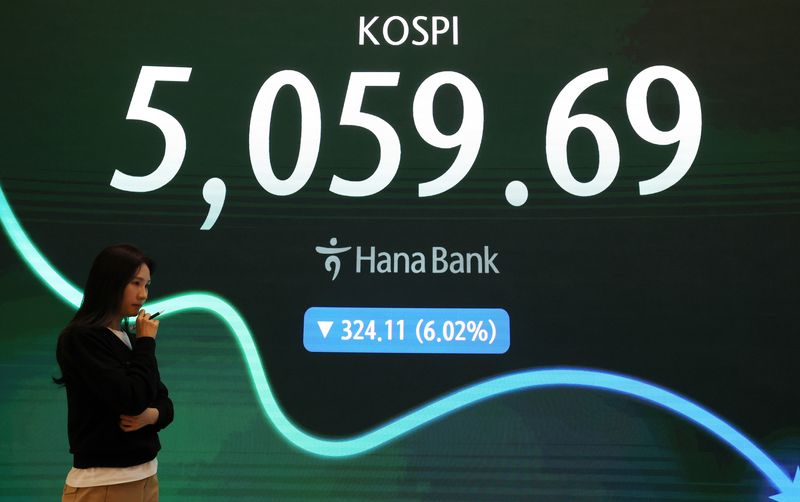
[Financial News] As domestic equities plunged on concerns about slowing artificial intelligence (AI) investment, global investment bank (IB) Nomura maintained its 10,000-point target for the KOSPI. Nomura’s analysis is that the potential for delayed AI investment to weaken earnings at Korean companies is limited, and that factors supporting a market rally, including amendments to the Commercial Act and expanded shareholder returns, remain in place.
According to the financial investment industry on the 7th, Nomura set its KOSPI target at 10,000 points, unchanged from its previous target, in a report released that day titled “Korea’s Market Reform Moving to the Next Phase.”
Nomura’s analysis is that the domestic stock market has fallen excessively relative to companies’ fundamentals. Cindy Park, head of Nomura’s Korea Research Center, said, “The Korean stock market is oversold, but fundamentals appear solid.”
Nomura’s assessment that the domestic stock market is undervalued is based on share prices being low relative to corporate value. Using the previous day’s KOSPI close of 5,383 points, the projected 2027 price-to-earnings ratio (PER) is just 3.8 times and the price-to-book ratio (PBR) 1.1 times, it said.
The 10,000-point KOSPI target was calculated by applying a PER of 7.1 times to a projected 2027 return on equity (ROE) of 31%. However, taking into account macroeconomic uncertainty and AI investment risks, Nomura set its target for the next three months at 7,500–8,000 points.
Nomura said market concerns may be excessive about the impact of tighter U.S. regulations on AI data centers on domestic equities. It said there was no need to view the regulatory issues behind the recent sharp share-price decline too negatively.
Nomura expects demand for AI-related investment to hold up even if regulations tighten. Data center construction could be delayed or investment could shift to different regions, but demand itself is not disappearing, it said. Accordingly, it forecast that the negative impact on Korean memory chipmakers after 2028 would also be smaller than the market expects.
It also expects demand to remain steady for the power equipment, multilayer ceramic capacitors (MLCCs) and energy storage systems (ESS) needed to build data centers.
Improved corporate governance at Korean companies is also a key factor behind Nomura’s forecast of a KOSPI rally.
Nomura cited four factors that could underpin a long-term rise in the KOSPI: improved corporate earnings as AI investment expands; increased share buybacks; stronger shareholder rights through amendments to the Commercial Act; and greater influence for institutional and activist investors.
Nomura assessed that capital market reform in Korea had moved beyond establishing laws and systems and was beginning to affect companies’ actual business practices.
In this regard, Nomura highlighted SK hynix’s decision to halt its review of an initial public offering (IPO) for Solidigm. It said minority shareholders’ interests are increasingly being reflected in major corporate decisions.
Shareholder-return policies are also expanding. According to Nomura, KOSPI-listed companies announced share buybacks totaling 77.6 trillion won this year. Of that amount, treasury share cancellations totaled 62 trillion won, about 3.5 times last year’s level. Nomura viewed the companies’ expanded shareholder returns positively.
Nomura also expects capital market reforms to lead to further institutional improvements as they are applied to the actual management of companies. Cindy Park, head of the center, said, “Korean stock market reform will move from the stage of amending laws and establishing systems to the stage of actual implementation,” adding, “After that, discussions on reform may expand to unresolved issues such as discounts on preferred shares and the net asset value (NAV) discounts at holding companies.”
The companies Nomura named as preferred investment picks include Samsung Electronics, SK hynix, LG Energy Solution, Samsung Electro-Mechanics, Celltrion, Hyundai Mobis, Doosan Enerbility, Samsung SDS and HD Hyundai Marine Solution.
[email protected] Han Seung-gon Reporter