“Hold cash and wait” — warning back in focus after the KOSPI fell below 5,000
- Input
- 2026-11-07 06:00:00
- Updated
- 2026-11-07 06:00:00
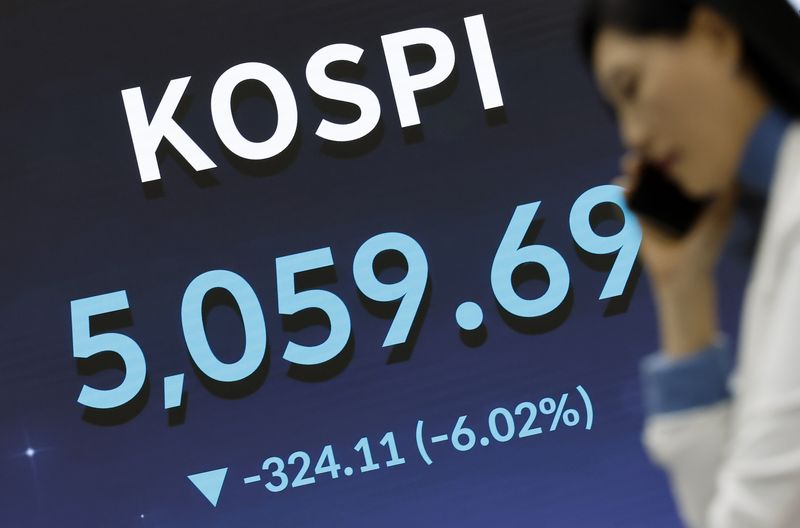
[Financial News] With the KOSPI plunging below the 5,000 mark on the 6th, renewed attention is being paid to analysis by Kim Young-ik, an adjunct professor at Hanyang University's Institute for Future Talent Education, who has warned of further declines in the domestic stock market. Professor Kim said the market correction could last for at least a year and advised investors to reduce their stock holdings and build up cash-like assets.
Online stock-investing communities saw a string of posts that day with titles such as “Kim Young-ik is the winner of this stock market prediction.” A video was shared again in which Professor Kim warned on an economic broadcast on the 20th of last month, “This isn’t the end. We need to prepare for further declines.”
The KOSPI deepened its losses shortly after opening that day, plunging at least 8% in three minutes. A circuit breaker was triggered, and the index fell below the 5,000 mark for the first time in nine months. The KOSPI had also closed at 5,383.80 on the 5th, down 5.28% from the previous trading day.
Since August, Professor Kim has warned of the possibility that the KOSPI could fall below 5,000. At the time, he said the KOSPI had “completely lost its upward momentum” and forecast that the index’s highs and lows could continue to fall through the first half of 2027.
He also warned of a stock market correction in July. On his YouTube channel, “Kim Young-ik’s Economic School,” Professor Kim noted that the KOSPI had risen 101% in the first half of the year and forecast the possibility of a correction in the second half. In particular, he cited the news sentiment index, which moves about five months ahead of the leading economic index and had been falling since March.
In October, he also forecast that the KOSPI could fall to around 4,500–5,000.
Professor Kim has continued to argue recently that the domestic stock market has entered a full-fledged downturn.
On the 3rd, he also analyzed the possibility of further declines on “Kim Young-ik’s Economic School.” He said that although the KOSPI has fluctuated between gains and losses since reaching an intraday high in mid-June, its overall downward trend has continued.
Professor Kim predicted, “Once the leading index starts falling, it declines for about 20 months,” adding, “It may be difficult for stock prices to rise significantly even next year.”
Professor Kim’s analysis is that the stock market is unlikely to turn into a clear upward trend for the time being. He stressed, “The market will remain range-bound for at least about the next year,” and added, “In this kind of market, it’s important to wait. Holding cash and waiting may also be a form of investing.”
He advised individual investors to focus on managing risk through asset allocation rather than making additional purchases. He recommended reducing the share of stocks in financial assets to about 20% and holding the rest in cash-like assets, including short-term bonds.
He explained that investors with a high proportion of their investments in stocks should consider gradually reducing their holdings when the market rebounds.
However, not all of Professor Kim’s past forecasts have proved accurate. Last December, he predicted that the KOSPI would remain around 3,500 this year and that Samsung Electronics’ share price would also struggle to exceed 90,000 won. In fact, the KOSPI broke above the 9,000 mark in June, producing an outcome that differed from his forecast at the time.
As past forecasts diverged from actual stock prices, some investors even joked that they should invest in the opposite direction from Professor Kim’s predictions.
With the KOSPI plunging recently, Professor Kim’s past warnings of a downturn have once again drawn attention. Investors have continued to take an interest in his strategy of reducing stock holdings and building up cash-like assets.
[email protected] Han Seung-gon Reporter