'Indiscriminate' to 'precision strikes': Trump’s targeted tariffs will persist even if Democrats take power
- Input
- 2026-11-06 16:48:52
- Updated
- 2026-11-06 16:48:52
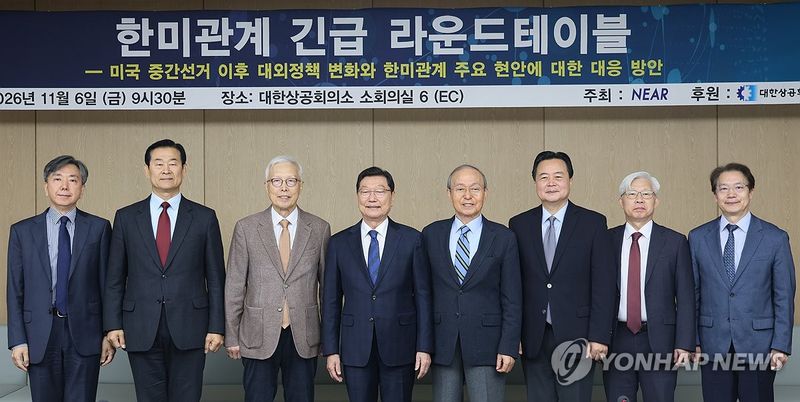
At a roundtable titled “The Impact of the U.S. Midterm Elections” hosted by the NEAR Foundation on the 6th, Lee Jae-min, a professor at Seoul National University School of Law, said, “The trade war and the overall direction of trade policy itself will not change.” He added, “The direction will not change just because the midterm elections are over, or even because a new administration takes office following the results of the presidential election two years from now.”
Professor Lee said the Trump administration’s tariff policy had in fact grown more sophisticated as it used various legal tools, including the International Emergency Economic Powers Act (IEEPA), Section 232 of the Trade Expansion Act of 1962, and Section 301 of the Trade Act of 1974. As the requirements and limits for imposing tariffs under each law have become more clearly defined, he said, the United States has established a basis for selectively pressuring specific countries and products.
Professor Lee predicted, “During President Trump’s remaining two years, refined, targeted and differentiated tariffs will continue within this framework.” He added, “Even if a Democratic administration returns, the tariffs may not be as drastic as they are now, but tariffs that carefully select target countries and products, as with the Inflation Reduction Act (IRA), will remain in place.”
The assessment is that U.S. tariff policy is becoming established as a bipartisan industrial and security strategy, moving beyond President Trump’s personal, unilateral trade pressure. Professor Lee explained that dissatisfaction with the multilateral trading system, efforts to counter China, and trade policies that put national security first have been trends in the United States for more than 10 years. However, he said the Trump administration’s frequent policy reversals and additional demands have also caused discontent within the United States, and predicted that Democratic control of Congress could make tariff policy somewhat more predictable.
Kim Byung-yeon, a chair professor of economics at Seoul National University, also highlighted the benefits of attracting investment and generating government revenue through tariffs. “Under the Biden administration, incentives were offered to attract investment to the United States, but now tariffs can bring in investment even without incentives,” Professor Kim said. “It’s the best card for the United States. Biden couldn’t bring himself to do it, but Trump did. Why would they stop?” He continued, “It’s like getting two birds with one stone: the government collects revenue while attracting investment. I wonder if there will be a ‘good’ government in the next Democratic administration that would overturn this.”
Song Min-soon, a former minister of Foreign Affairs and Trade, also emphasized the likelihood that coercive trade policies will continue. “Before Trump, the United States hit its opponents with gloves on. When Trump came in, he took the gloves off and hit them with his bare fists,” Song said. “Once you’ve tried bare fists, you find they work pretty well.” Citing cases in which the United States secured pledges for large-scale investments from South Korea, Japan and others, he predicted, “It will be quite difficult for the next Democratic administration to retreat from that point.”
[email protected] Jiwon Song Reporter