Kakao Mobility Corp.: “Integrated operational capabilities are key to commercializing robots”
- Input
- 2026-11-06 16:51:40
- Updated
- 2026-11-06 16:51:40
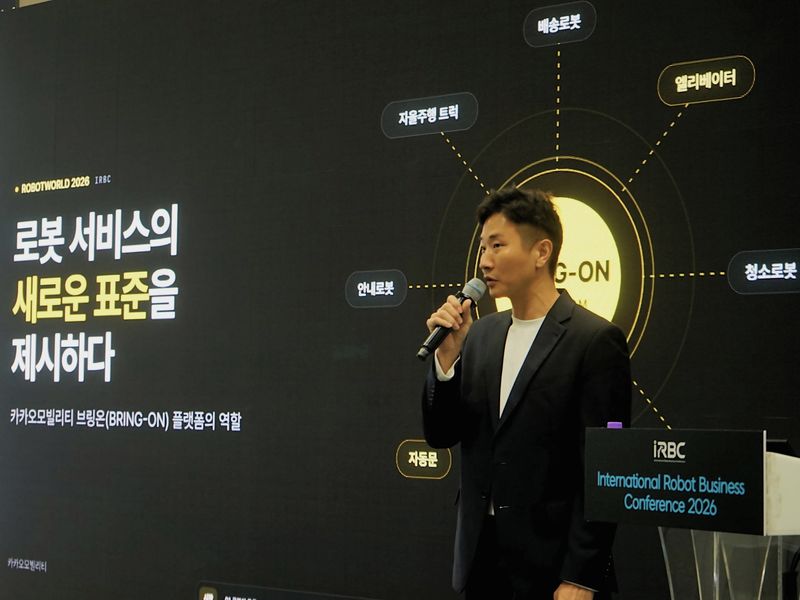
According to industry sources on the 6th, Kakao Mobility Corp. took part in the ‘2026 International Robot Business Conference (IRBC 2026),’ held at KINTEX in Goyang, Gyeonggi Province, on the 4th and 5th, and presented its strategy for its robot platform business.
The event was organized as part of ‘K Connect AI,’ an advanced-industry collaboration project led by the Ministry of Trade, Industry and Energy. A total of 36 sessions were held across three fields: AI transformation (AX), humanoids and physical AI, and mobility.
On the 5th, Kang Eun-gyu, leader of Kakao Mobility Corp.’s Future Business Platform Team, spoke in the mobility track and emphasized that, as robot hardware technology becomes more uniformly advanced, the ability to operate a platform that centrally controls multiple robots is becoming increasingly important.
Kakao Mobility Corp. plans to address this challenge through its in-house robot service platform, ‘BringOn (BRING-ON).’ The service uses dispatch algorithms and platform operations technology developed by Kakao Mobility Corp. to centrally manage everything from robot requests and AI-based dispatching to building-system controls and task handoffs between people and robots. It currently supports robot operations in hotels, hospitals, offices and residential facilities.
A key feature is that robots from different manufacturers can also be managed on a single platform. Previously, each robot manufacturer faced the challenge of having to integrate elevators, automatic doors, security systems and other equipment separately. BringOn connects key building systems to the platform, allowing robots to access the facilities they need by communicating with BringOn just once.
This is said to reduce the burden on businesses operating a range of robots of having to connect each device to building systems one by one, while improving the operational efficiency of robot services.
Leader Kang said, “We plan to standardize the quality of robot services through open collaboration with a range of manufacturers and facility partners,” and added, “We will build an environment where robots can automatically complete tasks even in complex and unpredictable situations.”
[email protected] Jang Min-kwon Reporter