Nongshim steps up global push with first Noksan export-specialty plant; targets 7.3 trillion won in sales by 2030
- Input
- 2026-11-08 12:00:00
- Updated
- 2026-11-08 12:00:00
[Financial News] “Leveraging our smart factory expertise and global strategic products, we will usher in an era by 2030 in which overseas sales account for at least 60% of our total and annual sales reach 7.3 trillion won.”
Nongshim CEO Cho Yong-chul said on the 8th, “We have established a global ramen supply system based on the Noksan Export Specialty Plant in Busan.”
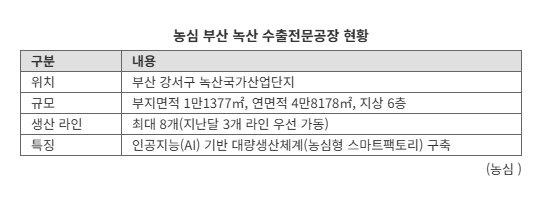
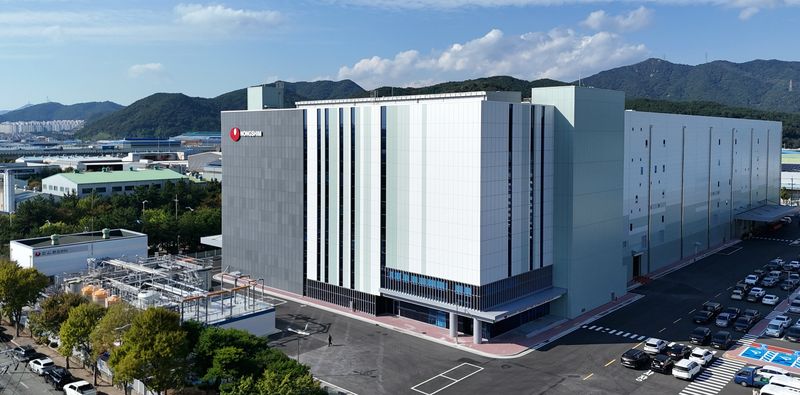
Nongshim is accelerating its push into global markets through its first export-only plant, the Noksan Export Specialty Plant, located in the Noksan National Industrial Complex in Gangseo District, Busan.
According to industry sources, Nongshim has established a global ramen supply system with an annual capacity of 6.2 billion units, based on its Busan Noksan Export Plant, which began operating on the 29th of last month.
This is the combined production capacity of Nongshim’s six plants in South Korea (including the Noksan Export Specialty Plant), two plants in the United States, and two ramen plants in China. That is enough to supply ramen every year to seven out of every 10 people worldwide, whose population is about 8.3 billion.
Ramen produced there is exported to emerging markets such as India and Southeast Asia, as well as to countries where Nongshim has subsidiaries, including those in Europe, Japan and Australia.
The Noksan Export Plant occupies a site of 11,377m2, has a gross floor area of 48,178m2 and stands six stories above ground. It can operate up to eight production lines as global demand grows. The three lines that began operating last month—two for bagged noodles and one for cup noodles—are ultra-high-speed lines capable of producing at least 600 units per minute. The plant can produce 500 million packs of ramen a year.
This exceptional production capacity comes from smart factory equipment incorporating artificial intelligence (AI). Like the Gumi factory, the home of Shin Ramyun, the Noksan Export Plant’s strength is that most of its production processes are unmanned.
The Noksan Export Plant’s biggest feature is its ability to switch production quickly. It has cut product changeover times by up to 25% compared with existing domestic plants, allowing it to handle both diversified global demand for different flavors and formats—including stir-fried noodles, cup noodles and vegan products—and growing overseas volumes each year.
To achieve this, Nongshim built an “AI-based mass-production system (Nongshim-style smart factory)” that brings together AI and new automation technologies throughout the production process. Key technologies include an advanced production management system (PMS) and an AI-based predictive maintenance system for equipment.
A magnetic conveying system that uses magnetic fields has been introduced in the packaging process to keep products properly aligned even during high-speed production. For internal logistics, autonomous mobile robots that navigate on their own using only sensors, without floor markings, automatically deliver materials such as packaging. At the inspection stage, an AI deep-learning-based inspection system has further improved quality consistency.
Nongshim plans to build on the Noksan Export Plant’s production capabilities to expand the Shin Ramyun lineup, a leading K-ramen brand, into non-soup noodles. Next year, it plans to launch a new stir-fried noodle product with a fresh concept, following Shin Ramyun Toomba and Shin Ramyun Rosé.
Nongshim CEO Cho Yong-chul stressed, “The Noksan Export Plant will become the core hub of Nongshim’s global business, capable of supplying products tailored to the diverse needs of consumers around the world quickly and in large quantities.”
[email protected] Kim Seo-yeon Reporter