Motorcyclist threatens elementary school student who filmed him riding on the sidewalk: “I’ll make sure you can’t go to college” [True Case]
- Input
- 2026-11-07 12:00:00
- Updated
- 2026-11-07 12:00:00
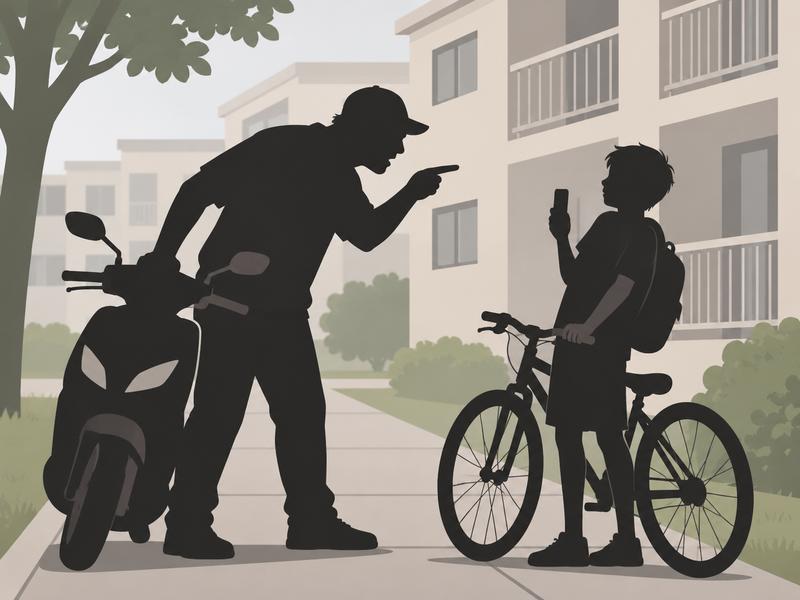
A followed B and used his motorcycle to block the bicycle at another apartment complex. As security guards and residents looked on, A hurled insults at B, including “You little bastard” and “Well, look who thinks he’s an apostle of justice.”
The insults escalated into threats. A threatened that if B did not delete the photos and other footage he had taken, A would file a complaint with the school, have it entered in B’s school record, and make sure he could not get into high school or college. A also said, “I’ll show you how scary adults can be.”
But B did not delete the footage. The argument between the two lasted more than 15 minutes. When B tried to leave on his bicycle, A also stopped him by grabbing the bicycle’s seat or handlebars.
In the end, an apartment security guard who was mediating the argument at the scene called 112.
According to legal sources on the 6th, the Seventh Criminal Division of the Seoul Western District Court, presided over by Judge Lee Tae-young, sentenced A to a fine of 5 million won on August 13 on charges including violating the Child Welfare Act (child abuse), attempted coercion and insult. However, the court acquitted A of the unlawful confinement charge, for which he had also been indicted.
A was indicted on charges of publicly hurling insults at B and attempting to force him to delete the footage by threatening to disadvantage him in school and in his future education. Prosecutors also considered the conduct to constitute emotional abuse that harms a child’s mental health and development.
At trial, A’s side argued that his words and actions had merely been somewhat excessive and did not amount to threats intended to force B to delete the footage. They also argued that insulting remarks alone do not constitute emotional child abuse.
The court rejected those arguments. The panel found the attempted coercion charge sufficiently established, taking into account the nature and degree of the threatened disadvantages and the victim’s age.
The court also found A guilty of emotional child abuse. The panel found that A’s insults and threats were enough to cause humiliation and psychological shock to a 12-year-old child. It also cited B’s statement to investigators that he had felt wronged and afraid at the time.
The court reached a different conclusion on the unlawful confinement charge. Prosecutors argued that A had blocked B from moving for about 17 minutes, depriving him of freedom of movement, but the court found there was insufficient evidence to establish this.
The closed-circuit television (CCTV) footage did not show A physically grabbing or pushing B. It only confirmed that A had briefly grabbed the bicycle’s seat or handlebars at times to stop B from moving, the court said.
At the scene, a security guard was mediating the dispute between the two, and there were also passersby nearby. Considering these circumstances together, the panel found it difficult to conclude that A had physically restrained B and deprived him of his liberty for a substantial period.
[email protected] Choi Seung-han Reporter