“Retail investors’ accounts are deep in the red”... John Lee: “When stock prices fall, look at the company first”
- Input
- 2026-11-06 16:31:08
- Updated
- 2026-11-06 16:31:08
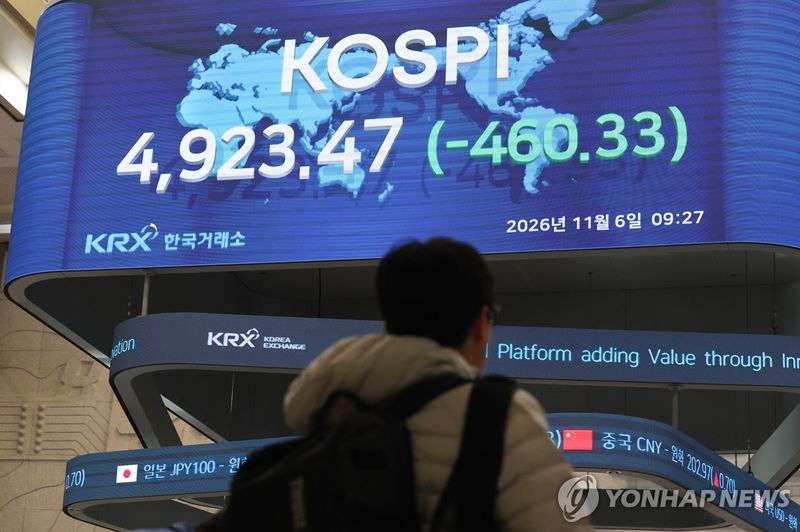
[Financial News] South Korea’s stock market has plunged, fueling individual investors’ frustration with long-term investing. As market volatility grows, attention is also turning to the investment advice of John Lee, head of John Lee’s Rich School, who has long championed long-term investing.
John Lee, known as an “evangelist for long-term investing,” stressed that investors who have suffered losses as stock prices fell should first reassess their investment horizon and approach. “One or two years is not long-term investing,” he said, advising investors not to be overly swayed by short-term price movements.
South Korea’s stock market fell sharply from the moment it opened on the 6th. According to the Korea Exchange (KRX), the KOSPI opened down 2.2% from the previous session before its decline widened to the 8% range in just two minutes. It fell as low as 4,911.28 intraday, dropping below the 5,000 mark for the first time in about nine months, since Feb. 6.
The results of the U.S. midterm elections and concerns about slowing investment in artificial intelligence (AI) contributed to weaker investor sentiment. The shock of the so-called “blue wave,” in which the Democrats took control of both the Senate and the House, weighed on the stock market.
On the KOSPI market, a Level 1 circuit breaker was triggered just three minutes after the open, halting stock trading for 20 minutes. Sell orders continued after trading resumed, and a sell-sidecar was triggered at around 9:35 a.m. A sell-sidecar was also triggered on the KOSDAQ market at around 9:08 a.m.
Losses were also steep among major semiconductor stocks such as Samsung Electronics and SK hynix. Samsung Electronics shares fell as low as 179,200 won intraday, plunging by at least 11%. SK hynix also fell as low as 1,089,000 won at one point.
Most stocks on the KOSPI market also fell. Just 52 stocks advanced, while 845 declined.
Earlier, U.S. stocks had plunged, led by technology and semiconductor shares. The NASDAQ Composite fell 5.52%, while the PHLX Semiconductor Sector (SOX) dropped 12.25%, its steepest decline since 2020. Among major semiconductor companies, Micron plunged 17.46%, AMD fell 17.26%, and Broadcom dropped 10.43%.
Against this backdrop, investors continue to grapple with the long-term investing principles John Lee has championed.
Recently, the YouTube finance channel “Y Street” discussed the concerns of investors who incurred losses of 40–50% while trying to hold stocks for the long term. The host shared with John Lee their frustration at suffering major losses despite believing in long-term investing, and asked how they should respond.
John Lee said it was wrong to think of long-term investing as holding stocks for just six months or a year. He explained that people need to invest with a 10–20-year horizon to build retirement savings, but many investors react too sensitively to short-term stock price movements.
In a YouTube video he posted on the 31st of last month, he also criticized mistaken ideas about stock investing. “People still think stock investing is about predicting prices,” John Lee said. “They keep forgetting that they have invested in a company.”
He also expressed opposition to an approach focused on analyzing stock charts and timing trades. “Many people think investing means looking at charts or figuring out when to cut losses and take profits,” he said. “That’s not investing; that’s gambling.”
He stressed that investors should also be wary of buying and selling stocks based on trading activity by foreign and institutional investors, as well as news about interest rates and exchange rates.
He criticized investors for being swayed by outside information and repeatedly making unnecessary trades. “A lot of the information flooding the market, such as U.S. benchmark interest rates and exchange rates, is already reflected in stock prices,” John Lee said. “Selling along just because foreign investors are selling stocks is behavior driven by herd mentality.” Frequent trading may only serve to increase the fees investors pay to brokerages.
He advised investors to check a company’s business competitiveness and earnings when stock prices fall, rather than focusing on whether to sell. If there are no particular problems with the company’s business or earnings, a market downturn can be used as an opportunity to buy shares in high-quality companies at lower prices, he explained.
John Lee criticized the strategy of buying when stock prices are rising, then rushing to sell out of fear when prices fall. Investors should avoid selling in what is known as a “bargain sale,” when stock prices are lower, he said.
He also urged caution about selling holdings and moving into cash in anticipation of a stock market decline. Trying to buy back after prices reach their lowest point requires accurately predicting the market’s highs and lows, which is virtually impossible, he explained.
As an alternative, John Lee recommended regular, fixed-amount investing regardless of stock price movements—a strategy known as dollar-cost averaging.
He offered investing a set amount every payday as a specific example. “The best way to invest is to buy regularly,” he said, explaining that “if you invest through an automatic transfer on payday, you won’t have to worry so much about whether stock prices are going up or down.”
He recommended investing 10–20% of monthly income. Rather than holding shares in just one company, investors should diversify their investments, for example by using exchange-traded funds (ETFs), and stay invested for the long term, he advised.
He also warned against concentrating investments in the semiconductor sector. “It’s poor investing to buy only Samsung Electronics and SK hynix just because they’re good companies,” John Lee stressed. If investors already own shares in semiconductor companies, buying additional semiconductor ETFs is unlikely to provide meaningful diversification, he explained.
He advised investors to diversify across industries and countries to avoid concentrating their money in a particular sector and reduce the risk of losses in a sharp downturn.
However, he recommended that investors with about three years until retirement reduce the share of their investments allocated to stocks to 30–40%. As retirement approaches, they should manage investment risk by using bond ETFs and dividend-focused REITs, he said.
John Lee reiterated the importance of investing regularly with a long-term perspective. “Stock investing isn’t about predicting prices; it’s about investing consistently,” he said. “There’s no way to get rich in the short term.”
[email protected] Han Seung-gon Reporter