China’s YMTC, the world’s No. 3, aims to localize up to 70% of its NAND equipment as it chases Samsung and SK
- Input
- 2026-11-08 15:14:53
- Updated
- 2026-11-08 15:14:53
[Financial News] Chinese semiconductor companies are expanding production capacity using domestically made equipment and are catching up with Korean companies in the global NAND flash (NAND) market. Yangtze Memory Technologies (YMTC), China’s largest NAND maker, has raised the share of Chinese-made equipment at its new third fab to at least 50% and is reportedly working to increase it to as much as 70% at its subsequent fourth fab. As China expands production facilities using domestic equipment amid U.S. restrictions on exports of advanced semiconductor equipment, competition is expected to intensify in the global NAND market long led by Samsung Electronics and SK hynix.■China aims to localize up to 70% of equipment According to semiconductor industry sources and securities analysts on the 8th, Chinese-made semiconductor equipment accounts for about 20% of the equipment installed at YMTC’s existing first and second fabs in Wuhan, China, but that share is expected to rise to at least 50% at its new third fab. That would be an increase of at least 30 percentage points in the share of Chinese-made equipment compared with existing production facilities.
The share of Chinese-made equipment is expected to rise further at subsequent fabs.
Major foreign media have reported that YMTC has set the share of Chinese-made semiconductor equipment to be installed at its fourth Wuhan fab at a minimum of 60% and a maximum of 70%, and is holding preliminary talks with relevant suppliers. The fourth fab is reportedly expected to produce high-layer-count NAND with memory cells stacked vertically in at least 300 layers, targeting the storage market for artificial intelligence (AI) data centers.
The move is seen as a strategy to reduce reliance on foreign equipment in response to U.S. restrictions on semiconductor equipment exports to China. The Chinese government’s unofficial recommendation that new semiconductor production lines use at least 50% domestic equipment is also thought to have played a role. Existing fabs face high costs and the risk of lower yields when replacing equipment, while new fabs are considered relatively well suited to localization because they can incorporate Chinese-made equipment from the design stage.
YMTC is expanding production capacity alongside its efforts to localize equipment. The utilization rate at its first and second fabs reportedly rose from 97.9% last year to 98% in the first quarter of this year. With the fabs effectively operating at full capacity, the need to secure additional production facilities has grown.
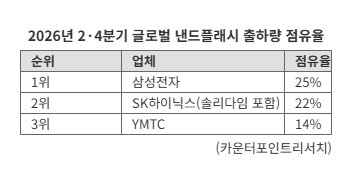
YMTC is expected to begin initial operations at its third fab at the end of this year and add production capacity of 50,000 wafers per month by the end of next year. According to KB Securities and other sources, the combined capacity of its first and second fabs is around 200,000 wafers per month. Adding capacity of 50,000 wafers per month at the third fab would increase total capacity by about 25%. ■NAND competition with Samsung and SK expected to intensifyChina’s localization of equipment and expansion of production capacity are seen as medium- to long-term sources of pressure for Samsung Electronics and SK hynix, which lead the global NAND market. According to market research firm Counterpoint Research, YMTC captured 14% of global NAND shipments in the second quarter of this year, overtook KIOXIA Corporation and rose to third place worldwide for the first time. Its market-share gap with second-place SK hynix (22%) is 8 percentage points.
Samsung Electronics and SK hynix (Solidigm) operate major NAND production hubs in Xi’an and Dalian, China, respectively, leaving them exposed to uncertainty stemming from U.S. restrictions on semiconductor equipment exports to China. Concerns have been raised about the conditions for investment in the country after reports recently emerged that an export license for equipment to expand SK hynix’s Dalian fab had been put on hold. However, equipment needed for existing fabs continues to be brought in as usual under the relevant permits, and procedures for next year’s permits are also reportedly underway. YMTC, facing restrictions on importing U.S.-made equipment, is pursuing the construction of new production lines using Chinese-made equipment.
Industry observers say that as China advances toward equipment self-sufficiency, conditions for investment in production facilities could diverge between Korean companies and Chinese firms. However, they say that greater adoption of Chinese-made equipment will not immediately translate into a narrower technology gap. Producing high-layer-count NAND at scale requires precise equipment and consistently high yields, while product reliability and securing customers are also vital in the enterprise solid-state drive (eSSD) market.
An industry official said, “Expanding the use of Chinese-made equipment is significant in that it helps build a domestic semiconductor ecosystem, but the technological capabilities of the equipment itself have not yet been sufficiently verified,” adding, “It will take considerable time to work through trial and error in actual mass production and build up technical know-how.”
YMTC’s fundraising plans have also recently hit a snag. Major foreign media have reported that YMTC’s parent company, CCSH, recently put on hold the process for an initial public offering (IPO) worth 33 billion yuan (about 6.7 trillion won). The company had planned to invest 20.8 billion yuan (about 4.2 trillion won) of the proceeds in upgrading production lines, prompting concerns that a prolonged delay to the listing could disrupt the expansion of production facilities and development of next-generation NAND technology.
[email protected] Lim Su-bin Reporter