Responds in 0.04 seconds... Kakao Corp. unveils technology to help AI make decisions
- Input
- 2026-11-06 15:00:38
- Updated
- 2026-11-06 15:00:38
[Financial News] Kakao Corp. has open-sourced an in-house AI model designed to speed up decision-making by AI agents. The technology quickly determines what task to perform in response to a user’s request, with the aim of improving AI agents’ work efficiency and expanding their use in real-world services.
According to industry sources on the 6th, Kakao Corp. released ‘Kanana-2-v-Decide,’ a multimodal AI model that analyzes text and images together to support decision-making, on the global AI platform Hugging Face.
Unlike general-purpose generative AI, which answers users’ questions in sentences, a decision-making model presents numerical results, such as the likelihood that a particular condition is met or which of several options is the most suitable. It helps AI move quickly on to the next task by reducing the need to extract relevant information again after generating a response.
The model can be particularly useful for AI agents that handle multiple tasks in sequence. To carry out a user’s request, an AI agent must decide at each step which tools to use and what information to check; the decision-making model provides the results needed for this process.
Kakao Corp. developed the model based on its in-house multimodal language model, ‘Kanana-2-v-3b.’ Because it can analyze images as well as text, it can be used for a range of tasks, including classifying customer inquiries, identifying products in images, and helping AI agents choose tools.
For example, if a customer requests an exchange and attaches a photo of a damaged product, the AI analyzes the image and the inquiry to determine whether the product is damaged, the type of inquiry, and the customer’s emotional state, among other things. The service can then use those results to connect the customer with a representative or explain the exchange process.
The model provides its results in three forms: probabilities, choices, and scores. It can calculate the likelihood that a particular condition is met, select the most suitable option from several choices, or generate a score according to evaluation criteria.
Kakao Corp. also applied technology that converts questions and options into ‘vectors,’ or numerical data, and compares them. The company said data for the same options can be stored and reused, reducing the amount of computation and response time in repeated decision-making processes.
Kakao Corp. emphasized that it had also achieved competitive processing speed and decision-making accuracy. According to the company, the average response time using a single NVIDIA H200 graphics processing unit (GPU) was within 0.04 seconds, making it 43 times faster than GPT-6 Luna, the model used for comparison.
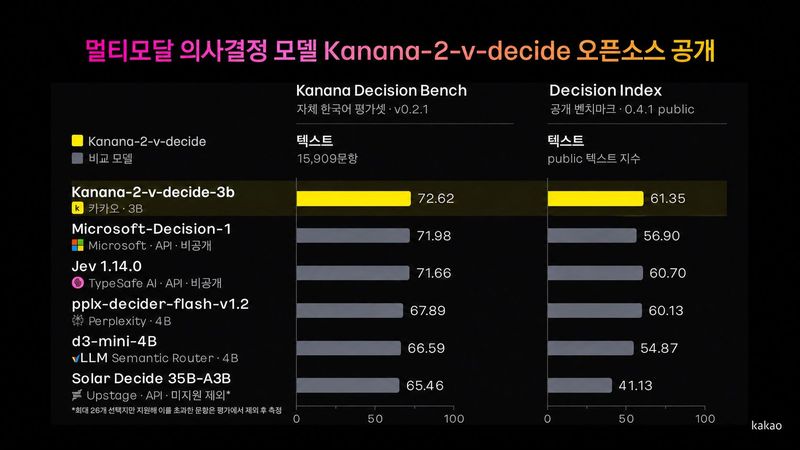
It also recorded the highest performance among the models compared on its own evaluation dataset, ‘Kanana Decision Bench,’ comprising 15,909 Korean-language questions, and the public evaluation dataset ‘Decision Index.’
The model is released under the ‘Kanana Open License,’ which allows commercial use as well as research. This enables companies and developers in South Korea and abroad to use the technology in AI agent services without having to develop a separate model from scratch.
Kakao Corp. plans to first apply the model to internal projects, including web search and automatic product-category classification, to verify and improve its performance in real-world service environments. In the longer term, it also plans to develop technology that integrates search and decision-making functions into a single model.
[email protected] Jang Min-kwon Reporter