KOSPI recovers above 5,100 after circuit breaker is triggered...down 4.84% [Financial News Afternoon Market]
- Input
- 2026-11-06 14:23:09
- Updated
- 2026-11-06 14:23:09
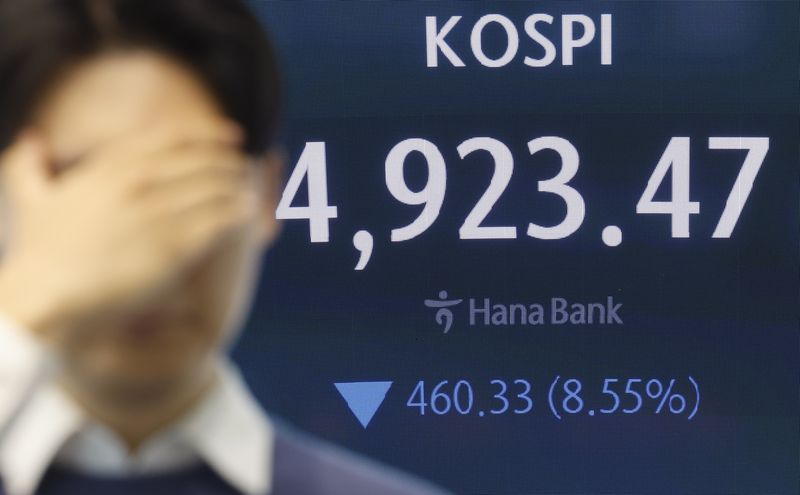
According to the Korea Exchange, as of 2:05 p.m. on the 6th, KOSPI was trading at 5,123.02, down 260.78 points (4.84%) from the previous trading day. At 9:03 a.m., it fell as low as 4,924.61, triggering a Level 1 circuit breaker. A sell-sidecar was also triggered at 9:34 a.m., shortly after trading resumed.
On the main board, institutions and individual investors were net buyers of 1.1928 trillion won and 179.6 billion won, respectively. Foreign investors were net sellers of 1.7949 trillion won.
By sector, IT services (3.09%) and telecommunications (2.76%) were rising. In contrast, electrical and electronics (-6.67%), medical and precision instruments (-5.67%), machinery and equipment (-5.21%), insurance (-4.92%), and securities (-4.88%) were among the sectors falling.
Among the largest stocks by market capitalization, NAVER (4.38%), Kia (1.19%), and Samsung Biologics (0.33%) were rising. Meanwhile, SK Square (-9.27%), SK (-7.88%), Samsung Electro-Mechanics (-6.46%), and Samsung C&T (-5.51%) were falling.
Large-cap semiconductor stocks pared their losses from the morning but remained weak. Samsung Electronics was trading at 190,500 won, down 11,000 won (5.46%) from the previous trading day. SK hynix was at 1,151,000 won, down 113,000 won (8.94%).
KOSDAQ was trading at 657.12, down 21.29 points (3.14%) from the previous trading day. KOSDAQ, where a sell-sidecar was triggered early in the session, also narrowed its losses from around 5% in the morning to around 3%. Institutions were net buyers of 218.8 billion won, while individual and foreign investors were net sellers of 143.8 billion won and 76.4 billion won, respectively.
Analysts say semiconductor stocks’ losses widened as it became harder to gauge the scope and severity of data center regulations after the U.S. midterm elections. They say that although regulatory remarks had been made before the election, after it ended the market began to put greater weight on the possibility that the winners would turn those remarks into actual policy.
Another concern is that data center investment is concentrated in regions where candidates have pledged to impose regulations. Three states—Texas, Georgia, and Ohio—elected governors who pledged to halt data center construction or regulate it, and together they account for 37.7% of the power capacity of data centers under construction or in the planning stage in the United States. Texas alone accounts for 26.9%. Some analysts also expect that, if regulations take shape, big tech companies could revise their capital expenditure plans over the next two to three years.
Kim Min-gyu, a researcher at KB Securities, said, “The uncertainty over what regulations might be introduced and how extensive they would be fueled the sharp drop in technology stocks,” adding, “For the time being, we are likely to be unable to avoid a pattern of repeated sharp rises and falls.”
[email protected] Bae Han-geul Reporter