KOSPI plunges like autumn leaves, hits a historic low: “We’ll look for clues to a rebound”
- Input
- 2026-11-06 14:29:15
- Updated
- 2026-11-06 14:29:15
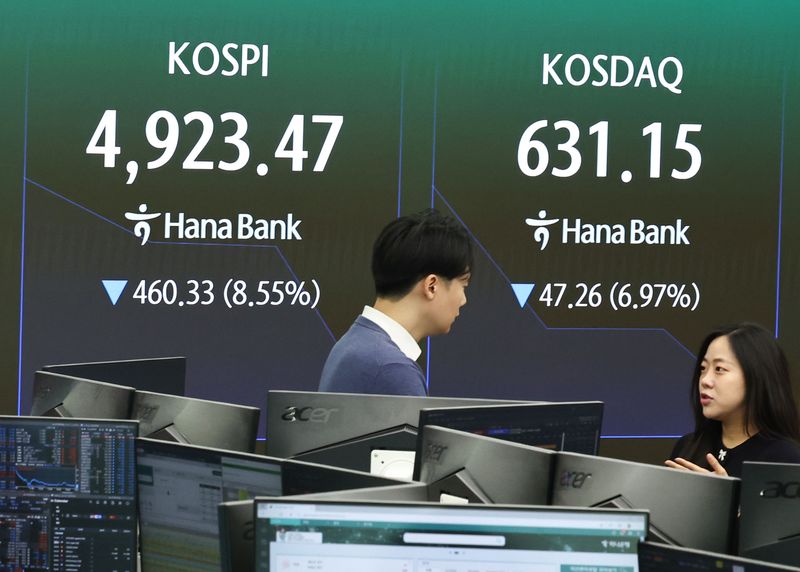
[Financial News] Fears of a slowdown in AI investment stemming from the United States have battered the domestic stock market. Shares of major semiconductor companies, including Samsung Electronics and SK hynix, plunged, briefly sending the KOSPI below the 5,000 level, while the KOSDAQ also fell sharply.
As foreign selling has coincided with weakening investor sentiment, fears of further declines are spreading in the market.
However, analysts are focusing on the possibility that the latest plunge reflects excessive weakness in investor sentiment rather than damage to the domestic stock market’s fundamentals.
That is because the KOSPI’s valuation has fallen to historically low levels, while there has been no confirmation that the trend of expanding AI capital expenditure has actually reversed. The key question is whether the market can move beyond a technical rebound after excessive losses and return to an upward trend.
In an analytical report on the 6th, Daishin Securities forecast that the domestic stock market would seek a shift in sentiment next week as it digests U.S. inflation data and CoreWeave’s earnings.
“The heightened volatility amid concerns about data-center regulations after the U.S. midterm elections presents an opportunity to increase semiconductor exposure,” Lee Kyung-min, head of Daishin Securities’ FICC Research Division, said. “With big tech maintaining its trend of expanding AI capital expenditure, we believe the market’s reaction to concerns about weaker investment is excessive.”
KOSPI forward P/E at 3.77x... potential rebound from a historic low
The KOSPI’s valuation is drawing attention in the latest selloff. According to Daishin Securities, the KOSPI’s 12-month forward price-to-earnings ratio (P/E) fell below 4x to 3.77x, setting a new historic low. The analysis is that, as a vicious cycle of weakening investor sentiment and unfavorable supply-demand dynamics takes hold, share prices are falling faster than corporate earnings forecasts.Daishin Securities put the KOSPI level corresponding to a forward price-to-book ratio (P/B) of 1 at 5,330. The index could fall below this level if market anxiety persists, but the firm viewed that as an undershooting phase in the process of forming a medium-term bottom. It also cited past instances, including one in late July, when the market quickly recovered after a short-term plunge and went on to form a bottom.
Still, lower valuations alone are not enough to conclude that the market has bottomed. If foreign selling continues and doubts about the semiconductor sector’s earnings outlook remain unresolved, the appeal of low valuations is also unlikely to support share prices for the time being. The first hurdle for a rebound is whether the vicious cycle between investor sentiment and supply-demand dynamics can be broken.
A recovery in large-cap semiconductor stocks is key to a rebound in the domestic stock market. The possibility of big tech adjusting its capital expenditure has fueled concerns about weaker demand for memory and AI semiconductors, concentrating selling pressure across the domestic semiconductor value chain. Since the semiconductor sector has a major influence on domestic market indices, a recovery in sentiment toward the sector is also expected to affect the direction of the broader market.
Daishin Securities acknowledged that concerns about data-center regulations have grown amid the Democrats’ control of Congress, but said the likelihood of a sweeping construction halt at the federal level was limited. Variables such as the executive branch’s veto power remain in the legislative process, and big tech companies may accelerate data-center construction before regulations take effect, the firm said.
Ultimately, what the market needs to determine is not whether AI investment will stop, but whether originally planned capital expenditure will be maintained and financing will remain available. If the trend of expanding investment continues, the recent plunge in semiconductor stocks may reflect excessive fears. Conversely, if investment schedules are delayed and financing pressures grow, further valuation adjustments cannot be ruled out.
CoreWeave earnings and U.S. inflation in focus... next week’s test for a change in sentiment
CoreWeave’s third-quarter earnings next week are expected to test whether sentiment toward AI investment can recover. CoreWeave is an AI-focused cloud, or neocloud, company that secures large quantities of high-performance GPUs from NVIDIA, builds data centers, and then rents them out to companies such as Microsoft and OpenAI. Recently, the company has been at the center of credit concerns related to AI investment amid high corporate bond yields and rising credit default swap (CDS) premiums.The results will need to be assessed not only for revenue growth but also for cash flow, interest expenses and future financing plans. If the sustainability of AI infrastructure investment and the company’s financial capacity are confirmed, that could also be a positive signal for the domestic semiconductor sector.
The U.S. October Consumer Price Index (CPI) and Producer Price Index (PPI) are also factors to watch. If inflation is confirmed to be slowing, expectations for stable interest rates could help create conditions for a rebound led by growth stocks that have suffered outsized losses. On the other hand, if inflation exceeds expectations, concerns about further Federal Reserve rate hikes could resurface and weigh on the domestic stock market.
Lee said, “I think there is a strong likelihood of efforts to turn sentiment around as this week’s U.S. inflation data and CoreWeave earnings are assessed.” Analysts say whether the KOSPI, which has fallen to historically low levels, can find clues to a rebound will depend on foreign selling easing and confirmation that AI investment is sustainable.
[email protected] Kang Jung-mo Reporter