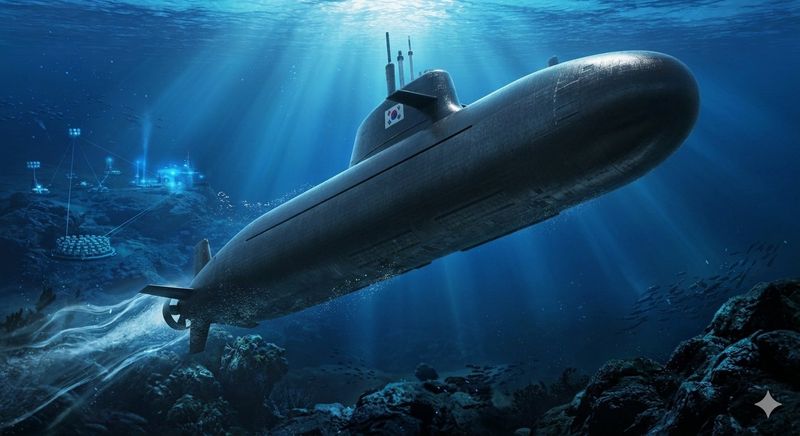
South Korea Sets Sail on Indigenous Development of a 'Nuclear-Powered Submarine'; Defense Acquisition Program Promotion Committee Approves Jang Bogo N Project
- Input
- 2026-11-06 15:55:41
- Updated
- 2026-11-06 15:55:41
The Defense Acquisition Program Administration (DAPA) said it held the 179th Defense Acquisition Program Promotion Committee meeting at the Ministry of National Defense on the afternoon of the 6th, chaired by the Minister of National Defense and attended by DAPA Commissioner Lee Yong-cheol and others. The committee deliberated and approved the proposed basic strategy for the Jang Bogo N project. This was the first meeting chaired by Defense Minister Kang Shin-cheol since he took office.
Military authorities plan to launch full-scale development next year (2027), with operational deployment targeted for the late 2030s or later. A detailed analysis of the total project cost is currently under way.
At its core, the Jang Bogo N project, now getting under way, aims to secure the ability to remain submerged for extended periods—approaching unlimited endurance—and overwhelming underwater maneuverability, surpassing the limitations of existing diesel submarines, including those equipped with AIP. Nuclear-powered submarines do not need to conduct snorkel operations to recharge their batteries, allowing them to completely neutralize enemy surveillance networks. They are the most reliable stealth platforms for continuously tracking and monitoring North Korean submarines carrying submarine-launched ballistic missiles (SLBMs) underwater and striking them immediately if necessary.
Alongside the Jang Bogo N project, five major advanced force projects to significantly upgrade the South Korean military's strike and command capabilities were also addressed at the committee meeting.
First, the basic strategy for the 'Tactical Surface-to-Surface Guided Weapon (KTSSM)-I Block-II' project was approved. The weapon is intended to neutralize early the enemy's long-range artillery tunnels and covered positions threatening the Seoul metropolitan area. Through the project (2028–2036, total cost of approximately KRW 536 billion), the military is expected to acquire new guided missiles and launchers with a range at least 30% greater than that of the existing 'Ure' guided weapon, raising its ability to conduct full-scale counterfire operations by a level.
The model for the Next-Generation Command Helicopter-II project (2025–2031, total cost of approximately KRW 873 billion), a key asset for airborne command and control, has also been finalized. The committee selected the S-92A+ made by U.S.-based Lockheed Martin Corporation to replace the aging command helicopters currently in service, beginning in 2031. The next-generation command helicopter will be equipped with extensive upgrades to its survivability and mission systems. The project also seeks to strengthen the competitiveness of the domestic defense industry by securing aircraft modification and maintenance technologies and linking domestic small and medium-sized companies to parts exports.
A large-scale communications infrastructure project to realize network-centric warfare is also moving forward. The second follow-on production plan for the 'TICN Block I-2 (TMMR)' system (2020–2028, total cost of approximately KRW 1.2 trillion) was approved. The project will provide a combat radio system whose voice and data wireless communications functions are implemented in software and can be selected for use, laying the groundwork for integrating command and tactical systems down to the smallest units.
In addition, R&D on naval vessels and unmanned systems to fill gaps in maritime security has taken shape. To improve efficiency, the Harbor Patrol Boat-II project (2028–2037, approximately KRW 611 billion), which will replace aging harbor patrol boats with vessels offering improved combat and operational endurance, will for the first time in a naval vessel project combine the basic design stage with the detailed design and lead ship construction stage. The plan is to shorten the schedule and reduce costs at the same time. The Mine Warfare Unmanned Surface Vessel project (2028–2038, approximately KRW 591 billion), which will strengthen mine detection and clearance capabilities to minimize risks to crewed vessels, will also proceed through domestic R&D.
A DAPA official emphasized, "The nuclear-powered submarines, advanced guided weapons and unmanned force systems approved at this committee meeting will be key pieces of the puzzle for self-reliant defense, completing deterrence by denial against increasingly sophisticated security threats."
[email protected] Lee Jong-yoon Reporter