[Editorial] US Midterm Fallout Sends Stocks Plunging; Avoid Alarmism and Respond Calmly
- Input
- 2026-11-06 15:48:05
- Updated
- 2026-11-06 15:48:05
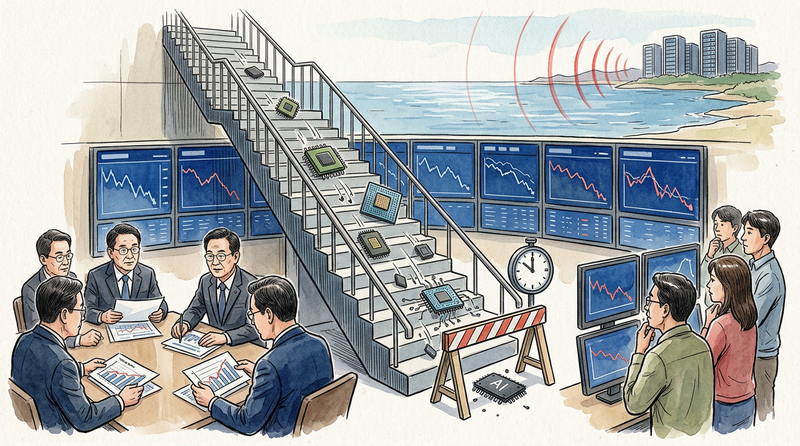
[Financial News] South Korea’s stock market fell sharply on the 6th, as US-led declines in AI-related stocks reverberated through the market. The KOSPI fell more than 8% within three minutes of the opening, triggering a circuit breaker, while a sell-sidecar was triggered on the KOSDAQ. Circuit breakers have been triggered 11 times this year alone. Even when the market’s losses are steep, the government should respond calmly, guided by confidence in the market’s functioning and consistent principles, rather than resorting to short-term fixes driven by panic.
The source of the plunge is the United States. After the Democratic Party swept the midterm elections in what was dubbed a “blue wave,” taking control of both the House and the Senate, concerns arose over AI regulation and a slowdown in data center construction. The Texas governor-elect reportedly pledged to suspend approvals for new data centers until laws protecting electricity rates and water resources are put in place. Forecasts of weak results from US semiconductor company Qualcomm and news that Microsoft was tightening management of its data center projects also severely dampened investor sentiment. On the 5th (local time), the Nasdaq Composite fell 5.52%, and the Philadelphia Semiconductor Index dropped 12.3%.
The shockwaves from the US AI sell-off spread to leading domestic semiconductor stocks. Intraday, Samsung Electronics fell 5.16% and SK hynix dropped 7.67%.
It is too soon to conclude that this plunge marks a lasting collapse of the AI industry. Nomura Securities pointed to supply-and-demand factors, including hedge funds’ profit-taking sales ahead of year-end. LS Securities assessed that a change in the direction of the AI trend does not mean long-term demand is disappearing.
Calls, particularly from politicians, also emerged for forceful intervention in the market by financial authorities. Democratic Party leader Kim Min-seok urged the government and financial authorities to “closely monitor market conditions and, if necessary, swiftly and decisively take measures to stabilize the market.” Independent lawmaker Han Dong-hoon criticized the government, saying, “The KOSPI just fell below 5,000. The KOSPI 5,000 mark is a figure the Lee Jae Myung administration set as a national policy goal.” The concern about market instability is understandable, but political intervention in the stock market only heightens market anxiety.
With the crisis at its doorstep, the government held emergency market-monitoring meetings with relevant agencies on two consecutive days, the 5th and 6th. Following those meetings, it announced a measure to waive securities firms’ obligation to maintain a 140% collateral ratio on margin loans for three months, starting on the 9th. If stocks whose collateral value has fallen because of declining prices are forcibly sold on the market all at once, that can create a vicious cycle that deepens market losses. The measure helped defend the KOSPI’s precarious 5,000 level to some extent, but it was not enough to calm a market gripped by fear.
The authorities’ first priority should be to assess how effective the market’s institutional safeguards are. The fact that circuit breakers have been triggered 11 times this year alone shows that their trigger thresholds and effectiveness need to be reviewed. The government should continuously monitor margin lending to ensure it does not become fuel for forced selling that deepens market losses, while clearly informing investors of the risks.
With a longer-term perspective, the government should address the industrial structure’s heavy concentration in semiconductors and devise ways to improve it. It should also carefully analyze how changes in US policy could affect public finances, trade, industry as a whole, and investment in the United States. Companies should review sources of demand and investment plans in light of changes in the AI market. Politicians should refrain from remarks that stoke market anxiety and from turning the issue into a political controversy. It is important to consistently respect the market’s self-correction in response to external shocks while activating necessary safeguards in a timely manner to prevent volatility from being amplified excessively.