Company CEO in Their 40s: “Will More Hiring and Investment Mean Exclusion from a Tax Audit?” [Tax and Investment Q&A]
- Input
- 2026-11-07 08:00:00
- Updated
- 2026-11-07 08:00:00
Q. A, a business owner in their 40s, runs Company B, a small and medium-sized enterprise that processes auto parts in Changwon, South Gyeongsang Province. Company B reported revenue of KRW 65 billion for the 2025 business year, and this year its average number of regular employees is 100. With sales recently rising, the company is considering new hires and expanding its facilities next year. But because it has been a long time since its last tax audit, A is concerned it could be selected for one. After hearing that submitting a plan to increase employment or investment could keep the company off the list for regular tax audits, A sought advice.
A. According to BDO Korea, the National Tax Service will exclude small and medium-sized enterprises that submit either a job-creation plan or an investment-expansion plan from selection for regular tax audits for corporate tax for the 2025 business year and comprehensive income tax for tax year 2025.
Eligible applicants are corporations and sole proprietors whose revenue for the 2025 business year is at or below the threshold for their industry and that meet the small and medium-sized enterprise requirements under the Restriction of Special Taxation Act. Excluded, however, are corporations with total assets of KRW 200 billion or more and revenue of KRW 50 billion or more, as well as professional personal-service corporations and individual professional-service providers with revenue of KRW 50 billion or more.
Applicants need to submit only one of the two plans. Applications are due by the 30th and can be filed through HomeTax or by mail or in person at the competent tax office.
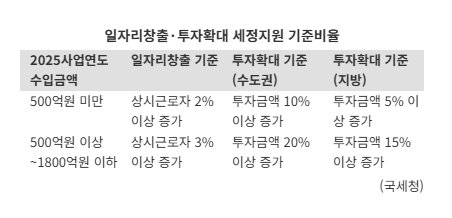
A job-creation plan must state that the company will increase its number of regular employees in 2027 by at least a specified percentage compared with 2026. The required increase is at least 2% for businesses with 2025 business-year revenue below KRW 50 billion, and at least 3% for those with revenue of KRW 50 billion or more and up to KRW 180 billion.
Company B, with revenue of KRW 65 billion, must increase its number of regular employees by at least 3%. A simple calculation suggests it would need to hire three additional people on average over the year, but weighting rules may reduce the actual number of hires required. Young and older workers and people with disabilities each count as two employees, while increases in employee numbers at regional workplaces outside the Seoul Capital Area receive an additional 0.5 weighting.
If Company B hires two young workers at its Changwon factory starting in January next year, the increase will count as five employees: two in the basic count, two from the youth weighting, and one from the regional weighting. The resulting increase rate of 5% meets the requirement.
However, the number of regular employees is calculated as the average of the headcount at the end of each month, not the year-end headcount. If the same two young workers are hired in July, the average annual increase and the increase rate after weighting would be just 2.5%, below the requirement. Departures of existing employees are also factored in, so the company should consider both hiring dates and employee turnover. Executives; the spouse and relatives of the largest shareholder; and workers with employment contracts of less than one year, among others, are excluded from the regular-employee count.
An investment-expansion plan must state that investment in the 2027 business year will exceed that in the 2026 business year. Companies with revenue of KRW 50 billion or more and up to KRW 180 billion must increase investment by at least 20% at workplaces in the Seoul Capital Area and at least 15% at regional workplaces.
Eligible investment is limited to assets covered by the integrated investment tax credit under the Restriction of Special Taxation Act. These include machinery and equipment, research and testing facilities, energy-saving facilities, and safety facilities. Land and buildings, vehicles and transport equipment, tools, instruments and fixtures, used goods, and leased assets are generally excluded.
If Company B invested KRW 3 billion this year, applying the 15% regional benchmark means it must invest at least KRW 3.45 billion next year. Even if it spends KRW 2 billion on a factory extension and KRW 1.5 billion on processing equipment, the factory extension costs will not count, leaving eligible investment at just KRW 1.5 billion. If a plan focuses mainly on expanding buildings, a job-creation plan may be more advantageous than an investment-expansion plan.
Submitting a plan does not guarantee the benefit. If a company excluded from selection for a regular audit does not increase employment or investment as planned, it may be added in 2028 to the list of companies selected for a regular tax audit for the 2025 business year. The exemption does not apply to irregular audits prompted by suspected tax evasion or reports, among other reasons.
Kim Hyo-young, a partner at BDO Korea, advised, “You should draw up a plan within achievable limits after considering the timing of hires, employee departures, and investment assets eligible for tax credits,” adding, “It is advisable to compare whether employment or investment is easier to bring up to the required level and choose the more advantageous plan.”
[email protected] Lee Jeong-hwa Reporter