Gwangju Special City, Kia, CNU and GIST join hands to build a PBV-based future vehicle ecosystem
- Input
- 2026-11-06 12:47:02
- Updated
- 2026-11-06 12:47:02
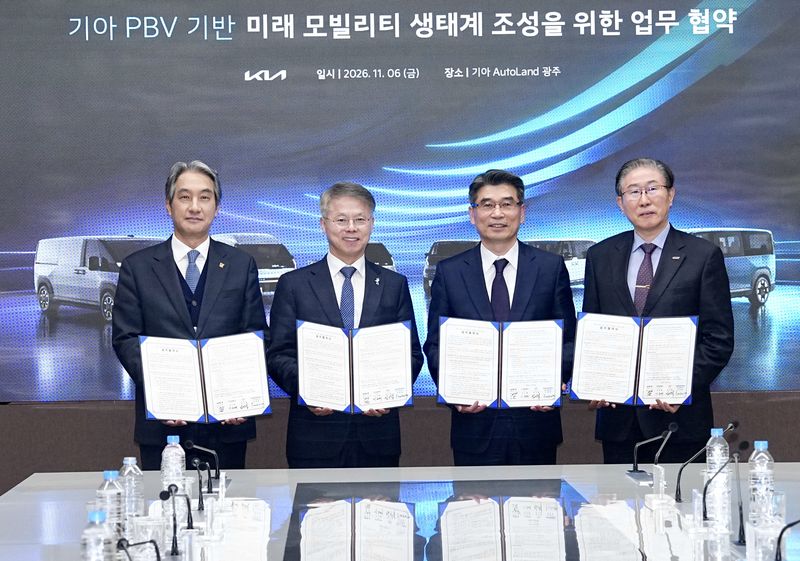
【Financial News, Jeonnam-Gwangju = Hwang Tae-jong, Reporter】Jeonnam-Gwangju Integrated Special City (Gwangju Special City), Kia, Chonnam National University and GIST (Gwangju Institute of Science and Technology) have joined hands to build a PBV (Platform Beyond Vehicle)-based future vehicle ecosystem.
PBV (Platform Beyond Vehicle), meaning “a platform beyond the vehicle,” is Kia’s new business model. Based on customer needs, it proposes new businesses and lifestyles and delivers an optimal mobility experience through innovation.
In particular, Kia plans to invest approximately 3 trillion won in the Jeonnam-Gwangju region by 2029 to build a future vehicle production system based on innovative manufacturing technology and further develop a future mobility industry ecosystem using PBVs.
According to Gwangju Special City, the city signed an MOU with Kia, Chonnam National University and GIST at Kia AutoLand Gwangju on the 6th.
The agreement was pursued to expand the foundation for the future mobility industry through technology demonstrations and commercialization partnerships using PBVs, while training specialized talent and building a related industry ecosystem.
Under the agreement, the four institutions will work together in various areas, including developing dedicated vehicles for PBV-based demand-responsive transport (DRT); demonstrating PBV shuttle services incorporating autonomous-driving technology; demonstrating remote-driving technology based on the Kia PV5 WAV (Wheelchair Accessible Vehicle) to improve mobility for people with limited mobility; and demonstrating Easy Swap technology, which allows a vehicle’s use to be changed according to its purpose, such as logistics or passenger transport. The initiative is considered significant because it will apply future mobility technologies to real-world transport and logistics services and assess their potential for commercialization.
Gwangju Special City Mayor Min Hyung-bae said, “Since the integration of Jeonnam-Gwangju after about 40 years, large-scale corporate investments have continued,” adding, “I am deeply grateful to Kia for deciding to make a bold investment. The Special City will do its utmost to support Kia AutoLand Gwangju as it grows into a key production base for future vehicles in the global market.”
Kia President Song Ho-sung said, “This agreement will help promote the development and commercialization of PBV-based future mobility technologies,” adding, “Through the establishment of a future vehicle production system and the expansion of its PBV business, Kia will contribute to Jeonnam-Gwangju Integrated Special City’s emergence as a leading hub for the future mobility industry in Korea.”
Gwangju Special City expects the agreement and Kia’s investment plan to serve as a catalyst for shifting the region’s auto industry, previously centered on internal-combustion-engine vehicles, toward electrification and autonomous driving. It also expects the initiative to boost the competitiveness of the future vehicle industry by linking the region’s existing production base with its capabilities in artificial intelligence (AI) and advanced industries.
Building on the investment and agreement, the city also plans to accelerate the creation of an industrial ecosystem connected with local parts suppliers and to continue identifying and pursuing support programs to develop Jeonnam-Gwangju into a key global hub for future vehicles.
Meanwhile, following investments by Samsung Electronics, SK hynix and Amkor Korea to build a semiconductor cluster in the Southwest region, Kia’s announcement of a major investment has added to the momentum. Analysts say Gwangju and Jeonnam are developing an advanced strategic industrial base centered on semiconductors and automobiles.
[email protected] Hwang Tae-jong Reporter