Jeju Black Cattle, a Natural Monument, up 46.6% in three years; efforts underway to expand market access
- Input
- 2026-11-06 11:00:38
- Updated
- 2026-11-06 11:00:38
【Financial News Jeju = Jeong Yong-bok, reporter】 The number of Jeju Black Cattle, designated a Natural Monument, rose 46.6% in three years to 1,593 head. Jeju Province aims to expand market access for farmers by preserving the breed’s unique bloodline while strengthening production and distribution infrastructure.
According to Jeju Special Self-Governing Province on the 6th, a full census conducted in December last year found that the Jeju Black Cattle herd numbered 1,593, up 506 from 1,087 in 2022.
Jeju Black Cattle are an indigenous breed native to Jeju and were designated Natural Monument No. 546 on July 22, 2013. Records in the Annals of the Joseon Dynasty and Tamna Sunryeokdo show that they were used in ancestral rites and as tribute offerings. They are a livestock genetic resource with bloodline characteristics that distinguish them from ordinary Hanwoo.
Jeju Province is working both to preserve the breed’s bloodline and to expand the breeding base. This year, Seogwipo City is providing production incentives of up to 1 million won per animal for bloodline-registered Jeju Black Cattle and black Hanwoo calves, and is also working to improve livestock facilities.

However, an increase in herd size does not immediately translate into improved farm profitability. Jeju Black Cattle take longer to reach market than ordinary Hanwoo and have a lower weight at shipment, resulting in higher production costs. This makes it necessary to expand processing and distribution networks while securing a stable scale of production.
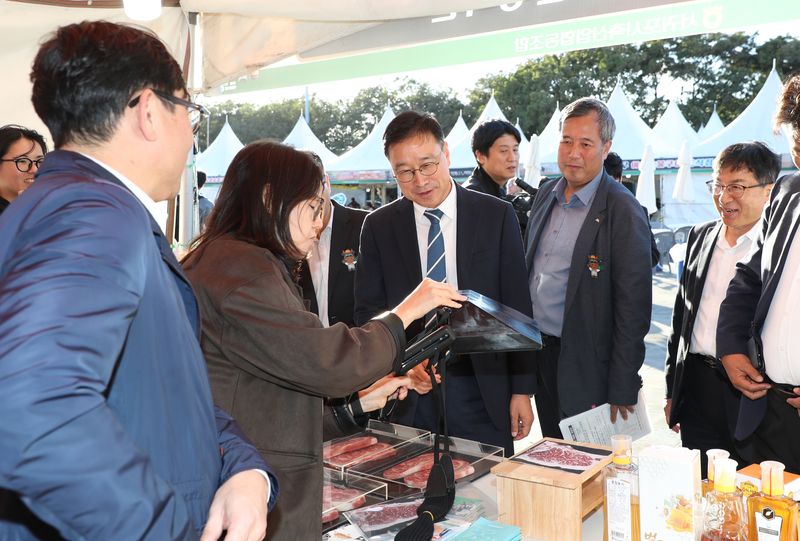
Against this backdrop, the 2026 Jeju Black Hanwoo Brand Expo opened on the 5th at the plaza of Jeju World Cup Stadium in Seogwipo. Hosted and organized by the Seogwipo City Livestock Cooperative and supported by Jeju Province, the event runs through the 8th.
The expo introduces Jeju Black Cattle and Hanwoo, and sells Jeju-produced beef, pork and other products at discounts of 10% to 50%. Free tastings and an outdoor charcoal-grilling area are also available.
A special black Hanwoo tasting event featuring chefs will be held on the 7th and 8th, and a black Hanwoo cooking competition will take place on the 8th. A separate promotional pavilion introduces the history of Jeju Black Cattle, the characteristics of different breeds, and the features of different cuts.
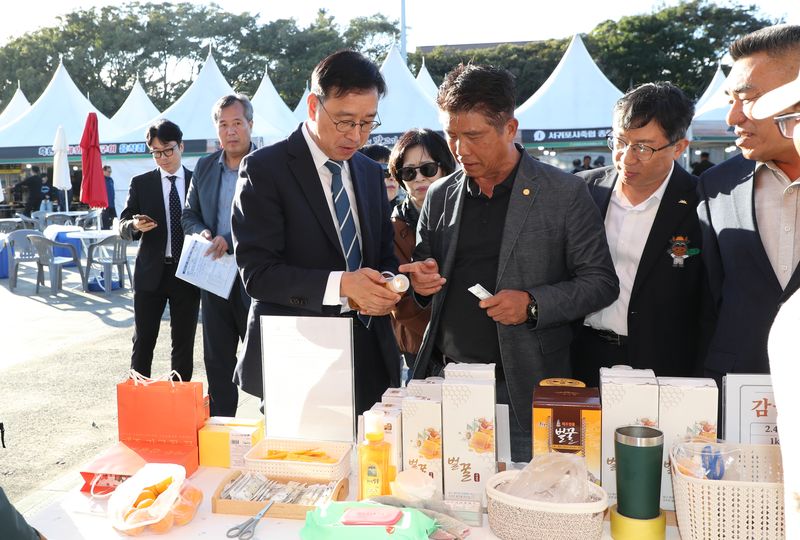
The regional partnership pavilion features the National Hanwoo Association, the beekeepers’ association, the Korea Institute for Animal Products Quality Evaluation (KAPE), Mokwoochon, and local businesses dealing in mandarin oranges, coffee and other products, showcasing Jeju agricultural and livestock products and processed goods.
Wi Seong-gon, governor of Jeju Island, attended the opening ceremony on the 5th, toured the livestock product sales area and promotional pavilion, and stressed the need to establish a stable production base for farmers, improve quality, and expand domestic and overseas market access.
Governor Wi said, “We will improve the quality of Jeju Black Cattle and Hanwoo while establishing a stable production base, strengthen processing and distribution infrastructure, and expand domestic and overseas market access to boost the competitiveness of Jeju’s livestock sector and support stable farm operations.”
The challenge for the Jeju Black Cattle industry is to turn its growing herd into a stable supply and income for farmers. It is becoming increasingly important to secure actual shipment volumes and sales while working to preserve the breed’s unique bloodline, maintain quality, and expand distribution infrastructure.
[email protected] Jeong Yong-bok Reporter