Stock Price Suppression Prevention Act faces a ‘marathon debate’ on the 9th; valuation method is key sticking point [fn Market Watch]
- Input
- 2026-11-06 10:50:39
- Updated
- 2026-11-06 10:50:39
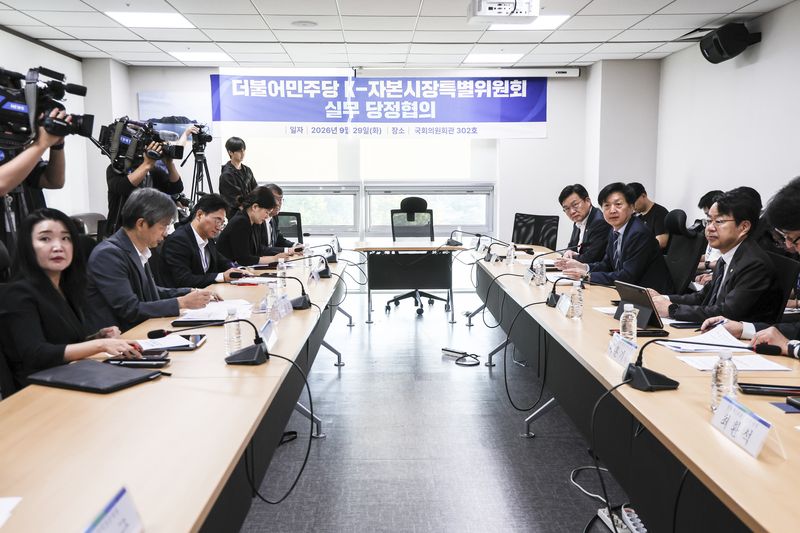
[Financial News] The final version of the ‘Stock Price Suppression Prevention Act,’ which aims to curb the practice of major shareholders keeping share prices low to reduce inheritance and gift taxes, will be decided at a marathon debate. The Ministry of Economy and Finance will unveil a revised proposal modifying its government plan from August, while Rep. Lee Hoon-gi of the Democratic Party of Korea (DPK) will also put forward an alternative that builds on the existing bill. This is the first time the government and the National Assembly will face off in one place with their respective proposals.
According to the investment banking (IB) industry on the 6th, the DPK’s Special Committee on the K-Capital Market for Korea Premium will hold a public debate on amendments to the Inheritance and Gift Tax Act to prevent stock price suppression at 4 p.m. on the 9th at the National Assembly Members’ Office Building. The event will compare Rep. Lee Hoon-gi’s bill, Rep. Lee So-young’s bill and the ministry’s revised proposal, and hear views on the issues.
The biggest sticking point is the valuation method. Under current law, listed shares are valued at their average market price over the two months before and after the valuation reference date. The lower the share price, the less tax a controlling shareholder has to pay. The government proposal unveiled by the Ministry of Economy and Finance on Aug. 3 classifies as ‘presumed stock price suppression targets’ companies whose price-to-book ratio (P/B ratio) ranked in the bottom 25% by industry for KOSPI-listed companies or the bottom 10% for KOSDAQ-listed companies in 12 of the 13 most recent half-year periods, or whose share prices plunged after a dual listing or issuance of exchangeable bonds within the past year. The National Tax Service’s Valuation Review Committee then makes the final determination, and companies confirmed to have suppressed their stock prices face a valuation premium of at least 30%.
The market response was cool. The proposal was criticized as a ‘law that lets stock price suppression go unchecked’ after analyses suggested that, with no absolute floor for the valuation amount and numerous exceptions, it would apply to only about 15% as many companies as the original proposal. Rep. Lee pointed out that a company could avoid the measure by falling outside the threshold in just two of the 13 half-year periods. In the example he cited, a company would remain outside the scope of the measure until the first half of 2029 because its share price had been high in the past, leaving the controlling shareholder’s inheritance tax at about 58.5 billion won, the current level.
By contrast, the bill introduced by Rep. Lee as its lead sponsor on Aug. 5 applies the valuation method for unlisted shares if the market price of listed shares held by a controlling shareholder is less than 80% of the per-share net asset value under tax law. It also prevents the valuation amount from falling below 80% of net asset value. In return, it removes the 20% valuation premium for controlling shareholders that applies to both listed and unlisted shares and allows listed shares to be used for tax payments in kind, easing the burden of ordinary business succession. Companies in financial distress are exempt.
Investor interest in the bill is also growing. According to VIP Asset Management, 586 companies have a P/B ratio below 1, accounting for 73% of KOSPI-listed companies—a number that has actually risen from a year ago. Critics say the number of undervalued companies did not fall even as the index surged, and that undervaluation deepened in the downturn. A public petition calling for the bill to be effective surpassed 50,000 signatures in just one week. Kim Min-guk, CEO of VIP Asset Management, is also expected to attend the debate.
The debate will be moderated by committee chair Oh Ki-hyung. Presentations will be given by Lee Hyo-seop, senior research fellow at the Korea Capital Market Institute, representing the Ministry of Economy and Finance; Y Street reporter Lee Dae-ho, representing Rep. Lee So-young’s bill; and Rep. Lee Hoon-gi. The panelists will represent the respective proposals: attorney Kim Tae-hee and Yonsei University professor Lee Jung-kyo; attorney Shim Hye-seop and Kim Ji-yeol, a director at Quad Asset Management; and attorney Oh Chung-jin and Na Min-chae, CEO of The Value & Co.
Some in the business community are concerned that the Stock Price Suppression Prevention Act, together with the ‘Korean-style bear hug’ currently under discussion, could threaten control of companies with low P/B ratios. Analysts say that, as persistently undervalued companies face pressure from both tax policy and mergers and acquisitions (M&A), value-up efforts will ultimately be their surest defense.
Rep. Lee criticized the proposal, saying, “The vice minister of the Ministry of Economy and Finance visited my office on the 3rd and explained the revised proposal, but it did nothing at all to uphold the purpose of preventing stock price suppression.” He added, “The revised proposal, too, is nothing more than a ‘law that lets stock price suppression go unchecked.’” He then stressed, “I will do everything I can to conclude legislative discussions by the end of November and ensure the bill passes at the December plenary session.”
The K-Capital Market Special Committee plans to consolidate the key issues based on the debate’s results by mid-November and prepare a final proposal by the end of the month. It will then seek passage at the December plenary session after review by the Finance and Economy Committee.
[email protected] Kang Gu-gwi Reporter