Hyundai Engineering and Construction’s 80-year history painted on a 45-meter rice silo, turning it into a landmark on Seosan reclaimed land
- Input
- 2026-11-06 10:06:03
- Updated
- 2026-11-06 10:06:03
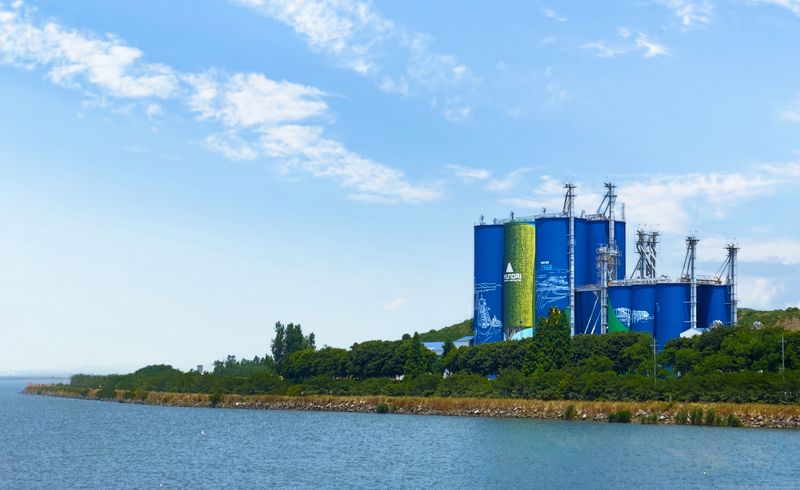
[Financial News] A rice storage silo as tall as a 15-story apartment building has become a vast canvas displaying nearly 80 years of Hyundai Engineering and Construction’s history.
Hyundai Engineering and Construction said on the 6th that it had transformed the exterior of the silos at the Rice Processing Complex (RPC) on Hyundai Seosan Farm in Buseok-myeon, Seosan City, South Chungcheong Province, with supergraphics, making it a local landmark.
The facility mills and processes rice harvested from the Seosan reclaimed land. It consists of six storage silos, six regulating silos, a rice mill, a receiving room and warehouses. The 45-meter-high storage silos can hold more than 20,000 metric tons of rice.
A tree stands at the center of the graphic. A large tree growing above green fields is painted on the largest storage silo, while the other storage and regulating silos feature signature projects that trace Hyundai Engineering and Construction’s growth, set against a blue backdrop evoking the sea. The design uses the triangular shape and signature colors of the company’s corporate identity to express its identity, and weaves the brand story into a single chronology.
The design takes advantage of the silos’ round shape so that different scenes appear from different viewing angles. From the direction of Cheonsu Bay, line drawings depict the restoration of the Han River Bridge, a symbol of postwar national reconstruction, and construction of the Gyeongbu Expressway, which ushered in an era of nationwide one-day travel. From the direction of Taean County, home to the HMG Driving Experience Center, and Bunam-ro, where Hyundai Mobis’s Seosan proving ground is located, viewers can see the Seosan reclamation project and an image of Seosan cattle, which helped open the way for inter-Korean cooperation. From the direction of the Asan Training Center, they can see the Barakah Nuclear Power Plant in the United Arab Emirates (UAE), Korea’s first overseas nuclear power project, and Kuwait’s Sheikh Jaber Causeway, which is 36.1 kilometers long. Because the facility stores grain, the company chose environmentally friendly paint with reduced harmful substances and shortened the work period to within 10 weeks.
The Seosan reclamation project was a large-scale national land development project in which founding chairman Chung Ju-yung, guided by the belief that “land is the most precious legacy we can pass on to future generations,” transformed the waters of Cheonsu Bay into about 16,000 hectares of land. The project increased the country’s land area by 1% and is still considered a signature achievement embodying Hyundai Engineering and Construction’s corporate philosophy. Construction began in 1979, and its crowning achievement was the final closure of the seawall in 1984. At the last 270-meter stretch of the about 6,400-meter seawall, where powerful currents had made it impossible to close the gap, the company sank the 322-meter decommissioned oil tanker Cheonsumanho to block the waterway. The “oil-tanker method” reportedly completed the final closure in just two days and saved 29 billion won in construction costs. The reclaimed land was completed in 1988 and turned into a mechanized farming complex. Hyundai Engineering and Construction began as Hyundai Civil Industries on May 25, 1947, and will mark its 80th anniversary next year.
In addition to this facility, Hyundai Engineering and Construction operates the Asan Memorial Hall, renovated from the lodging used by founding chairman Chung, as well as employee training and accommodation facilities at the Seosan farm. It also runs separate heritage tours for Hyundai Motor Group employees, using them for new-hire onboarding and corporate DNA training.
A Hyundai Engineering and Construction spokesperson said, “I’m proud that, as we approach the company’s 80th anniversary next year, we seem to have transformed Seosan, imbued with the convictions of founding chairman Chung Ju-yung, into a symbolic place where Hyundai Engineering and Construction’s history and pioneering spirit live and breathe.” The spokesperson added, “Going forward, we will continue to enhance both our corporate value and the area’s symbolic significance through various initiatives and content development that reflect our brand heritage.”
[email protected] Jeong Gyeong-su Reporter