“Is the AI party over?” U.S.-led AI shock devastates South Korean stocks as KOSPI breaks below 5,000
- Input
- 2026-11-06 09:58:01
- Updated
- 2026-11-06 09:58:01
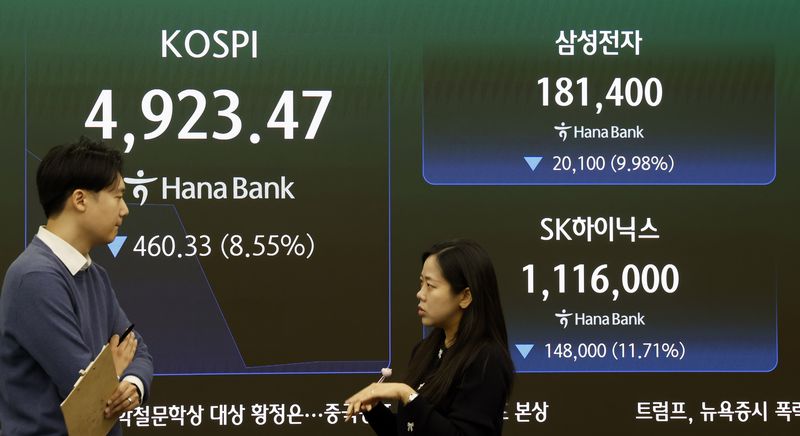
[Financial News] Skepticism about investment in artificial intelligence (AI) originating in the United States has engulfed South Korea’s stock market. As confidence in the AI industry’s growth—which had driven global stock markets higher—began to crack, South Korean stocks took a direct hit.
Selling has concentrated on the AI infrastructure supply chain, including semiconductors, materials, components and equipment, and power equipment. The KOSPI has now broken below even the 5,000 mark and continues to slide. Analysts say the market is facing a simultaneous test of a possible turn in the AI investment cycle and the industrial concentration of South Korea’s stock market, going beyond a simple short-term correction.
As of 9:47 a.m. on the 6th, the KOSPI stood at 4,988.11, down 415.69 points (7.22%) from the previous trading day. It had fallen below 5,000 intraday, with losses also exceeding 7%. The KOSDAQ likewise sank 42.48 points (6.26%) to 635.93. After falling 5.28% and 5.11%, respectively, the previous day, the KOSPI and KOSDAQ were posting sharp losses for a second consecutive day.
Large-cap semiconductor stocks led the decline. Samsung Electronics traded at 184,800 won, down 8.29%, while SK hynix plunged 10.28% to 1,134,000 won. Selling pressure spread across semiconductor and AI infrastructure-related stocks, with SK Square also losing more than 11%.
The source of the shock is the United States. On the 5th (local time), the Nasdaq fell 5.52% on the New York stock market, the S&P 500 dropped 4.36%, and the Dow Jones Industrial Average declined 3.44%. The Philadelphia Semiconductor Index also plunged more than 12%. The sell-off spread across technology stocks as concerns mounted over the possibility of tighter data-center regulations following the U.S. midterm elections, alongside worries that big tech companies would slow the pace of their AI investments.
South Korean stocks take a direct hit as the AI investment story falters... The paradox of supply-chain concentration
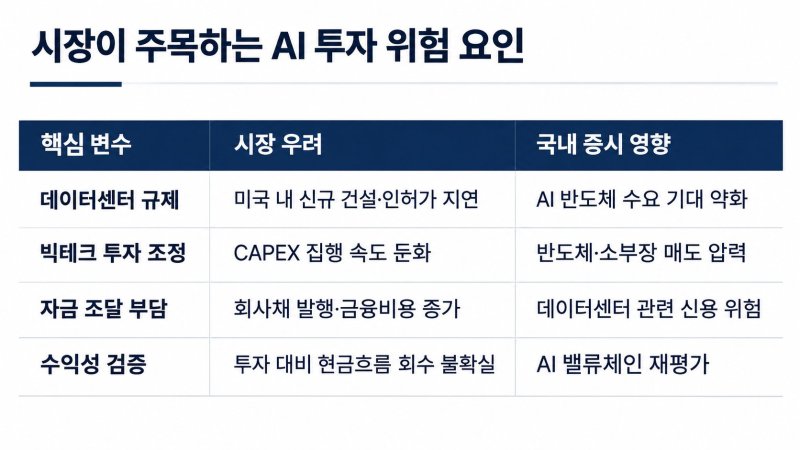
The sharp decline was triggered by what is known as a “blue wave,” with the Democrats securing control of Congress in the U.S. midterm elections. As forecasts emerged that the Democrats could tighten regulations on data-center power use and construction permits, concern grew that the expansion of AI infrastructure investment could be held back. A weak earnings outlook from Qualcomm and news that Microsoft was tightening oversight of some data-center projects also dampened investor sentiment.The market has begun asking not simply whether the AI industry will grow, but whether companies can bear the enormous investment costs and turn that spending into actual profits. The reasoning is that delays in data-center construction could alter demand outlooks for related supply-chain products, including GPUs, memory and power equipment. Stocks that have so far been especially buoyed by expanding AI investment are inevitably facing greater pressure for valuation adjustments.
The problem is South Korea’s heavy reliance on semiconductors and the AI supply chain. In the United States, stock performance may diverge between big tech companies making AI investments and the firms supplying related equipment and components. But South Korean stocks have a high weighting in supply-chain companies—including those in semiconductors, materials, components and equipment, and power equipment—making it easier for concerns about a slower pace of investment to spread across the entire index.
Hwang San-hae, an analyst at LS Securities Co., Ltd., said the impact appeared greater in South Korea, where supply-chain companies account for a large share of the market, as selling concentrated on semiconductors, materials, components and equipment, and power equipment. U.S. policy changes have not yet established that growth across the entire AI industry will slow, the analyst explained, but the decline in South Korean stocks deepened as the market priced in a change in investment direction first.
This correction is indeed unfolding as investor sentiment and market flows falter before any deterioration in earnings has been confirmed. LS Securities Co., Ltd. said that, because this is a major event capable of changing the market’s complexion, volatility could persist on the strength of narratives and market flows alone, even without confirmed fundamental changes.
Foreign investors sell nearly 4 trillion won... Cash and futures selling fuel broader panic
Large-scale foreign selling was another factor that deepened losses in South Korean stocks. According to Samsung Futures, foreign investors net sold 3.4039 trillion won worth of KOSPI stocks on the 5th. They also sold 62.6 billion won worth of KOSDAQ stocks. Across the entire stock market, including Nextrade (NXT), their net sales totaled 3.8734 trillion won.By contrast, individual investors net bought 2.1667 trillion won worth of KOSPI stocks, while institutions net bought 924.6 billion won. Individuals and institutions stepped in to buy the dip, but their purchases were not enough to absorb the volume sold by foreign investors. Of particular concern, foreign selling was not limited to cash equities; in the futures market, it also involved moves to hedge against downside risk.
Jeong Hee-chan, an analyst at Samsung Futures, described the intraday market conditions the previous day as a period “with foreign investors continuing to build downside hedge positions.” Open interest rose steadily during the session, building positions in preparation for further declines. Although foreign investors turned to net buying after liquidating some positions near the close, market anxiety remained, he said.
Volatility gauges also reflect the unsettled market conditions. Samsung Futures said the KOSPI 200 Volatility Index (VKOSPI) surged to exceed the intraday high reached during previous episodes of sharp declines. Sell-sidecars were triggered in quick succession on the KOSPI and KOSDAQ the previous day, and the sharp declines continued from the opening of trading today, leaving investors’ risk aversion slow to subside.
Jeong also forecast that the market would “remain biased to the downside as risk aversion spreads and investors await the release of U.S. employment data.” The implication is that U.S. employment and inflation figures could affect the interest-rate outlook, leaving the market vulnerable to simultaneous pressure from a technology-stock correction and uncertainty over monetary policy.
AI demand has not collapsed yet... Investment delays and credit risks are the variables
However, analysts say it is too early to interpret the sharp drop as a sign that the AI industry’s growth engine itself is disappearing. The key question is whether data-center investment will be halted altogether or whether construction schedules and investment locations will simply change. Until it becomes clear whether a slower pace of investment will actually reduce semiconductor orders, short-term weakness in sentiment needs to be distinguished from the medium- to long-term demand outlook, they say.LS Securities Co., Ltd. said a change in the direction of the AI cycle does not mean long-term demand will disappear. It also proposed a long-term strategy of buying in stages, saying that if the forward price-to-book ratio (P/B) of South Korean semiconductor stocks approaches or falls below 1, they could enter a historically attractive price range. However, it expects a sustained rebound to be possible only after a recovery in earnings and the demand cycle is confirmed.
Samsung Futures also highlighted the possibility of divergent performance across sectors. The previous day, the KOSPI 200 index excluding Samsung Electronics and SK hynix fell by only about 1.9% in the South Korean market. Some sectors, including banking, health care, automobiles and cosmetics, held up relatively well. Analysts say market rotation could emerge as selling shifts from the AI supply chain to other sectors.
Another risk lies in the financing and creditworthiness of AI infrastructure companies. LS Securities Co., Ltd. noted that companies that expanded investment through borrowing could find themselves having to cover interest expenses and existing payment obligations if delays in data-center construction postpone revenue recognition and the collection of payments. It said the possibility that such credit concerns could spread through suppliers and creditors to the broader market cannot be ruled out.
The earnings report from AI infrastructure company CoreWeave, scheduled for the 10th (local time), is seen as a key turning point. It could show how investment delays are affecting actual revenue and cash flow, as well as the fulfillment of customer contracts.
Ultimately, analysts say whether South Korean stocks rebound will depend less on short-term bargain-hunting in U.S. technology stocks than on how firmly big tech companies’ investment plans, data-center construction schedules and semiconductor order flows hold up.
[email protected] Kang Jung-mo Reporter