“Busan Is Now the Destination”: 4 Million Foreign Visitors and 1 Trillion Won in Spending Reached Ahead of Schedule
- Input
- 2026-11-06 10:28:34
- Updated
- 2026-11-06 10:28:34
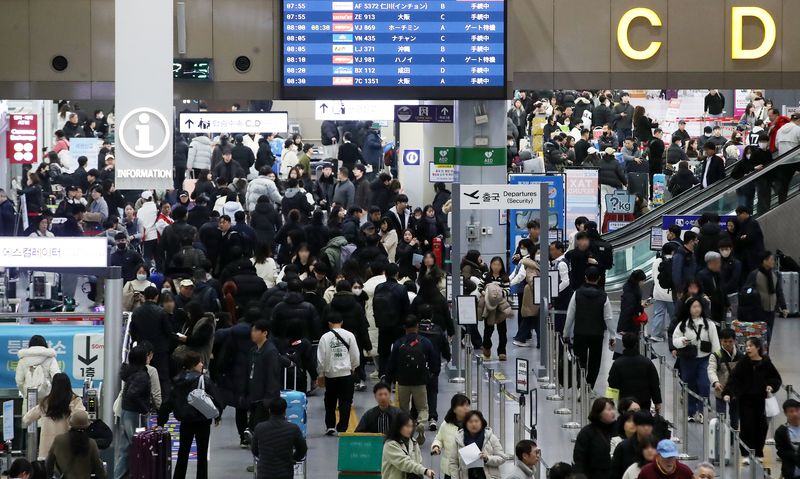
[Financial News] With a sharp rise in foreign tourists visiting Busan, the city is on the verge of entering an era of 4 million annual visitors. Foreigners’ credit card spending has also topped 1 trillion won alongside the increase in visitors, helping boost the local economy.
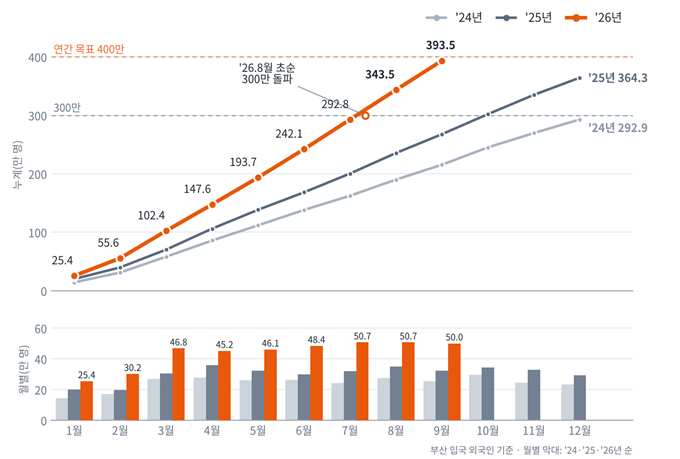
The Busan Metropolitan Government said that 3,934,876 foreign tourists visited the city from January through September this year. That figure surpassed the 3,643,439 visitors recorded for all of last year in just nine months, marking a 47.0% increase from the same period a year earlier. This is 2.2 times the national growth rate of 21.5%.
Only about 60,000 visitors remain before the city reaches its annual target of attracting 4 million. After recording monthly visitor numbers in the 500,000s for three consecutive months, and with an average of about 17,000 people visiting Busan each day in September, the city expects it may already have reached its target by early October. The number of visitors in October will be officially tallied in late November.
With Busan’s global tourism competitiveness drawing attention, this upward trend is expected to continue for the time being. After CNN introduced Busan as “Asia’s next-generation coastal city,” interest in the city has also grown on global travel platforms. Searches for accommodations in Busan on Airbnb have increased by 30% over the past year, and Expedia selected Busan as the only Korean destination among its 10 “2027 Destinations of the Year.” The increase in searches related to Busan ranked fifth worldwide.
The city cited the expansion of direct arrivals through Gimhae International Airport and the Port of Busan as a key factor behind the increase in visitors. Unlike in the past, more foreign tourists are choosing Busan not simply as a place to pass through, but as both the starting point and final destination of their trips.
In fact, 2,333,199 foreign nationals arrived directly in Busan from January through September this year, up 52.7% from the same period last year. In particular, arrivals at the Port of Busan in September totaled 96,493, a 147.8% increase from the same month a year earlier, while arrivals at Gimhae International Airport rose 48.1% to 210,849.
The diversification of the tourism market was also notable. From January through September this year, the number of tourists from France rose 106.5% from the same period a year earlier, while arrivals from the United States increased 77.2% and those from Australia 47.8%. Foreign visitors in September also rose 55.0% year on year to 500,256, sustaining the growth trend even in the off-season.
The increase in visitors has led to higher spending. Foreigners’ credit card spending in Busan totaled 1.0162 trillion won from January through September this year, up 51.9% from the same period a year earlier. After first topping 1 trillion won last December, the city surpassed that mark again in September this year. Busan is the only city other than Seoul to exceed 1 trillion won. It ranks second nationwide after Seoul and first outside the capital region, accounting for 51.8% of total spending outside the capital region. By sector, shopping accounted for the largest share at 47.8%, followed by food and beverage at 22.5% and medical and wellness services at 12.1%.
The city plans to accelerate efforts to develop a wider tourism zone centered on Gimhae International Airport. In September this year, Busan, Ulsan, and the South Gyeongsang cities of Geoje and Tongyeong, which are in the airport’s catchment area, were selected by the Ministry of Culture, Sports and Tourism for a “tourism zone centered on regional airports.” Building on that selection, the city plans to establish a regional tourism system with Busan as its gateway, extending foreign tourists’ travel and spending to nearby areas.
Mayor Jeon Jae-su said, “People from around the world are traveling straight to Busan without stopping elsewhere, and the increase in visitors is also translating into higher spending. We will focus the city government’s efforts on the qualitative growth of tourism so that visitors stay longer and return to the city.”
[email protected] Kwon Byeong-seok Reporter