“It topped 9,000, but now it’s at 4,900”... KOSPI is ‘halved’ in five months
- Input
- 2026-11-06 09:41:41
- Updated
- 2026-11-06 09:41:41
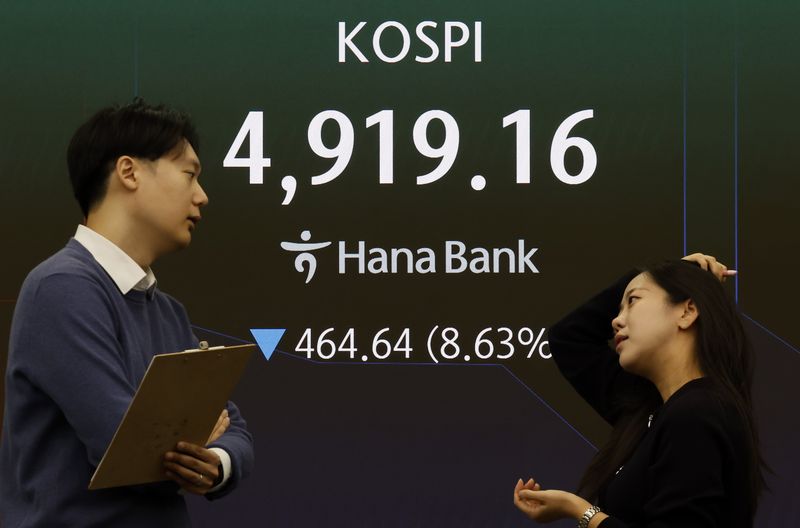
[Financial News] KOSPI gave up about 86% of the gains it had accumulated by this year’s peak after even falling below the 5,000 level intraday. The index, which at one point had more than doubled from the end of last year, slid into the 4,900s. Unlike the strong rebound after the sharp decline in the first half, recovery in the second half was limited, and losses have widened again.
At 9:02 a.m. on the 6th, KOSPI stood at 4,911.28, down 472.52 points (8.78%) from the previous trading day. This was its second consecutive day of sharp losses, following a 5.28% drop the day before. The index opened at 5,263.26 but fell below 5,000 as selling intensified immediately after the market opened. A Level 1 circuit breaker was triggered at 9:03 a.m. It is triggered when KOSPI remains at least 8% below its level on the previous trading day for one minute.
The index’s course this year shows the depth of the correction since its peak. KOSPI rose from 4,214.17 on the last trading day of last year to 9,114.55, its highest closing level, on June 22. Its gain from the end of last year reached 116.28%.
However, early in the session that day, the index was 4,203.27 points (46.12%) below its highest closing level. That meant 85.8% of the 4,900.38-point rise from the end of last year to the peak had been erased. Its gain from the start of the year also shrank to 16.54%. The index was 5.99% below its end-of-January close of 5,224.36.
The difference between the first and second halves emerged in the recovery after the sharp decline. KOSPI rose 23.97% in January and 19.52% in February, then fell 19.08% in March. But it surged 30.61% in April and 28.45% in May, rebounding 67.76% over the two months. After fully recovering its March losses and setting a record high, it climbed above the 9,100 level on a closing basis in June.
The rebound was weaker in the second half. After falling 22.19% in July, KOSPI rose 3.40% in August and 0.26% in September, but its cumulative gain over the two months was just 3.68%. Without having recovered to its level before the sharp decline, it fell another 16.19% in October.
The decline continued into November. The index, at 5,730.74 at the end of October, had fallen 14.30% by early in the session that day. Compared with its level of 6,838.04 at the end of September, the cumulative drop was 28.18%. The gradual rebound after the summer plunge has crumbled again.
The decline since the previous day is being attributed to the ‘blue wave’—the Democrats taking control of both the House and Senate in the U.S. midterm elections.
Overnight on Wall Street, concerns about tighter regulation of AI data centers surged, triggering a wave of selling centered on technology stocks. The Philadelphia Semiconductor Index fell by at least 12%, while the Nasdaq dropped 5.52%, its steepest decline since President Trump announced tariffs last April.
[email protected] Joo Won-gyu Reporter