France's protests over soaring prices flare up again; at least 600,000 take part
- Input
- 2026-11-06 08:59:11
- Updated
- 2026-11-06 08:59:11
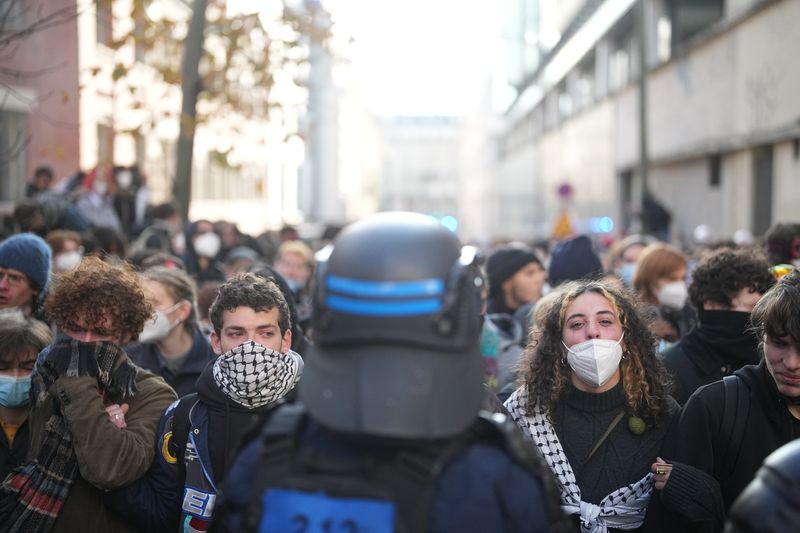
[Financial News] France’s major labor unions and student groups took to the streets again on the 5th (local time) to protest poor public-sector services and high prices.
According to the AP and AFP news agencies, union strikes protesting rising living costs, including energy costs, and demanding higher wages took place across the country, including in the capital, Paris, as well as Lyon, Marseille and Nantes.
By 5 p.m. that day, France’s Interior Ministry had provisionally counted more than 600,000 protesters nationwide, including in Paris. The three previous large-scale weekend protests drew 550,000, 410,000 and 320,000 people, respectively, according to authorities. Despite it being a weekday (Thursday), more people took to the streets than at any of those protests.
The General Confederation of Labour (CGT), which organized the protests, put turnout at 1.6 million. The CGT described the large demonstrations in Paris, Marseille, Bordeaux, Lille and elsewhere as “unprecedented in scale since 2023.”
“The longer we wait, the higher the bills get,” CGT Secretary-General Sophie Binet said, urging the government to act immediately.
Prime Minister Sébastien Lecornu said he plans to hold a meeting on the cost of living and wages with unions and employers’ organizations on the 9th.
High school students blocked school entrances in locations across the country and staged protests again that day. Teachers joined the strike as well as students.
According to the Education Ministry, 81 of the country’s 3,700 high schools were blockaded. Student groups, however, estimated that classes were unable to proceed normally at more than 1,000 schools, close to a third of the total.
The Education Ministry said about 16% of teachers nationwide had joined the strike. The BBC also reported that, according to government statistics, 9.89% of civil servants had taken part.
Tourist attractions including the Eiffel Tower and Arc de Triomphe temporarily closed ... Public transport disrupted
Paris tourist attractions the Eiffel Tower and the Arc de Triomphe were temporarily closed that day, and some galleries at the Louvre also shut their doors. Nuclear power plants operated at reduced capacity, and public transport was disrupted in many areas.
In a joint statement, major unions said France was at risk of recession and that layoff plans were increasing. “Everything is going up—fuel, food, rent, gas and electricity,” they said. “Only wages and pensions aren’t rising.”
“The anger is immense,” they said, urging the government to act. “The country’s situation is fragile. Social and environmental challenges must be addressed without delay.”
At the protests that day, students and workers called on the government to improve services, saying operations were failing across various public sectors, including education, healthcare, rail and postal services. Specifically, the unions are demanding an increase in the minimum hourly wage, currently €12.31 (about 19,000 won).
Fabien Villedieu, secretary-general of the SUD-Rail union, who was protesting in Paris, told the AP: “We went on strike because the state-owned rail operator SNCF and Emmanuel Macron’s government are not being reasonable.”
Corinne Kuchini, a member of a private healthcare workers’ union, said: “Staffing and equipment shortages are serious at private hospitals in Paris. We’re demanding higher wages and better working conditions.”
[email protected] Lee Seok-woo, international affairs correspondent Reporter