Nasdaq plunges 5.5% on AI regulation fears... 3,400 trillion won wiped from market value in a single day
- Input
- 2026-11-06 08:42:41
- Updated
- 2026-11-06 08:42:41
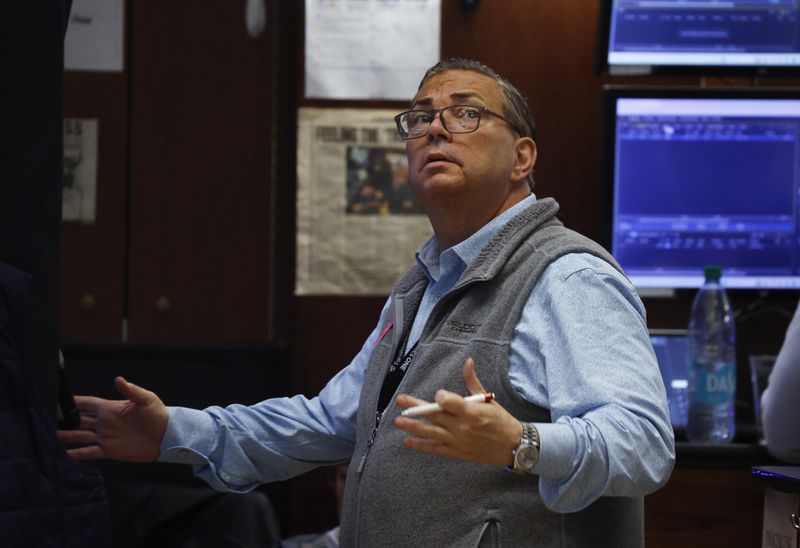
[Financial News] The three major New York stock indexes plunged across the board on the 5th (local time), led by AI-related technology stocks.
Selling intensified after the Democrats secured majorities in both chambers of Congress and gained control of local governments as well in the U.S. midterm elections, fueling concerns about tighter regulation of the AI industry and slowing investment in data centers.
The Dow Jones Industrial Average fell 1,833.06 points (3.44%) from the previous session to close at 51,523.06.
The tech-heavy NASDAQ Composite Index plunged 1,421.52 points (5.52%) from the previous session to 24,315.00, while the S&P 500 fell 334.89 points (4.36%) to 7,353.73.
Biggest decline since reciprocal tariffs were announced in April last year
The Nasdaq and S&P 500’s percentage declines that day were their biggest since April last year, when the New York stock market was jolted by U.S. President Donald Trump’s announcement of reciprocal tariffs.
The Wall Street Journal (WSJ) reported that the market capitalization of companies in the Nasdaq index fell by about $2.5 trillion (about 3,400 trillion won) that day—the largest one-day decline on record.
The market capitalization of companies in the S&P 500 also fell by about $2.9 trillion, a record one-day drop.
The Nasdaq in particular fell more than 10% from the record high it set last month, entering a technical correction.
The day before, the New York stock market rallied, buoyed by reduced political uncertainty after the Democrats took control of Congress and a sharp drop in international oil prices amid hopes for an early end to the Iran war. But sentiment shifted sharply in just one day as the potential negative impact of the Democrats’ victory on the AI industry came into focus.
The Cboe Volatility Index (VIX), known as Wall Street’s “fear gauge,” surged to 28.09 during the session, its highest level in eight months.
Concerns grew that regulations on new data center construction could tighten after the Democrats won elections not only in Congress but also in key areas such as Texas and Georgia, where the data center industry is concentrated.
That fueled fears that the massive capital spending and semiconductor demand that have supported gains in AI-related companies’ stock prices could slow more quickly than expected.
More than 1,356 trillion won wiped from the Magnificent Seven’s market value alone
Selling was fierce, with AI chip leaders NVIDIA, Broadcom and AMD plunging 9.3%, 10.6% and 17.3%, respectively.
As a result, the Philadelphia Semiconductor Index plunged more than 12%, its steepest decline since 2020, early in the COVID-19 pandemic.
According to The Wall Street Journal (WSJ), at one point that afternoon, more than $1 trillion (about 1,356 trillion won) was wiped from the market capitalization of the “Magnificent Seven” (M7), the group of seven major U.S. big tech companies that includes NVIDIA and Microsoft.
Michael O’Rourke of JonesTrading said, “A slowdown in data center investment driven by political changes will become a reality, and earnings estimates—the key basis for the bullish case—are no longer valid.”
He said, “Investors don’t know at what level earnings expectations will be reset,” adding, “They are reducing their exposure to risk assets until the uncertainty clears.”
Tesla and SpaceX, led by Elon Musk, who poured large sums into supporting Republican candidates in this midterm election, also plunged 10.8% and 9.3%, respectively.
As selling that began in technology stocks spread to financials, industrials and other sectors, all 11 sectors in the S&P 500 fell.
U.S. Treasury yields fell as demand for safe-haven assets strengthened.
The yield on the 10-year U.S. Treasury fell to 4.84% that day, down 0.06 percentage points from 4.90% the previous day.
Jonathan Kofina of Meridian Equity Partners said, “It feels as though the market is collapsing beneath our feet,” adding, “Amid all the uncertainty ahead, the market remains extremely vulnerable.”
[email protected] Lee Seok-woo, international affairs correspondent Reporter