Ilsan’s anger: “Why drop a bomb to rein in home prices?” [Real Estate A to Z]
- Input
- 2026-11-07 14:00:00
- Updated
- 2026-11-07 14:00:00
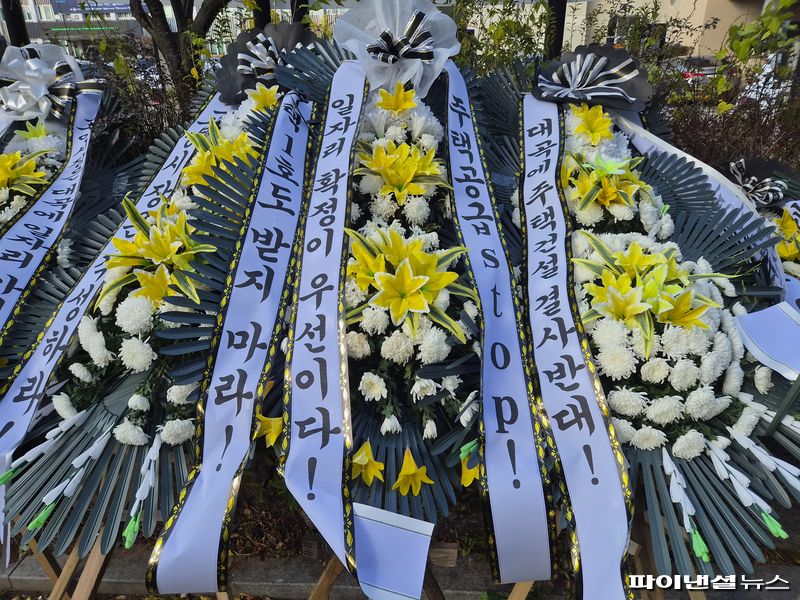
[Financial News] In May 2019, when the government added Goyang’s Changneung District as a third-generation new town, Ilsan residents strongly protested. The designation of Changneung District as a third-generation new town was met with the slogan, “A death sentence for Ilsan New Town.”
Time passed, and by November 2026, the same situation was unfolding. Discontent poured in after the government announced it would supply an additional 4,000 homes in Daegok District. Angry voices could also be heard saying, “Don’t accept even a single housing unit.” The timing is different, but the central question is the same: “Why should Ilsan be the sacrificial lamb for housing supply?”

Ilsan’s tears... “We are the sacrificial lamb for housing supply”
Ilsan was created as part of the first-generation new town project. According to data from the Ministry of Land, Infrastructure and Transport, the site covers 15.7 square kilometers and is home to around 70,000 households. By area and number of households, it is the second-largest of the first-generation new towns, after Bundang.
But Ilsan no longer has the status it once did. When homes were first put up for sale and residents moved in, it stood shoulder to shoulder with Bundang. Even setting aside jobs and transport networks, too many homes have been supplied or are planned for the surrounding area.
Consider data from Gyeonggi Province. Goyang City has 15 residential districts where land development has been completed or is under way, including Neunggok, Deogeun, Samsong, Wonheung, Janghang, Jungsan, Jichuk, Tanhyeon, Pungdong and Hyangdong.
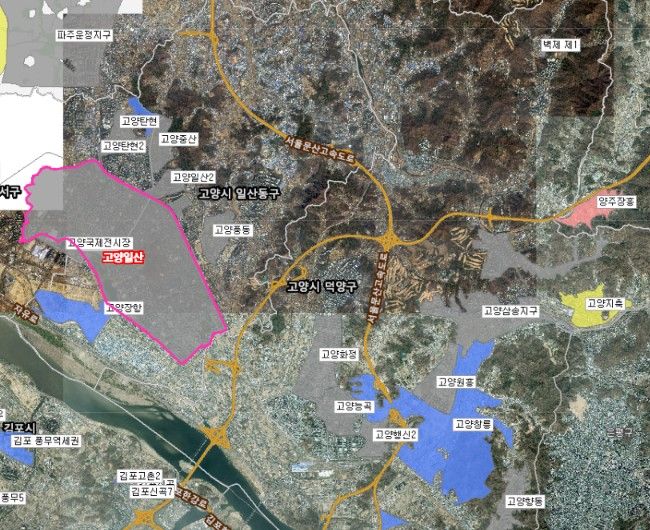
Their locations make it look as though they surround Ilsan New Town. First, Changneung, a large third-generation new town, lies between Ilsan New Town and Seoul. Smaller and medium-sized residential development areas, including Deogeun, Samsong, Jichuk and Wonheung, are also located nearby.
Pungdong, Tanhyeon, Jungsan and Ilsan 2 District are located north of Ilsan New Town. Nearby is Paju Unjeong, a large new town, while across the river, a residential development district in Gimpo has taken root.
“As new towns have gradually been developed in Goyang, Ilsan has ended up surrounded by housing complexes—not just in front, but behind it and to the south and north as well,” one source said. Residents had hoped to attract businesses to the area around Daegok Station. Instead, housing supply is now set to increase further.
Bundang is different from Ilsan... average sale price nearing 1.8 billion won
Let’s compare Ilsan with Bundang, which once stood shoulder to shoulder with it. Dongtan New Town and Gwanggyo New Town, mid- to large-scale districts added along the Gyeongbu Expressway corridor, are located farther south than Bundang. Pangyo New Town is the only place with better access to Seoul than Bundang.
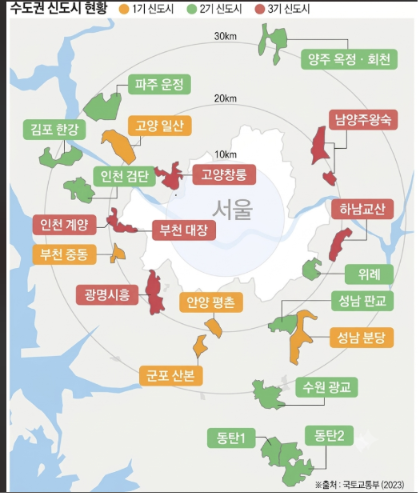
At one time, Bundang was overshadowed as Pangyo New Town rose. But as Pangyo New Town has expanded into a city where people can live close to work, Bundang too is being grouped with it as part of an adjoining living area. More recently, reconstruction issues have also arisen, bringing it shoulder to shoulder with Pangyo New Town.
Apartment prices in the western and eastern districts where Ilsan New Town is located peaked in January 2022. At the time, average apartment sale prices approached 700 million won in the eastern district and 600 million won in the western district. They now stand at 560 million won and 430 million won, respectively. During this period, home prices in the western district fell by at least 20%. Apartment prices in Ilsan New Town have remained mired in a prolonged slump.
Apartment prices in Bundang District, Seongnam, rose by at least 30% over this period. Average sale prices climbed from the 1 billion-won range in 2021 to the 1.3 billion-won range by early 2022. After reaching the 1.2 billion-won range in 2023–2024, they continued to rise and are now nearing 1.8 billion won. “The key to Ilsan New Town’s plight is that, regardless of jobs and other factors, the government has supplied far too many homes through various housing projects,” one source said.
[email protected] Lee Jong-bae Reporter