An ode to youth, all the more radiant for its innocence, stirs hearts on a chilly autumn night
- Input
- 2026-11-05 18:37:56
- Updated
- 2026-11-05 18:37:56
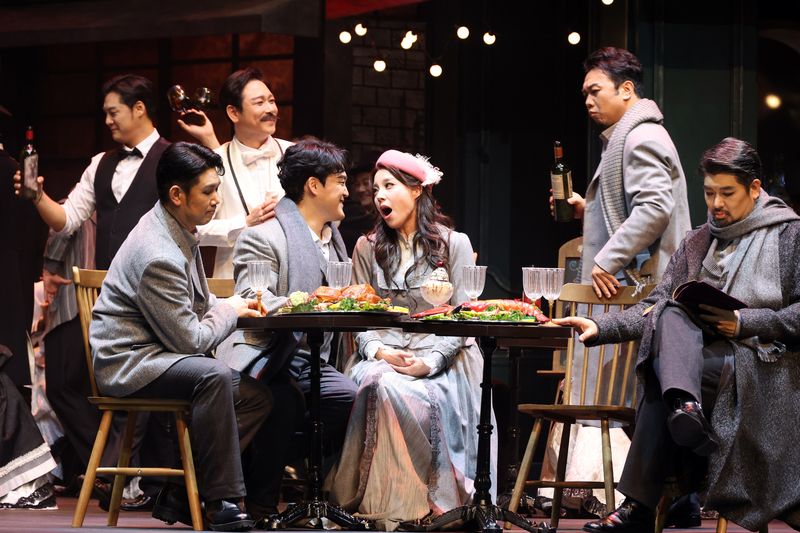
Based on Scenes of Bohemian Life by French writer Henri Murger, La bohème has become a world-renowned opera since its premiere in 1896. This production, co-presented by Financial News and Seoul Metropolitan Opera, unfolds that era like a memory in an old book. Centered on the “giant bookshelf” set that drew acclaim in the 2024 production, the cast has further refined the characters’ emotional arcs and musical details under director Sook Jung Um and conductor Kim Gwang-hyeon. Around 110 people—including principal singers, ensemble members, dancers, a military band and a children’s choir—have brought the atmosphere of late autumn to life with lyrical feeling and beautiful music.
As the curtain rises, a book slips from an old bookshelf and a candle is lit. The burnt paper turns into snowflakes, revealing an old attic, with snow falling over Paris visible through a large picture window. Rodolfo and his friends burn their manuscripts to keep warm, but in the space filled with friendship and jokes, romance takes precedence over poverty.
When Mimi comes by to borrow a candle, Rodolfo sings, “The poet has found a poem,” and Mimi tells him about her modest life and dreams, saying, “My name is Mimi.” Their voices blend in a love duet, and standing before a bookshelf as tall as a four-story building, the two look like tiny fairies inside a giant book.
When the bookshelf opens again in Act 2, the stage becomes a Paris street on Christmas Eve. Musetta, in a red dress, seduces her former lover Marcello as she sings “Musetta’s Waltz”; the ensuing merry commotion and the military band’s parade add to the festive spirit of winter. But after the lonely parting in Act 3, when the story returns to the attic in Act 4, the space fills with the helplessness and desperation of friends who have neither the money nor the strength to save ailing Mimi.
That day, Sumi Hwang portrayed Mimi, a role she has deepened through performances on many stages, with a clear, beautiful voice. Konu Kim, praised for his Rodolfo at Malmö Opera in Sweden, where reviewers said his “rounded, flexible tenor voice carries the performance,” delivered smooth high notes with almost no effort. The two exchanged arias and duets fluidly, and at the final moment Kim unleashed Rodolfo’s despair in an explosive cry, leaving the audience with deep sadness and a lasting impression.
Mimi’s death grows beyond the tragedy of a poor woman into a loss of the love, innocence and passion each person let slip away in a youth when they had nothing. Puccini’s lyrical melodies turn that loss into a beautiful memory to cherish for years.
According to director Sook Jung Um, the cast often met outside the rehearsal room and shared their everyday lives, building closeness and a sense of connection. This carried over into their genuine performances and natural musical rapport onstage.
Hera Hyesang Park, taking on the role of Mimi for the first time, and Lee Won-jong will play Mimi and Rodolfo, respectively. Clara Hyoyoung Kim and Yewon Han will play Musetta, while Young Kwang Yoo and Leon Kim will play Marcello. The Korea Coop Orchestra, Winner Opera Choir and Neulhaerang Little Singers Choir will also take part. Performances run through the 8th.
[email protected] Shin Jin-a Reporter