Virtual asset tax to take effect in 2029 ... Government to pursue three-year loss carryforwards
- Input
- 2026-11-05 18:34:39
- Updated
- 2026-11-05 18:34:39
The government says it will revamp and refine the tax system during the deferral period, reestablishing reasonable tax standards and procedures and improving tax equity. Given the nature of virtual assets, which are actively traded across borders, it will also pursue a measure to allow losses to be carried forward for three years, a practice being introduced worldwide. Industry representatives said, “The National Assembly and the government need to present a concrete roadmap to ensure there are no further delays.”
■ Standardizing the timing of cross-border transaction-information exchanges
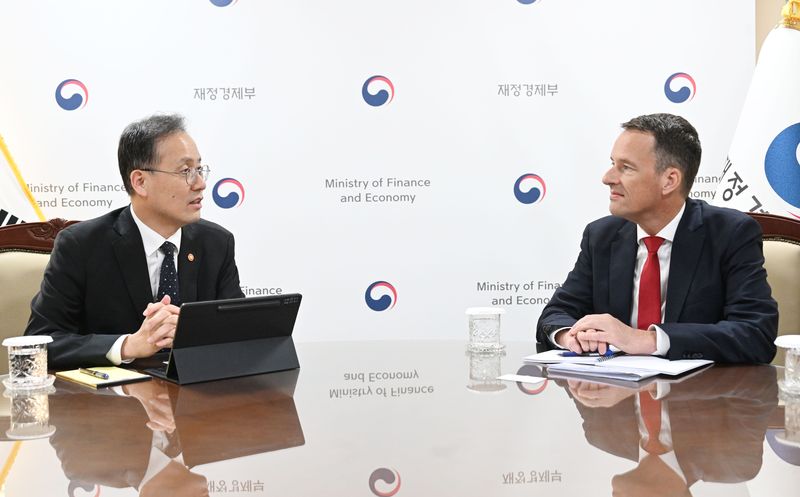
Deputy Prime Minister and Minister of Economy and Finance Lee Hyeong-il held a briefing at the Government Complex Seoul on the 5th and announced the policy to defer virtual asset taxation. “We made this decision after comprehensively considering concerns that the domestic market could be placed at a relative disadvantage compared with overseas markets, as well as views that changes resulting from the enactment of the Digital Asset Act should be reflected in the tax system,” he said.
“Even if the timing of taxation is adjusted, the fundamental tax principle of ‘tax where there is income’ must be upheld,” Deputy Prime Minister Lee said. “We will use the next two years to prepare so that virtual asset taxation can be implemented without a hitch in 2029.”
In deciding to defer taxation, the government took into account that the exchange of virtual asset tax information with the United States is scheduled to begin in 2029. It concluded that, given the active cross-border trading of virtual assets, international exchanges of virtual asset tax information need to take place alongside taxation. “Once we begin receiving virtual asset transaction information from the United States starting in 2029, we will have sufficient information to tax investors using U.S. exchanges appropriately, just as we do investors in the domestic market,” Deputy Prime Minister Lee said. “The government will actively participate in international discussions on the automatic exchange of virtual asset information, while linking and analyzing overseas tax data with domestic tax data and expanding the tax infrastructure so that overseas transactions can also be taxed effectively.”
■ Move to allow loss carryforwards
The virtual asset tax system will also be revised to align with the tax standards of major economies such as the United States, the United Kingdom and Japan. A key measure is to allow losses to be carried forward for three years. “Given the high price volatility of virtual assets, we took into account experts’ recommendations that it would be reasonable to allow an exception under which gains and losses are offset over a set period for tax purposes,” Deputy Prime Minister Lee explained. “Major economies such as the United States and the United Kingdom also allow loss carryforwards, and we also considered that Japan is shifting its policy toward allowing them after previously not doing so.”
However, revising laws and regulations will likely be necessary to move forward with this measure. Under current law, loss carryforwards are not allowed for other income, and income from virtual assets is classified as other income. Deputy Prime Minister Lee added, “We will work to have the loss carryforward measure passed alongside the deferral measure during the regular session of the National Assembly, so that it does not become a point of controversy in virtual asset taxation. We will establish tax standards for various types of transactions by the first half of 2028 at the latest and explain them fully to the market and taxpayers.” Assuming taxation takes effect in 2029, the market value as of December 31, 2028, is expected to be treated as the acquisition cost for assets acquired before then, for the purpose of calculating gains and losses.
The Ministry of Economy and Finance and the Financial Services Commission say they will also accelerate work on enacting the Digital Asset Act, which will affect virtual assets.
Industry representatives and experts said a clear legislative and tax roadmap was needed. Hwang Seok-jin, a professor at Dongguk University’s Graduate School of International Information Security, noted, “It is reasonable to promptly enact the Digital Asset Act, clarify the legal definition, and establish the principle that taxation will begin.”
[email protected] Kim Jun-hyeok, Han Young-jun Reporter