Loan balances fall, but shares pledged as collateral rise ... fears of forced liquidation grow [Anxious Stock Market]
- Input
- 2026-11-05 18:34:20
- Updated
- 2026-11-05 18:34:20
■ Pledged shares increase despite falling loan balances
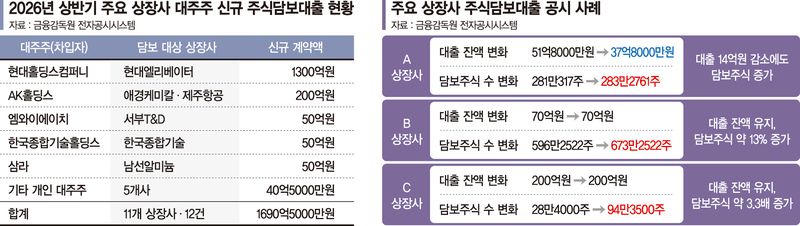
An analysis on the 5th of electronic disclosures on stock-backed loans taken out by major owners and controlling shareholders from January to October this year found what is being called the “stock-backed loan illusion”: a decline in borrowing does not necessarily mean lower collateral risk. In some cases, the number of shares pledged as collateral increased even though the loan balance fell or remained unchanged.
At Listed Company A, the loan balance fell by 1.4 billion won, from 5.18 billion won to 3.78 billion won, but the number of shares pledged as collateral rose from 2,810,317 to 2,832,761. At Listed Company B, the number of pledged shares increased by about 13% while the loan balance remained at 7 billion won. At Listed Company C, the number of pledged shares grew to about 3.3 times its previous level while the loan balance remained unchanged at 20 billion won.
This happens alongside falling stock prices. When a stock price falls, the value of the collateral also declines, and financial institutions demand additional collateral or repayment to maintain the agreed level. If a controlling shareholder lacks the cash to repay the loan, they may pledge more of their existing shares, so the number of shares tied up as collateral can rise even as the loan balance falls. In effect, their ability to sell shares and their buffer against falling stock prices both weaken.
Hwang Se-woon, a research fellow at the Korea Capital Market Institute, explained, “When the value of collateral falls, a margin call is usually issued,” adding, “If a stock price plunges 15–20% within a few days, it becomes more likely that the collateral requirements cannot be met. If the margin call is not properly met, the shares could be put up for forced sale.” He added, “Forced selling can become a factor that drives stock prices down even faster.”
The problem is that ordinary investors find it difficult to identify these risks in advance. Disclosures make it possible to check controlling shareholders’ stock-backed loans and changes in the shares pledged as collateral, but details in the actual loan agreements—such as margin-call terms and deadlines for providing additional collateral—are not made public.
Hwang said, “Details of the contract, such as how margin calls are structured, when they are issued, and how many hours after notification additional collateral must be provided, are not disclosed,” adding, “It is extremely difficult for ordinary investors to know how the situation is unfolding.” He also noted that, in practice, it would be difficult to require disclosure of every contract term, even if the scope of disclosures were expanded.
■ Forced sale of pledged shares can even lead to delisting
Investors are advised to examine not only the size of controlling shareholders’ collateral-backed loans but also the financial condition of the company in question.
Hwang said, “If a company is in sound financial condition, the risk may be relatively low even if it has a stock-backed loan in place. But if its financial condition is poor and it also has a large stock-backed loan, caution is warranted.”
There have been cases in which pledged shares were forcibly sold. Shares pledged as collateral by the controlling shareholder’s side at Suseong Webtoon were forcibly sold in February and April this year for reasons including failure to repay the loan at maturity and insufficient collateral.
The company was ultimately delisted on October 1. While it cannot be concluded that the stock-backed loan was the direct cause of the delisting, the case shows that the burden of collateral on controlling shareholders and the sale of their shares can affect a company’s management stability and even ordinary investors.
[email protected] Kang Jung-mo Reporter