Will It Satisfy ‘Angry Trump,’ Who Has Been Pressing for a Deployment to Hormuz?
- Input
- 2026-11-05 18:34:16
- Updated
- 2026-11-05 18:34:16
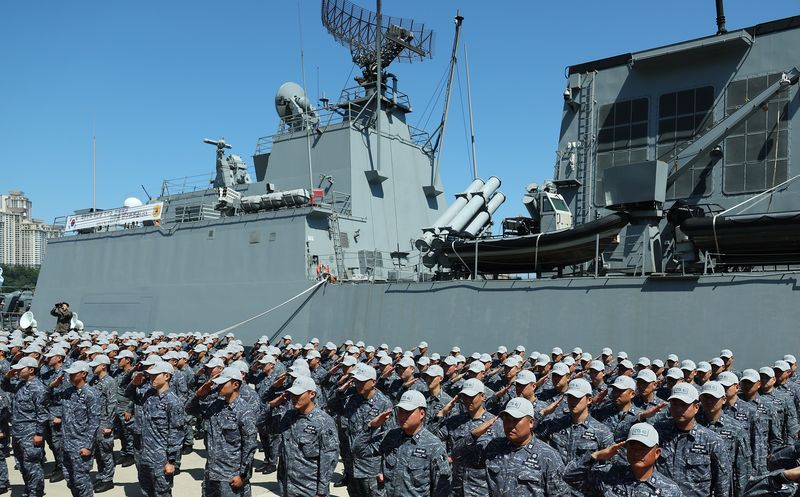
The Ministry of National Defense has finalized an amendment to the motion seeking approval to extend the Cheonghae Unit’s deployment and expand its operational area, and has begun taking concrete steps to put it before the National Assembly plenary session. Whether the overhaul plan passes the Assembly is expected to be a major test of the practical security of oil transport routes and the effectiveness of key military cooperation between South Korea and the United States. Attention is also focused on whether expanding the Cheonghae Unit’s operational area will be an effective card for persuading the U.S. administration under Donald Trump, which has pressed for a troop deployment.
According to officials from the Ministry of National Defense and the National Assembly on the 5th, the ministry has prepared an amendment to the motion to extend the Cheonghae Unit’s deployment and is said to have decided to complete the necessary administrative and political procedures next week, then submit it to the plenary session for consideration as early as the 16th of this month. Given that the current deployment mandate expires at the end of this year, the government plans to secure parliamentary approval after deliberation by the Cabinet and presidential approval. If the amendment passes, the Cheonghae Unit’s deployment will be extended through the end of next year (December 31, 2027).
The key to the amendment is that it takes a pragmatic approach: avoiding the political burden of deploying a separate new unit while expanding the existing Cheonghae Unit’s mission area by about twofold, to the waters south of Oman near the southern end of the Strait of Hormuz. Accordingly, the operational radius, previously confined to the Gulf of Aden area (about 600 nautical miles, or 1,111 km), will be significantly expanded to the waters south of Oman near the Strait of Hormuz (about 1,200 nautical miles, or 2,222 km).
The decision comes amid a worsening security situation, with pirate activity near Somalia surging from 11 incidents in 2025 to 36 recently.
The plan is also to fill the operational gap in the waters south of Oman, created as multinational forces from around the world concentrate in the Red Sea and the Strait of Hormuz, thereby ensuring the uninterrupted continuity of maritime supply routes and protecting South Korean-flagged vessels. Accordingly, the unit’s mission statement in the motion now adds ‘safeguarding freedom of navigation on international sea lanes’ to its existing mandate of ‘protecting our citizens and vessels.’
The forces and personnel available to strengthen military capabilities will also be substantially increased. The number of deployed personnel will rise by 75 to a maximum of 395. In addition to the 4,400-ton Korean-type destroyer (DDH-II) currently in service, one maritime patrol aircraft, an underwater mine and explosive ordnance disposal (EOD) team, and advanced unmanned mine-countermeasure equipment—including unmanned surface vessels and unmanned underwater vehicles—will be deployed for the first time. The maritime patrol aircraft is expected to use a hub base in Djibouti, Africa, to detect hostile forces’ movements on the outskirts of the operational area in advance; deployment to the area is expected to take about three days.
The Ministry of National Defense stressed, however, that expanding the operational area and strengthening military capabilities were not measures intended to involve South Korea in or intervene in any particular war in the Middle East.
A ministry official said, ‘This decision was made to protect our citizens and vessels and safeguard our economic interests, not to become involved in or intervene in a war with Iran.’ The official added, ‘With the operational area limited to waters south of Oman, direct reconnaissance of Iranian territory or the Strait of Hormuz will be restricted.’ The ministry maintains that deploying the maritime patrol aircraft and EOD team is also not a ‘backdoor deployment’ linked to the situation in the Strait of Hormuz.
Even so, military authorities said they ‘do not rule out also preparing in advance for the possibility of deployment to the Strait of Hormuz and elsewhere, following further approval by a National Assembly plenary session, should a “permissive environment”—such as an end to the war or an agreement between the parties—emerge and the international community make a request.’ This suggests a multipurpose strategic move to prepare for a situation in which demands for contributions to the South Korea-U.S. military partnership intensify.
[email protected] Lee Jong-yoon Reporter