Ruling party launches overhaul of tax rules for non-owner-occupied single-home owners and long-term holding deductions, aims to reach a decision this month
- Input
- 2026-11-05 20:27:43
- Updated
- 2026-11-05 20:27:43
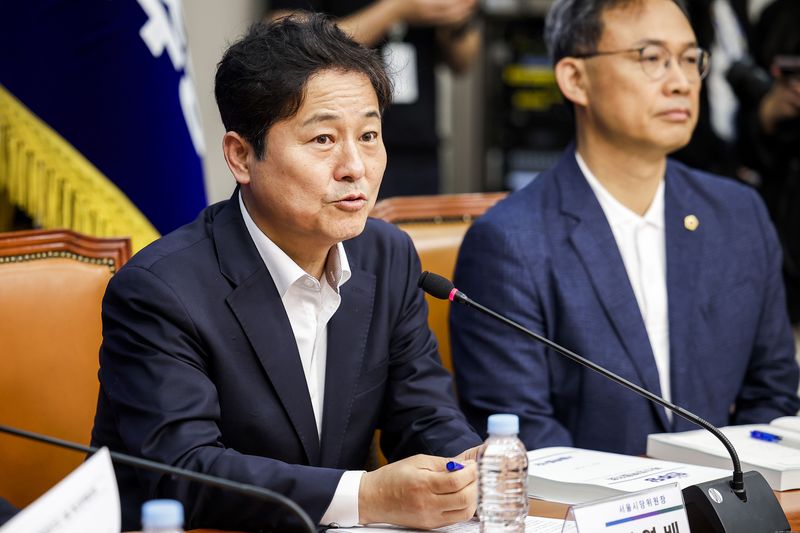
Kim Young-bae, chair of the Democratic Party of Korea’s Seoul chapter, told reporters after a closed-door real estate policy meeting with lawmakers representing Seoul constituencies at the National Assembly on the 5th, “There was broad agreement on moving in a direction that provides robust protection for ordinary people who own one home and for those buying homes for their own use.” He added, “We agreed to organize the agenda for discussions on taxation and housing supply and to pursue close consultations between the ruling party and the government.”
The meeting included wide-ranging discussions on tax rules for non-owner-occupied single-home owners and rental business operators, as well as the long-term holding special deduction. However, the participants did not agree on a plan to set the comprehensive real estate holding tax deduction threshold for owner-occupiers with one home at 1.4 billion won. The explanation was that real estate market conditions and residents’ demands vary by area, including the three Gangnam districts, Mayongseong (Mapo, Yongsan and Seongbuk districts) and Gangbuk, and that further input needs to be gathered.
Asked about the possibility of easing the government’s tax reform plan, Kim said, “While consolidating the results of the government’s policies, if there are areas where they impose unintended burdens on citizens, we should also consider the necessary easing measures.” The aim is to develop complementary measures that improve the effectiveness of government policies, rather than to ease taxes across the board.
Lawmakers representing Seoul constituencies plan to flesh out issues related to taxation and housing supply, with Kim, Oh Gi-hyoung, the ruling party’s secretary on the National Assembly’s Strategy and Finance Committee, and Kim Nam-geun, a member of the Land, Infrastructure and Transport Committee, taking the lead. They aim to settle on the direction of legislation by the third week of November after consulting with the Ministry of Land, Infrastructure and Transport, the Ministry of Finance and Economy, the Ministry of Planning and Budget, and the presidential office.
Kim explained, “Since the Strategy and Finance Committee needs to pass tax-related bills by the end of November, any areas that need to be revised should be settled by the third week of November,” adding, “The week or so from this weekend through next week will be the period for specific consultations between the ruling party and the government.”
[email protected] Jiwon Song Reporter