“South Korea and Japan must join forces to stand a chance in the U.S.-China AI race for dominance”
- Input
- 2026-11-05 18:21:24
- Updated
- 2026-11-05 18:21:24
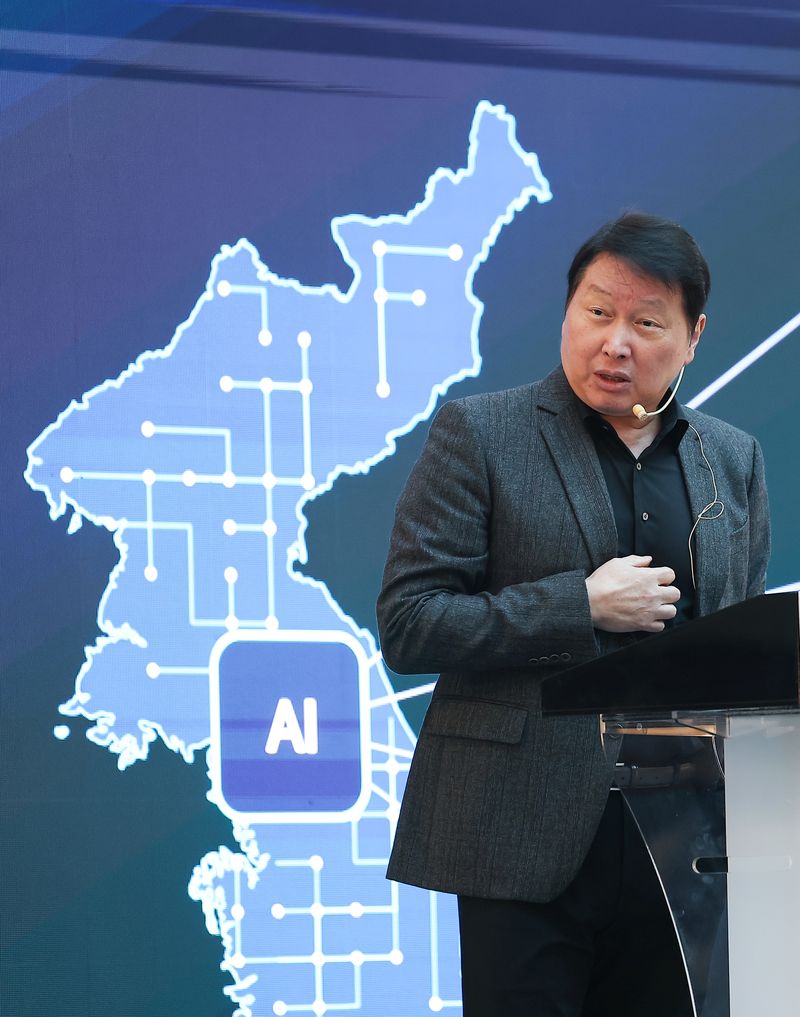
On the 5th, SK Group Chairman Chey Tae-won pointed to the hegemonic rivalry between the United States and China over artificial intelligence (AI), saying, “Our option is Japan.”
At a special lecture that day in the central hall of the College of Social Sciences at Seoul National University, titled “The AI Era, Changes in the Global Economic Paradigm and Korea’s Vision,” Chey emphasized, “Japan says, ‘Cooperation with South Korea is indispensable.’ Expanding that option could help us.”
Chey said, “Both South Korea and Japan have island-like economic structures that are self-contained, with economic infrastructure such as roads, power and railways disconnected from the outside world.” He added, “As the free-trade system weakens, if the economies of South Korea, with a GDP of $2 trillion, and Japan, with a GDP of $4 trillion, are linked, the ripple effect will be more than simply three times as great. It could also reduce the social costs both countries face, including low birth rates and an aging population.”
Chey also addressed the U.S.-China hegemonic rivalry, saying, “We have reached a crossroads where we have to take one side or the other,” and noting, “We have entered a situation where we are being forced to give up one side’s market.”
Chey said, “The United States and China are building infrastructure because losing in AI could mean losing the hegemonic war. They are pouring large sums of money, on a massive scale and in a short time, into building power grids, highways, mobile communications and cloud infrastructure. The resulting spillover benefits are also substantial, and this has extended to semiconductors.” Chey added, “The enormous sums invested in AI infrastructure have led to shortages of semiconductors and graphics processing units (GPUs), among other things,” and predicted, “This problem looks set to continue.”
Referring to how we are living amid the U.S.-China hegemonic clash and an era of massive capital investment in AI, Chey said, “The nature of the game has changed completely. The scale and concept of the money being invested have changed so much that a very different form has emerged.” He put forward ideas including “new capitalism,” “a state run on AI,” “expanding options” and “a new compensation system.”
On the AI state, Chey said, “It means the system surrounding us will change,” adding, “Ultimately, whether we can quickly adapt our growth model to AI in these geopolitically risky and difficult times will determine our country’s fate.”
[email protected] Park Ji-yeon, Kim Hak-jae Reporter