Chey Tae-won: “AI will determine South Korea’s fate ... There’s no way to catch up without betting on it”
- Input
- 2026-11-05 18:52:49
- Updated
- 2026-11-05 18:52:49
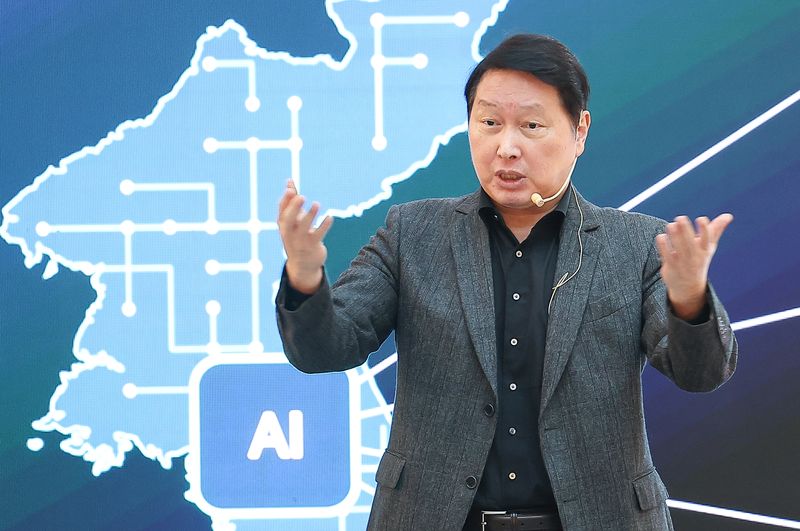
[Financial News] “Our country’s fate will depend on how quickly we can adapt our growth model to artificial intelligence (AI).”
Chey Tae-won, chairman of SK Group, outlined changes in the global economy in the AI era and how South Korea should respond at a special lecture held on the 5th at the Central Hall of Seoul National University’s College of Social Sciences.
Regarding the 2,100-trillion-won investment SK Group announced last June for the government’s “Three Mega-Projects,” Chey said, “We have no way to keep up unless we also make a bet of this scale,” adding, “In the past, we thought even spending 200 trillion won was a huge investment, but now it has grown to more than 10 times that. The nature of the game, the size and concept of money, have changed completely.”
He said South Korea’s traditional export-led growth model had also reached its limits amid the U.S.-China race for AI dominance. He also stressed that AI had emerged as critical infrastructure that would determine future hegemony. “In the past, investment in major infrastructure such as power grids and highways was around 1% of gross domestic product (GDP), whereas AI investment accounts for 3.8%,” Chey said.
He proposed four solutions for the South Korean economy: a new capitalism, an AI-native nation, expanding the size of the economy, and an incentive system. He said individuals and companies that create value by solving social problems should receive commensurate incentives, and that systems for work and education should also shift to put AI at their center.
As part of expanding the size of the economy, Chey emphasized a “South Korea-Japan economic community.” He said, “Japan says that cooperation with South Korea is indispensable. Expanding that option right away could benefit us,” adding, “South Korea’s GDP is currently about $2 trillion. If you imagine the two economies operating together with Japan, that would make $6 trillion. The return from succeeding in a $6 trillion economy would not simply be three times the return in a $2 trillion economy; it would be about 10 times as much.”
During the ensuing Q&A, Chey referred to the Democrats’ regaining majority-party status in both the House and Senate in that day’s U.S. midterm elections. “Policy hasn’t changed, but the market is reacting sensitively. It seems many people are expressing anxiety about AI,” he said, adding, “In a market where a lot of money is being injected, as it is now, roller-coaster swings could continue.”
[email protected] Park Ji-yeon Reporter