Namyangju Mayor Choi Hyun-deok Takes Farmland and Fiscal Issues to National Assembly
- Input
- 2026-11-05 18:19:33
- Updated
- 2026-11-05 18:19:33
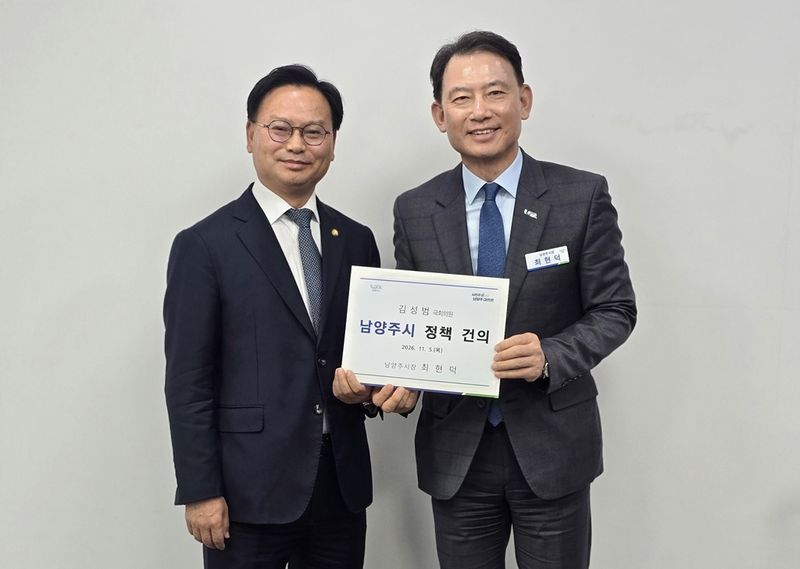
【Financial News | Namyangju = Kim Kyung-soo, reporter】 Choi Hyun-deok, mayor of Namyangju in Gyeonggi Province, has begun lobbying the National Assembly to ease farmland regulations and reduce the burden on local finances. The aim is to ease standards for installing agricultural facilities in development-restricted zones and reduce the disadvantages Namyangju faces in the government’s fiscal support process.
On the 5th, Mayor Choi visited the National Assembly and delivered policy proposals outlining key issues to Democratic Party of Korea (DPK) lawmakers Kim Seong-beom, Shin Jung-hoon and Kim Young-hwan.
He asked lawmaker Kim Seong-beom to ease standards for installing agricultural work convenience facilities and ancillary facilities at experiential and healing farms in development-restricted zones. He explained that, although the amended Farmland Act that took effect last August recognizes sites used for agricultural work convenience facilities such as toilets and parking lots as farmland, there is no clear legal basis for installing such facilities in development-restricted zones.
He also proposed deferring disposal orders and enforcement fines for farmland slated for expropriation for public projects, and not applying stricter disposal standards to farmland owned by Korean nationals that is not actually subject to land transaction permits.
He discussed local fiscal issues with lawmakers Shin Jung-hoon and Kim Young-hwan. Key proposals included preventing a decline in the Local Grant Tax following the establishment of the Future Fund, improving the criteria for calculating the Local Preferential Index, and increasing central government funding for long-term care benefits for older adults.
Mayor Choi pointed out that the government’s planned Future Fund could lead to a decline in the Local Grant Tax and increase the fiscal burden on local governments. He called for 19.24% of domestic tax revenue to be guaranteed first as a funding source for the Local Grant Tax, and for local governments to be allowed to participate in operating the fund.
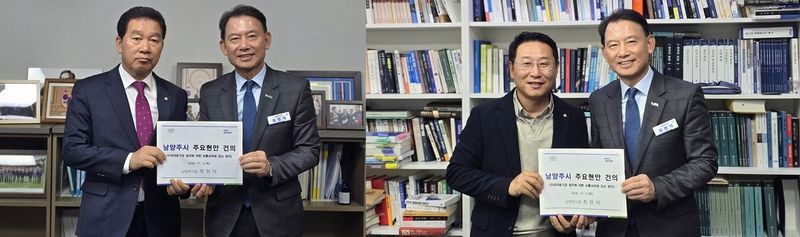
He also identified adjusting Namyangju’s regional tier under the Local Preferential Index as a key issue. The city is subject to eight overlapping regulations, including development restrictions. Its gross regional domestic product (GRDP) per capita ranked 30th among Gyeonggi Province’s 31 cities and counties in 2023. Mayor Choi asked that Namyangju, currently in Tier 1, be moved to Tier 3 to reflect these conditions.
He also proposed increasing central government funding for long-term care benefits for older adults. Namyangju’s related budget rose by about 47%, from 51.4 billion won in 2024 to 75.5 billion won this year. The city proposed either making long-term care benefits for medical aid recipients a national government responsibility or having the central government cover at least 80% of the related costs.
“The difficulties faced in agricultural fields and the burden on local finances are structural problems that individual local governments cannot resolve on their own,” Namyangju Mayor Choi Hyun-deok said. “I will continue consulting with the National Assembly so that these concerns can be reflected in amendments to relevant laws and improvements to the system.”
Meanwhile, Mayor Choi plans to visit the National Assembly again next week to continue making policy proposals on major projects in culture and sports, including the “Joseon Royal IEUM History and Culture Belt” project.
[email protected] Kim Kyung-soo Reporter