“My blood vessels are fine, so why does my chest hurt?” ... The culprit: ‘vasospasm’ [Health Talk]
- Input
- 2026-11-06 08:30:00
- Updated
- 2026-11-06 08:30:00
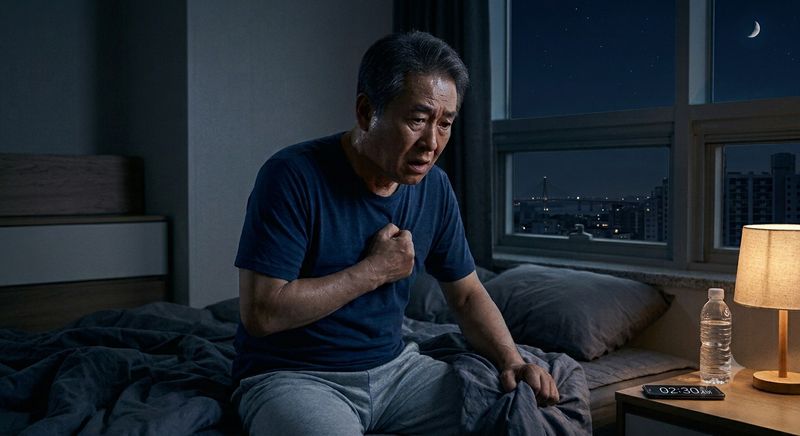
[Financial News] At 4 a.m., while fast asleep, you suddenly wake to a squeezing pain in your chest. A few minutes later, it subsides as if by magic, only to return at a similar time the next day. It may be easy to dismiss it as indigestion or stress, but it could be a typical sign of variant angina, in which the blood vessels supplying the heart go into spasm.
Ordinary angina occurs when coronary arteries narrow due to atherosclerosis. Variant angina, by contrast, can occur even without significant atherosclerotic narrowing of the coronary arteries: the blood vessels suddenly constrict severely, sharply reducing blood flow to the heart. This makes the cause difficult to detect with routine tests.
Pain that strikes at rest... a ‘warning light’ if it recurs around the same time
Its key feature is that the pain occurs regardless of exercise or physical activity. Chest pain typically strikes in the middle of the night or early morning while a person is resting, and tends to recur around the same time. It often lasts for several minutes before subsiding. But if the spasm is severe and prolonged, it can lead to a heart attack or a dangerous arrhythmia, and, rarely, sudden cardiac death—so it should never be taken lightly.
It is common in people with risk factors such as high blood pressure or smoking, but it can also occur in people with little atherosclerosis and in younger people. Smoking in particular is a major risk factor that can trigger or worsen blood vessel spasms. That is because nicotine in tobacco damages the inner lining of blood vessels, making spasms more likely. Sudden exposure to cold, the day after heavy drinking, and severe stress can also trigger pain.
Professor Seo Sun-yong of the Division of Cardiology at Korea University Ansan Hospital said, “Variant angina differs from ordinary angina in that the pain recurs in the early morning regardless of exercise.” He added, “Because quite a few cases are diagnosed late after people dismiss the pain as simple stress-related chest pain and leave it untreated, it is important to see a cardiology specialist if the pain keeps recurring around the same time.”
A disease that shows up only when it hurts... quitting smoking is the first prescription
If angina is suspected, tests such as an electrocardiogram, an echocardiogram and blood tests are performed. The problem is that tests may show no abnormalities when there is no pain, because the blood vessel spasm appears and disappears only while the pain is occurring. If symptoms are irregular, a 24-hour ambulatory electrocardiogram (Holter monitor), which records the heart’s electrical activity over a full day, can help capture when the pain occurs.
Coronary angiography is performed if necessary. Even if no significant narrowing is visible, a provocation test may be performed when variant angina is suspected: medication is administered to check for spasms in the coronary arteries. If chest pain and electrocardiogram changes occur and a temporary spasm of a coronary artery is confirmed, this can help with diagnosis. However, because the test deliberately induces a blood vessel spasm, it should be done at a medical facility where a cardiology specialist is on hand and able to respond immediately to an emergency.
The first steps in treatment are quitting smoking and avoiding triggers. Smoking is the strongest aggravating factor, so medication is less effective if a person does not quit. It is also essential to avoid situations that can trigger pain, such as cold weather, heavy drinking and severe stress.
Medication to prevent blood vessel spasms is central to treatment. For many patients, this medication alone greatly improves symptoms. If pain comes on suddenly, nitroglycerin placed under the tongue can provide rapid relief. However, some medications commonly used for ordinary angina can actually worsen symptoms of variant angina, so they must be taken only as prescribed by a specialist. For high-risk patients who continue to have life-threatening arrhythmias caused by blood vessel spasms despite medication, a procedure to implant a device that restores a normal heartbeat, such as an implantable cardioverter-defibrillator, may be considered.
Professor Seo emphasized, “Variant angina is a condition that requires medication, smoking cessation and lifestyle management to go hand in hand.” He added, “Even if symptoms improve, stopping medication on your own without consulting a specialist can lead to a recurrence, so caution is needed.”
[email protected] Jung Myung-jin, Medical Correspondent Reporter