Oh Se-hoon calls hold on Sewoon District 4 review “obstinacy in the guise of administration”
- Input
- 2026-11-05 17:22:29
- Updated
- 2026-11-05 17:22:29
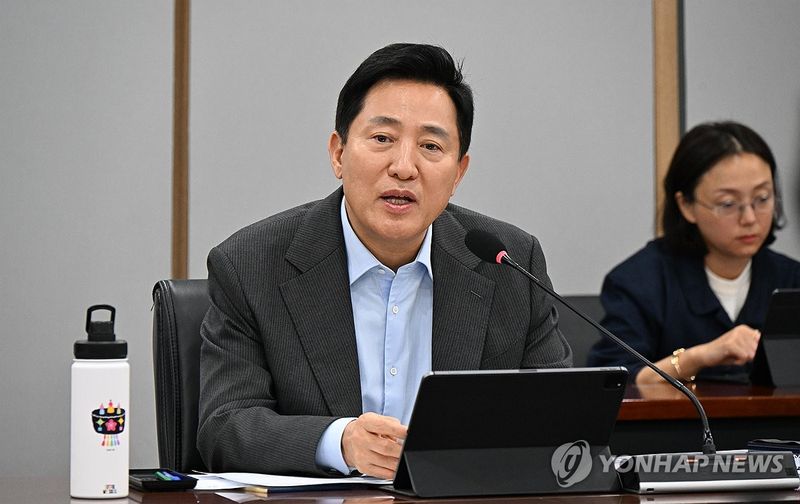
According to a Facebook post by Mayor Oh on the 5th, he raised concerns about the Korea Heritage Service’s review process and legal basis in a post titled “The Korea Heritage Service Is the Biggest Enemy of National Heritage.” The repeated postponement of reviews was what he took issue with. Sewoon District 4 was designated for redevelopment in 2004, but construction has yet to begin 22 years later. Mayor Oh argues that the project has been delayed because the Korea Heritage Service repeatedly put off reviews of plans to preserve buried heritage from August through October.
He also pointed out that the conditions required during the review process had changed. The Korea Heritage Service had said it needed to wait for confirmation of changes to the project plan, but later called for an on-site investigation. After the investigation, it put forward the principle of preserving the remains in situ.
While emphasizing the goal of the redevelopment project—to connect Jongmyo Shrine and Namsan with green space—Mayor Oh argued that the Korea Heritage Service was blocking the project by citing the possibility of damage to Jongmyo’s landscape. He said the agency was demanding a World Heritage Impact Assessment (HIA) even though Sewoon District 4 lies outside the World Heritage area, and was even pressing for revocation of the project approval.
He also identified the legal basis for the HIA as an issue. Mayor Oh took issue with the Korea Heritage Service’s statement in January that it would request an assessment under domestic law once revisions to the enforcement decree were completed, followed by its announcement on the 4th that it would establish management standards.
He criticized the agency, saying, “This is an admission that it has kept residents bound without any legal basis or standards until now,” and, “Only after the issue erupted did it rush to make rules, and now it is using those rules as a cudgel to pressure residents.”
He also highlighted the economic harm residents have suffered as the project has dragged on. Mayor Oh warned, “Residents have already filed a lawsuit against the state seeking around 25 billion won in damages after incurring considerable costs and spending considerable time. If even the fifth review, on the 18th, is put on hold, that decision itself will become evidence in the lawsuit.”
Administrative clashes over the preservation of World Heritage and urban redevelopment have continued throughout the project.
On January 26, the Korea Heritage Service said that important buried heritage, including roads and drainage systems from the Joseon era, had been found during an excavation at Sewoon District 4, and that a preservation plan needed to be prepared first. The excavation began after receiving a permit in May 2022. At the time, the agency explained that the excavation had not been legally completed because deliberations on a preservation plan had not been concluded.
On May 6, the Korea Heritage Service issued an administrative order to the Seoul Metropolitan Government, the Seoul Housing & Urban Development Corporation (SH Corporation), and Jongno District, requiring them to carry out an HIA. The order required the assessment results to be reflected in the project plan. Jongno District later approved a change to the implementation plan for Sewoon District 4 on June 18, and the change was announced on the 19th.
The Korea Heritage Service continues to maintain that an assessment is necessary to preserve cultural heritage. On the 4th, it countered that an HIA is not a regulation intended to halt development, but a system for finding ways for heritage protection and development projects to coexist. It said the measure is intended to ensure compliance with the World Heritage Convention and domestic laws.
As the two sides disagree over the scope of the HIA and plans for preserving buried heritage, the outcome of the review scheduled for the 18th has emerged as a factor that could affect the project timeline. The decision on which preservation plan to adopt could also affect the design and construction methods.
Mayor Oh referred to “UNESCOcide,” a term for the phenomenon of restricting residents’ lives in the name of protecting cultural heritage, and expressed concern that the Korea Heritage Service’s administrative approach could further fuel public resentment toward cultural heritage preservation.
[email protected] Seung-hyun Ahn Reporter