One in 3 adults has hypertension ... half of high-risk patients fail to meet their 'target blood pressure' goal
- Input
- 2026-11-05 17:08:32
- Updated
- 2026-11-05 17:08:32
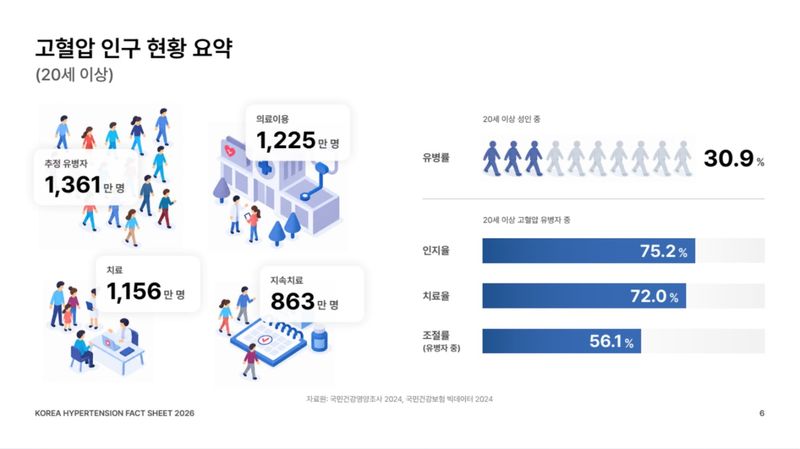
[Financial News] There are 13.61 million people with hypertension in South Korea—about one in every three adults. According to the Hypertension Fact Sheet 2026 released by The Korean Society of Hypertension, blood pressure is well controlled in 77% of patients receiving treatment, but the rate of meeting target blood pressure goals among high-risk patients remained around 50%.
The Korean Society of Hypertension released its Hypertension Fact Sheet 2026 (Korea Hypertension Fact Sheet 2026) on the 5th. The document compiles data on the prevalence of hypertension, levels of management, healthcare use and medication treatment, based on analysis by the Society's Hypertension Epidemiology Research Group of the Korea National Health and Nutrition Examination Survey (1998–2024) and National Health Insurance Service big data (2002–2024). This year, the analysis also examined blood pressure management among groups at high risk of cardiovascular and cerebrovascular disease.
As of 2024, an estimated 31% of adults aged 20 or older had hypertension. The awareness rate—the proportion who knew they had hypertension—was 75%, the treatment rate was 72%, and the control rate, defined as blood pressure managed below 140/90 mmHg, was 56%. Among patients receiving treatment, the control rate rose to 77%.
A total of 12.25 million people used healthcare services for hypertension. Of these, 11.56 million were prescribed medication, and 8.63 million received ongoing treatment. Sixty percent of those receiving treatment were taking two or more medications, while 72% were also being treated for dyslipidemia or diabetes.
By contrast, results among high-risk groups were less encouraging. The proportions meeting both targets—systolic blood pressure below 130 mmHg and diastolic blood pressure below 80 mmHg—were 49% among people with cardiovascular or cerebrovascular disease, 52% among people with diabetes, and 50% among people with chronic kidney disease. Among people with hypertension or prehypertension who were classified as being at high risk of cardiovascular or cerebrovascular disease, only 27% met these targets.
Kim Hyun-chang, chair of The Korean Society of Hypertension's Epidemiology Research Group and a professor at Yonsei University College of Medicine, said, “Our country's overall level of hypertension management has reached a world-leading standard, attracting considerable international attention and serving as a benchmark for other countries. Continuously monitoring the state of management and identifying new problems through nationwide data such as the fact sheet is an important starting point for successful hypertension management.”
Kim Gwang-il, president of The Korean Society of Hypertension and a professor at Seoul National University College of Medicine, emphasized, “Over the past several decades, the level of hypertension management in our country has improved substantially thanks to the efforts of medical professionals and the public. However, more intensive blood pressure control—systolic blood pressure below 130 mmHg and diastolic blood pressure below 80 mmHg—is needed for high-risk patients with hypertension who also have cardiovascular or cerebrovascular disease, diabetes, chronic kidney disease, and other conditions. Since only about half of people with these conditions meet those blood pressure targets, proactive care by medical professionals, including intensifying drug treatment with combination medications, must go hand in hand with patients' ongoing blood pressure management.”
[email protected] Jeong Myeong-jin, Medical Correspondent Reporter