“There’s nowhere for accountants to work, even if we hire them” ... Calls grow to cut annual intake from 1,150 to 850 as AI spreads [fn Market Watch]
- Input
- 2026-11-05 16:14:13
- Updated
- 2026-11-05 16:14:13
According to the accounting industry on the 5th, the Korean Accounting Association, the Korea Listed Companies Association, the Accounting Policy Research Institute and the Korean Institute of Certified Public Accountants held a seminar the previous day at the Listed Companies Association Hall in Mapo District, Seoul. The seminar was titled “A Study on Demand for Certified Public Accountants Reflecting Changes in the Accounting Environment, Including AI.”
Researchers at the Korean Accounting Association, including Hwang Mun-ho, a professor at Kyung Hee University (KHU), argued that the number of CPAs selected should be readjusted in light of slower growth at accounting firms and changes to work structures resulting from AI adoption.
The average annual revenue growth rate at accounting firms over the most recent three-year period was just 2.8%. Net hiring also fell from 1,160 in 2023 to 370 in 2025, a 68.1% decline in just two years. In effect, accounting firms’ capacity to absorb new hires is rapidly shrinking.
The problem of CPA exam passers not being assigned practical training has also worsened. As of September this year, 723 people, including current students, had been counted as unable to find a practical training placement. Of these, 623 passed the exam in 2024–2025. The researchers estimated that about 300 of those not assigned to training had actually been unable to secure a placement.
The share of candidates who began practical training in the same year they passed the exam fell by 25.6 percentage points, from 89.2% in 2022 to 63.6% last year. The analysis found that cracks are appearing in the existing system for developing the workforce, in which passing the exam led directly to gaining practical experience.
There are also concerns that AI adoption could further reduce accounting firms’ demand for staff. The researchers projected that demand for personnel in accounting firms’ audit divisions would fall by about 10% in the next 3–5 years and by 12–16% after five years.
The effects of AI adoption are expected to be concentrated among junior accountants. The researchers estimated that the impact of AI-driven changes to work structures would be greatest for Staff in their first or second year, at 5–50%. The impact was smaller at higher levels: 3–35% for seniors, 2–22% for managers, 1–12% for senior managers and 0.5–7% for partners.
There was also considerable support for reducing the number of CPAs selected. In a survey of stakeholder views, 67.6% of general companies and 45.9% of exam candidates said that the number selected in recent years had been too high.
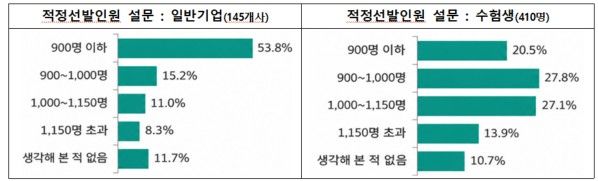
For the next five years, 69.0% of general companies and 48.3% of exam candidates said the appropriate annual intake would be 1,000 or fewer. The weighted-average appropriate intake was 933 for companies and 1,012 for exam candidates, both below the current 1,150.
Taking into account actual and standard audit hours, accumulated workforce supply and demand, and capacity for practical training, among other factors, the researchers proposed setting annual CPA intake at 850–1,000 for the next 2–3 years. Compared with the current intake, this would mean a reduction of 150–300 a year, or about 13–26%.
[email protected] Kim Hyun-jung Reporter