Korea Federation of Mid-sized Enterprises Calls for Overhaul of the Mid-Sized Enterprise Act and Labor and Environmental Systems to Counter China
- Input
- 2026-11-05 16:17:49
- Updated
- 2026-11-05 16:17:49
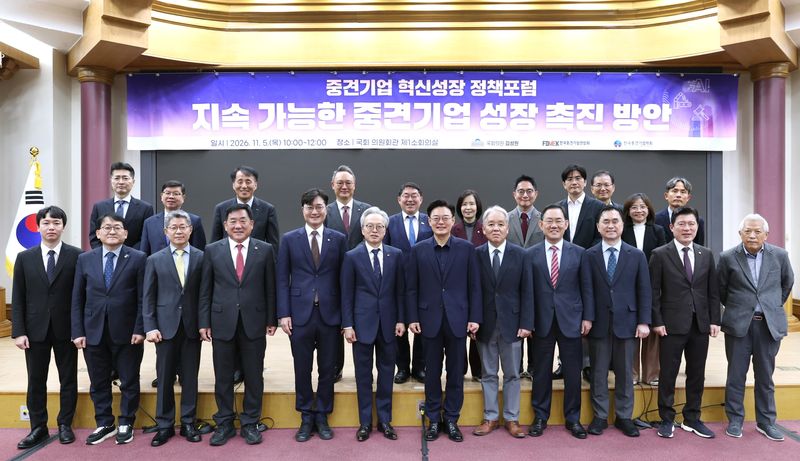
[Financial News] Choi Jin-sik, chair of the Korea Federation of Mid-sized Enterprises, proposed overhauling the support system for mid-sized enterprises and business-related regulations, including those on labor and the environment, to respond to China’s growing industrial competitiveness and the spread of artificial intelligence (AI).
At the 6th Mid-sized Enterprise Innovation Growth Policy Forum held on the 5th at the National Assembly Members’ Office Building, Choi said, “To prevent China’s industrial competitiveness from gaining further ground and take an early lead in distinctive future sectors, we must urgently and thoroughly review the achievements and limitations of all laws, institutions and policies based on the thinking of the ‘smokestack’ and information and communications technology (ICT) eras.”
At the forum, participants argued that the Mid-Sized Enterprise Act, enacted in 2014, should be updated to reflect the changed industrial environment. The proposal was to ease the investment and staffing burdens on companies while incorporating new needs, such as supply chains and the AI transformation (AX), into the support system.
Kim Dae-hong, a professor at Soongsil University, proposed clarifying the legal basis for support related to supply chains, AX and environmental, social and governance (ESG) issues, and expanding special provisions for finance, funds and staffing, in order to establish a consistent and predictable legal framework to support the growth of mid-sized enterprises. He also argued that, over the long term, the Mid-Sized Enterprise Act should be converted into a framework act and coordination among individual support laws strengthened.
Choi said, “Amending the Mid-Sized Enterprise Act should strengthen effective support across a range of areas, including supply chain stabilization and AX, finance, staffing, the environment and facilities,” adding, “This could reestablish the legal basis for restoring and sustaining the smooth functioning of the growth ladder, rather than focusing on individual groups of companies.”
[email protected] Kim Hyun-cheol Reporter