“Going to Japan to Buy Sushizaro”... Do You Need to Buy Three Months’ Worth to Break Even? A Look at the Numbers [The Shot That Changed the World 3]
- Input
- 2026-11-14 06:00:00
- Updated
- 2026-11-14 06:00:07
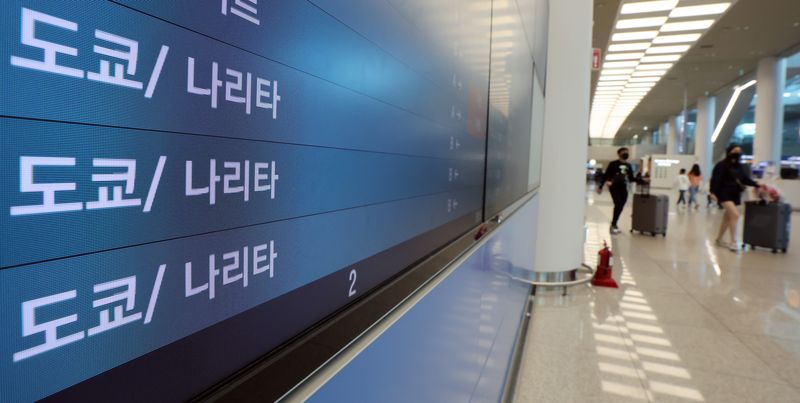
[Financial News]“For people who are genuinely obese, Mounjaro is a vital medication. If not for Sushizaro, I wouldn’t have been able to keep getting the injections like this.”These are the words of A, 43, a Mounjaro user who says they have been using “Sushizaro” for more than three months. The term is a portmanteau of sushi (referring to Japan) and Mounjaro. More people are heading to Japan—the so-called “Sushizaro”—to buy Mounjaro, a GLP-1 (glucagon-like peptide-1) obesity treatment that costs around 300,000 won a month in Korea. Some medical institutions in Japan prescribe and sell Mounjaro at lower prices than in Korea.
Once airfare and accommodation were included, the actual costs showed that buying only a one- or two-month supply was a losing proposition.At least three months’ worth was needed to offset the cost of a trip to JapanHowever, even products properly prescribed overseas must meet separate customs requirements when brought into Korea, which is a key factor.
Add airfare, and you need to buy three months’ worth to break even
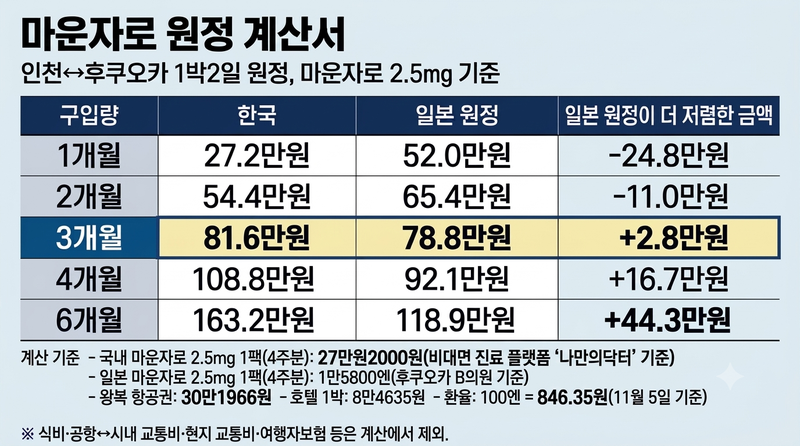
The price difference is substantial. As of the 4th, the lowest price for one 2.5 mg pack of Mounjaro (a four-week supply) among the prices collected from 2,451 locations nationwide by the telemedicine platform My Doctor was 272,000 won. At Clinic B in Fukuoka, Japan, one 2.5 mg pack sold for 15,800 yen (about 134,000 won), a noticeable difference.
The problem is the cost of getting to Japan. As of the 5th, a round-trip ticket from Incheon to Fukuoka cost 301,966 won, and one night at a local hotel cost 84,635 won. Meals, transportation between the airport and city center, local transport, travel insurance and other expenses were excluded. The exchange rate was set at 846.35 won per 100 yen, as of the 5th.
The calculations show that traveling to Japan to buy a one-month supply of Mounjaro would cost about 520,000 won in total, 248,000 won more than buying it in Korea. Even for a two-month supply, the trip to Japan would cost 654,000 won, 110,000 won more than the 544,000 won domestic purchase price.
The break-even point is three months. Buying a three-month supply in Japan would cost about 788,000 won including airfare and accommodation, 28,000 won less than the domestic lowest price of 816,000 won. Beyond that, the savings grow. A four-month supply would cost about 921,000 won, saving 167,000 won compared with buying in Korea; a six-month supply would cost about 1,189,000 won, saving 443,000 won. Some clinics even offer further discounts on bundled purchases, saying that “buying six months’ worth in bulk is the cheapest.”
Why is Sushizaro cheaper?
One reason Mounjaro is relatively inexpensive in Japan is the drug-pricing system.Japan lists Mounjaro as a treatment for type 2 diabetes under its national health insurance system, with the government controlling the price. In August this year, the price was cut by 25%.There is an important caveat. The price covered by Japan’s health insurance and the amount Koreans actually pay at Japanese clinics are not the same thing. The insurance price is the official price under Japan’s insured medical-care system, while Koreans who obtain a prescription and buy the drug at a Japanese clinic must pay the price set by that clinic for private-pay treatment.
The price used in these calculations for a four-week supply of 2.5 mg Mounjaro at Clinic B is also a private-pay price. So saying that “Mounjaro is cheaper in Japan” does not mean Koreans get the Japanese health-insurance price; rather, it means the price at some Japanese medical institutions for a prescribed purchase is lower than Korea’s price for treatment not covered by insurance.The threshold for getting a prescription is also low. Generally, showing a passport and filling out a medical questionnaire locally is enough to easily obtain a Mounjaro prescription.A, who uses Sushizaro, explained that the medication was delivered to a hotel after a telemedicine consultation by video call, without going to Japan. A said no diabetes diagnosis or blood test results had ever been submitted.
Customs barriers have also eased... Travelers may bring in up to a three-month supply
But the bill includes more than just the cost of the medication and airfare. Bringing the medicine into Korea adds customs clearance as another variable.
According to the Korea Customs Service (KCS), Mounjaro and Wegovy brought into Korea from overseas are among the harmful medicines that the Ministry of Food and Drug Safety (MFDS) has notified to the KCS. They cannot clear customs without meeting the prescribed import requirements. The reason is that it would be difficult to guarantee safety if products of unverified origin and quality were distributed in Korea.
Last September, the KCS said it would tighten customs controls on obesity treatments such as Mounjaro and Wegovy, and explained that products lacking the necessary import requirements would be held at customs and then returned or destroyed.
The number of cases detected is also rising rapidly. According to the KCS, detections of illegal imports of obesity treatments jumped from four cases in 2024 to 1,189 in 2025, reaching 5,030 by August this year. Some have questioned whether it is appropriate to handle under the same customs system products illegally bought overseas without a prescription and products prescribed properly after a consultation at a Japanese medical institution.
GLP-1 obesity treatments such as Mounjaro are often needed for long-term treatment, rather than being drugs taken for a short time and then stopped. When patients who struggle to continue treatment because of the cost seek care overseas where it is cheaper than in Korea, simply “blocking illegal online purchases from abroad” is not enough to resolve the problem.
As cases continued in which medicines properly prescribed and purchased overseas were held at customs when people entered Korea,the MFDS, after consulting with the KCS, decided to allow travelers to carry in medicines for personal treatmentit announced on the 11th. As a result, the process for bringing obesity treatments such as Wegovy and Mounjaro purchased overseas into Korea will be simplified. For medicines purchased with a valid prescription, starting on the 12th,travelers may carry in up to six bottles, and even amounts exceeding that limit are allowed up to a three-month supply.
Why are people saying “I won’t switch” even though a cheaper Korean drug is available?
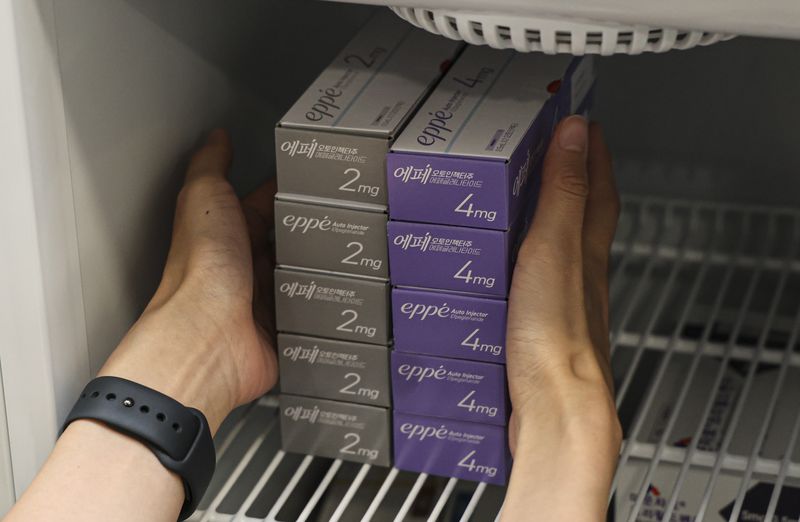
In terms of price, the domestically developed obesity treatment Epe is considered a rival to MounjaroEpe began to be prescribed on the 29th of last month, with an initial price of about 130,000 won for a four-week supply—half the price of Mounjaro. However, the price rises to as much as 299,200 won at higher doses, and some analysts say it has little price advantage at the maintenance dose.Some say people who have already seen results with Mounjaro are unlikely to choose Epe just because of the price. A said, “I have absolutely no intention of switching to Epe because of the price,” adding, “If the medication didn’t work, I’d consider switching to another one, but I wonder why I should switch when it works well. I think the problem is that Mounjaro is so expensive only in our country compared with other countries.”Ultimately, the problem is the price. Unless Mounjaro’s price in Korea comes down, Sushizaro is likely to continueto continue. But it remains to be seen how long people can keep going this way. Bae Jun-young, a lawmaker with the People Power Party, said, “The relevant authorities should also consider how to create an environment where people can receive treatment with safe prescriptions at a reasonable cost.”
It was a revolution. Weight that once came off only after enduring hunger, running and hardship began to melt away with a single injection. Mounjaro’s arrival in Korea in August last year turned the weight-loss landscape upside down. But revolutions have a downside, too. Neighborhood gyms were pushed to the brink of closure, while hair and muscle loss, as significant as the weight loss, became new concerns.[The Shot That Changed the World]takes a five-part look at how obesity treatments are changing Koreans’ bodies and daily lives, as well as the industry’s ups and downs.
[email protected] Kim Hee-sun, Seong Min-seo Reporter