‘Defense Drone Showdown’ Concludes, Setting the Stage to Strengthen ‘K-Drone’ Capabilities to Overmatch North Korea’s Unmanned Forces
- Input
- 2026-11-05 15:57:43
- Updated
- 2026-11-05 15:57:43
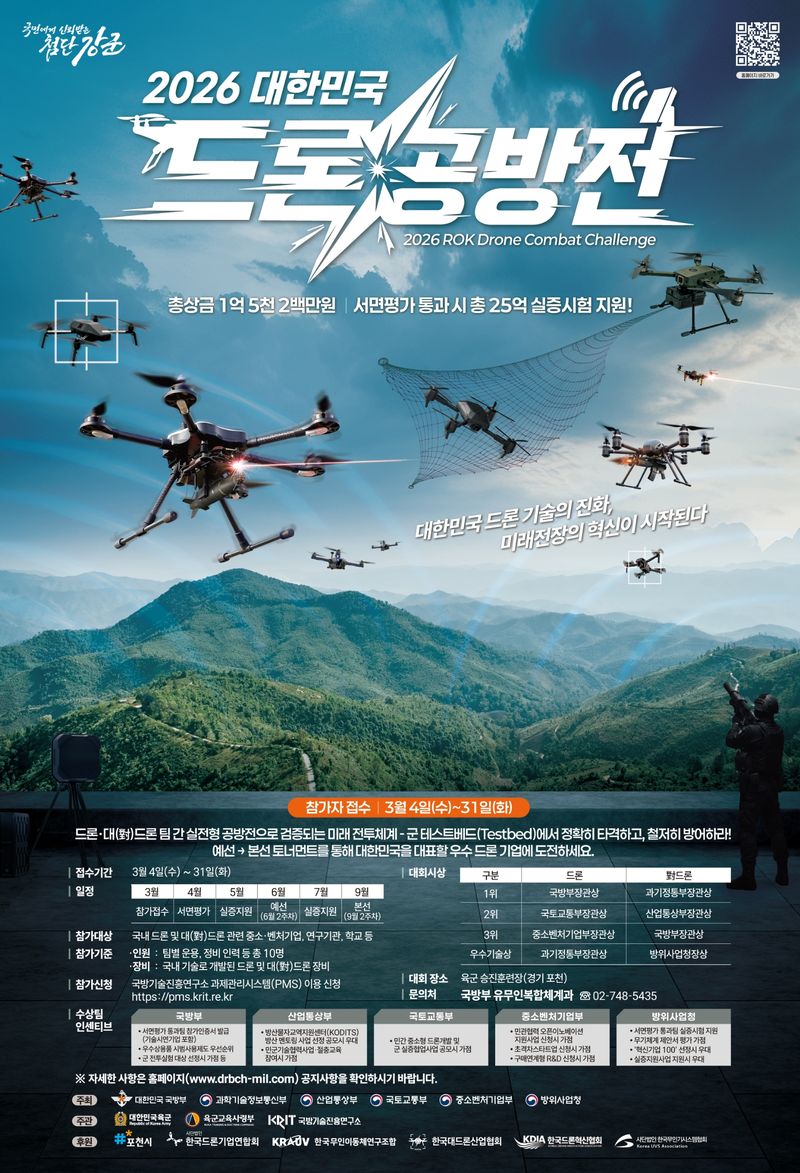
According to the Ministry of National Defense on the 5th, military authorities held the final round of the 2026 Defense Drone Showdown over two days, from the 3rd to the 4th, at the Seungjin Science Training Ground in Pocheon. The event was jointly hosted by the Ministry of National Defense, the Ministry of Science and ICT, the Ministry of Trade, Industry and Energy, the Ministry of Land, Infrastructure and Transport, the Ministry of SMEs and Startups, and the Defense Acquisition Program Administration, and organized by the Army Training and Doctrine Command. It was designed to directly assess the performance of advanced civilian drone and counter-drone technologies in conditions resembling real-world operations and maximize their alignment with defense-sector requirements.
The final six teams, which advanced through the preliminary round in June, drew matchups between the drone and counter-drone teams and competed fiercely with tactical equipment over six matches. Following rigorous technical testing and an assessment of mission performance, PRENEU won the drone category, while Dams Tech (a consortium of Ubifly and RF Core) took top honors in the counter-drone category, which focuses on neutralizing drones. The winning teams will receive certificates of commendation from the Minister of National Defense and prize money, as well as the exceptional incentive of bonus points when seeking support for future military combat experiments and government ministry projects.
Military experts say the competition goes beyond a one-off contest, carrying significant political and tactical importance amid the rapidly changing confrontation between unmanned forces on the Korean Peninsula.
North Korea is currently rapidly advancing its asymmetric unmanned aerial capabilities by actively adopting drone tactics developed during the Russia-Ukraine war. In particular, it is moving beyond reconnaissance drones and establishing mass-production capacity for small, cost-effective suicide drones, while increasingly signaling the possibility of tactical provocations using equipment linked to GPS jamming. This is emerging as a direct security threat that could bypass South Korea’s air-superiority forces and destabilize its low-altitude air defense network.
The competition, which combined civilian autonomous-navigation technology with hard-kill and soft-kill counter-drone technologies, is seen as having tested a defensive foundation capable of offsetting North Korea’s numerical advantage in drones. In particular, the fact that multiple government ministries jointly hosted the event, increasing the predictability of technology investment for competitive small private-sector companies, and offered bonus points when systems are fielded—helping build a self-sustaining ‘defense unmanned supply chain ecosystem’—is seen as a positive sign for military self-reliance.
The Ministry of National Defense also plans to use the competition to further strengthen its capabilities in manned-unmanned teaming systems suited to future battlefield environments. A ministry official stressed, “We will quickly connect promising new technologies from the private sector with the military’s requirements, encourage the spear and shield to compete and advance together, and systematically strengthen our unmanned-force capabilities so we can overmatch the threat posed by North Korean drones.”

[email protected] Lee Jong-yoon Reporter