“A 1–2 percentage-point increase in retirement pension returns doubled retirement assets”
- Input
- 2026-11-05 15:50:09
- Updated
- 2026-11-05 15:50:09
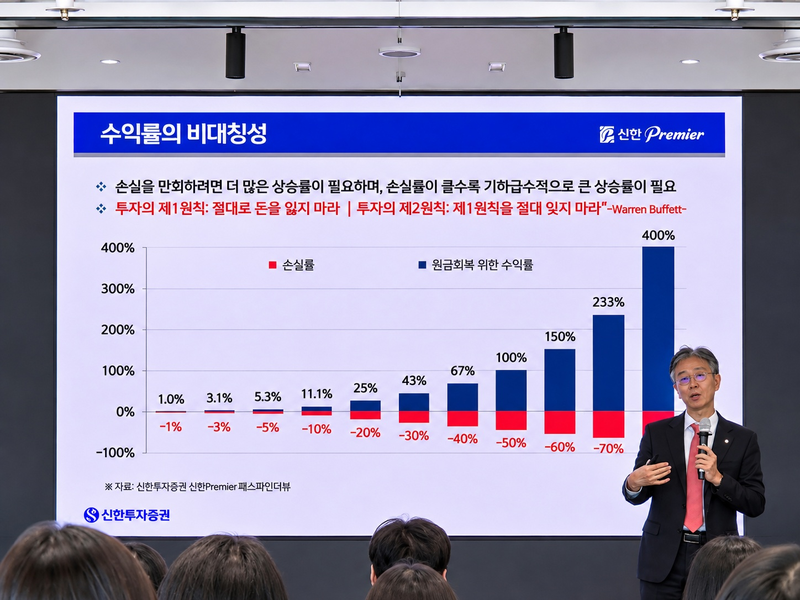
[Financial News] Advice was offered that the key to long-term asset growth is not chasing high returns, but reducing volatility and steadily building the benefits of compounding. An analysis found that adding an investment strategy tailored to the characteristics of each tax-advantaged account can further increase the actual impact on asset growth.
Park Geun-bae, an executive director at Shinhan Investment & Securities’ Shinhan Premier Pathfinder Division, said at the “Wise Asset Management Strategies” seminar hosted by Shinhan Investment & Securities at TP Tower in Yeouido on the 5th: “If you assume someone enrolls in a defined-contribution (DC) retirement pension plan or an individual retirement pension (IRP) at age 30 and begins receiving benefits at 70, the investment period comes to about 40 years. Even raising the average annual return by just 1–2 percentage points over that period could nearly double the size of their retirement assets.”
Park first addressed investors’ common belief in real estate’s invincibility and their expectations of high short-term returns. He cited as an example the fact that the long-term returns on apartments in Seocho District and Gangnam District were far lower than the total return of the S&P 500, including reinvested dividends.
In fact, data from Shinhan Investment & Securities comparing cumulative returns by asset from January 2006 through last September showed that apartments in Seocho District and Gangnam District returned around 240–270%, while the S&P 500 (TR) returned 785.5%. The KOSPI 200 (TR) also reached 694.9%.
The explanation is that differences in investment behavior underlie the perception of real estate as a more stable and profitable asset than stocks.
Park explained: “Real estate requires a large investment and is difficult to check prices daily or trade frequently, so people tend to hold it for the long term. Stocks, by contrast, are priced in real time, making investors sensitive to short-term fluctuations and more likely to trade repeatedly.” He stressed, “What matters in long-term investing is managing downside risk rather than achieving large gains.” That is because when asset prices fall sharply, recovering the principal requires a return far higher than the percentage decline.
The explanation is that the benefits of compounding can be maximized by choosing assets that are relatively less volatile and steadily trend upward, rather than assets that repeatedly undergo large swings.
The same reasoning underpins the emphasis on index strategies that invest in the market’s long-term growth as a whole, rather than in individual stocks or leveraged investments. The basic principle of asset management, he said, is to extend the investment horizon and trust in the market’s long-term upward trend rather than pursue high short-term returns.
He advised investors to manage their pension accounts starting with the timing of their contributions if they want to boost returns. Rather than putting in a lump sum at year-end for a tax credit and leaving it untouched, it is more advantageous to make regular monthly contributions starting at the beginning of the year to secure a longer investment period. This can maximize the rolling-return effect over the investment period, he said.
Park said, “ETFs should be allocated with the characteristics of tax-advantaged accounts in mind, including individual retirement pensions (IRPs), pension savings accounts and individual comprehensive asset management accounts (ISAs).”
Products such as domestic equity ETFs, whose capital gains are generally not taxed, can be held in a regular brokerage account or an ISA, while foreign ETFs listed in Korea, which are taxed on capital gains and dividends, can be placed in a pension savings account or an IRP. The explanation is that domestic equity ETFs held in a pension account may be subject to pension income tax when benefits are eventually withdrawn, so the tax benefits of each account should be weighed.
[email protected] Kang Jung-mo Reporter