LX Holds ‘Underground Information Seminar’... Public, Private and Research Sectors Join Forces to Prevent Sinkholes
- Input
- 2026-11-05 15:16:09
- Updated
- 2026-11-05 15:16:09
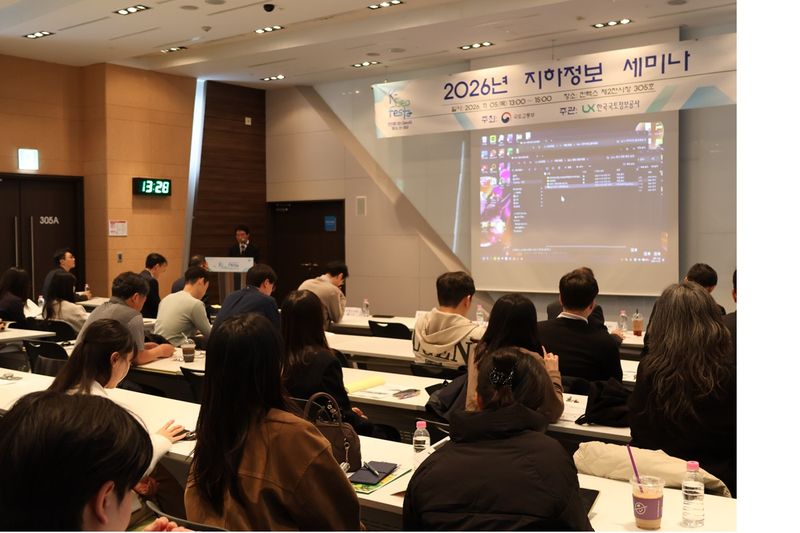
[Financial News] Institutions that produce underground information and those that use it came together to discuss ways to prevent sinkholes.
According to Korea Land and Geospatial InformatiX Corporation (LX) on the 5th, LX, the agency responsible for underground information, held the ‘2026 Underground Information Seminar’ at KINTEX in Goyang, Gyeonggi Province, that day during ‘2026 K-Geo Festa.’ About 80 representatives from the public, private and research sectors attended. The theme was ‘Advancing Underground Information and Institutional Innovation to Strengthen Underground Safety.’ The seminar was organized to find ways to prevent ground-subsidence incidents, including sinkholes, which have heightened public anxiety, and to make better use of underground information.
The presentations ranged from on-site response to technological research. Kim Jun-gyu, head of the Seoul Metropolitan Government’s Underground Safety Team, introduced the preventive results of new ground-subsidence monitoring technology deployed at major excavation sites. Heo Chun-geun, head of the Underground Inspection Office at the Korea Authority of Land & Infrastructure Safety, presented ways to assess and manage areas at high risk of ground subsidence. Kang Jae-mo, Ph.D., of the Korea Institute of Civil Engineering and Building Technology (KICT), discussed research into smart underground safety management using advanced technologies such as AI, while Shin Han-seop, an executive director at Allforland, shared ways to advance the compilation of underground facility information and ensure on-site safety.
LX has created and manages an ‘Integrated Underground Information Map’ that brings together 16 types of underground information managed by 225 institutions, helping manage underground spaces and prevent safety accidents. Going forward, it plans to continue public-private-research collaboration based on the technological trends and policy directions shared at the seminar and make underground information data more useful in the field.
Awareness of sinkhole risks has risen sharply since last year. On March 24 last year, the ground collapsed at an intersection near Daemyeong Elementary School in Myeongil-dong, Gangdong-gu, Seoul, burying and killing a motorcyclist. The Ministry of Land, Infrastructure and Transport’s Central Underground Accident Investigation Committee concluded that the accident resulted from a combination of discontinuities in a deep weathered rock layer, a drop in groundwater levels caused by nearby highway tunnel construction, and inadequate maintenance of aging sewer pipes. Seoul alone recorded 73 ground-subsidence incidents in the first half of last year, with damage to sewer pipes and manholes cited as major causes. Of Seoul’s 10,866 kilometers of sewer lines, 55.5% were more than 30 years old.
Sim Byeong-seop, head of LX’s Geospatial Information Division, said, “Safety beneath the ground cannot be ensured through the efforts of any one institution alone.” He added, “I hope this will be an opportunity for the institutions that create and use underground information to understand each other’s work in the field and strengthen their bonds of cooperation.”
[email protected] Jeong Gyeong-su Reporter