“Turning public ideas into law” ... Solutions for AI, people’s livelihoods and safety converge at the National Assembly [Legislation and Policy Proposal Contest]
- Input
- 2026-11-08 16:11:54
- Updated
- 2026-11-08 16:11:54
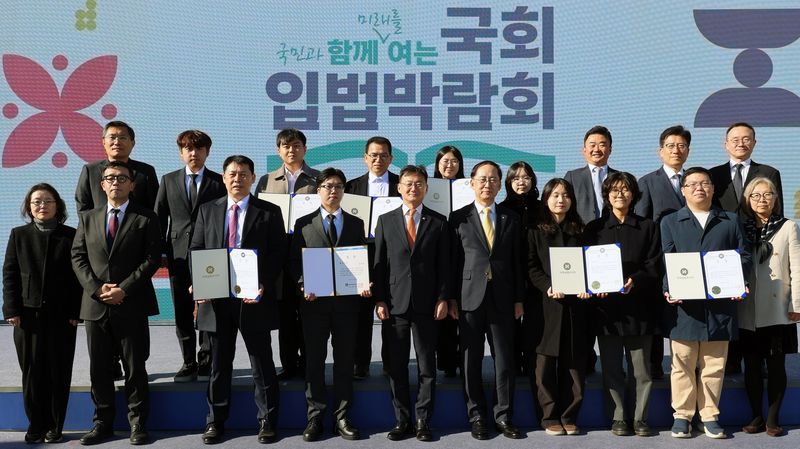
The awards ceremony for the “2026 Legislation and Policy Proposal Contest,” jointly hosted by Financial News and the National Assembly Research Service, was held at the National Assembly on the 6th. A total of 165 proposals were submitted this year. Thirteen winning proposals were selected based on six criteria, including potential for use, originality and practicality.
National Assembly Speaker Cho Jeong-sik said, “The inconveniences and concerns people experience in their daily lives, and their proposals for a better society, are important guides to the direction the National Assembly should take.” He added, “The National Assembly will not stop at listening to the public’s voices; we will work to carry them into substantive discussions.”
Financial News President Song Ui-dal said"This contest is establishing itself as the country’s foremost legislative and policy proposal contest,” adding, “I hope the proposals adopted this time will reach every member of the National Assembly and serve as a valuable foundation for legislative work.”
National Assembly Research Service Director Lee Gwan-hu said, “The Research Service will publish the outstanding proposals in a booklet and distribute it to lawmakers’ offices and relevant institutions. We will do our utmost to make active use of them in legislative support, research and analysis so that they can be developed into effective policy alternatives.”
This year’s grand prize, the Speaker of the National Assembly Award, went to Kim Yong-du for the proposal, “A Plan to Establish a Universal Basic Safety Net by Legislating a Citizen Safety Insurance Scheme That Proactively Identifies Beneficiaries.” The proposal calls for improving the system to narrow regional gaps in citizen safety insurance coverage and ensure that people receive the coverage they need on time. Speaker Cho also highlighted the significance of the winning proposal, saying, “It offered a solution to close regional gaps in safety coverage and ensure that people can receive the coverage they need on time.”
The top excellence award, the Financial News Chairman’s Award, went to Yang Hae-ryeong for the proposal, “Introducing Standard Special Contract Clauses to Promote Field Demonstrations of Physical AI in Manufacturing.” The proposal aims to establish an institutional foundation for testing and using physical AI technology in manufacturing settings. The National Assembly Research Service Director’s Award went to Kim Gyeong-gyu for the proposal “Establishing an AI-Based Integrated, Tailored Disaster Alert System and Revising Disaster and Safety Management Laws.” It proposes applying AI technology to disaster alerts to strengthen public safety.
This year’s contest covered three areas: “Establishing a Universal Basic Safety Net,” “Fostering Future Industries and Responding to the AI Era,” and “Strengthening K-Culture Competitiveness.” The largest number of submissions, 69, concerned future industries and AI; the basic safety net category received 61, followed by K-Culture with 35. A notable feature was that proposals addressed not only the use of AI in industry but also accountability in public services and the protection of people’s rights.
The Outstanding Proposal Awards included proposals addressing new institutional challenges arising from technological change, such as assessing dependence on public-sector AI procurement, legislating standards for public data that AI can read, and protecting prepaid credits when AI services are discontinued. Other selected ideas aimed to strengthen the safety net for vulnerable groups, including advance payment and later settlement of social security benefits, a medical emergency contact system for people living alone, and safeguards for livelihood benefit payments.
In the K-Culture category, winning proposals included ways to promote local tourism through tourism-oriented local-love gift certificates and to introduce official channels for transferring and reselling performance tickets.
[email protected] Kim Gyeong-min Reporter