Gwangju Special City puts Financial Innovation Task Force into full swing, steps up response to fiscal changes from Jeonnam-Gwangju integration
- Input
- 2026-11-05 15:23:55
- Updated
- 2026-11-05 15:23:55
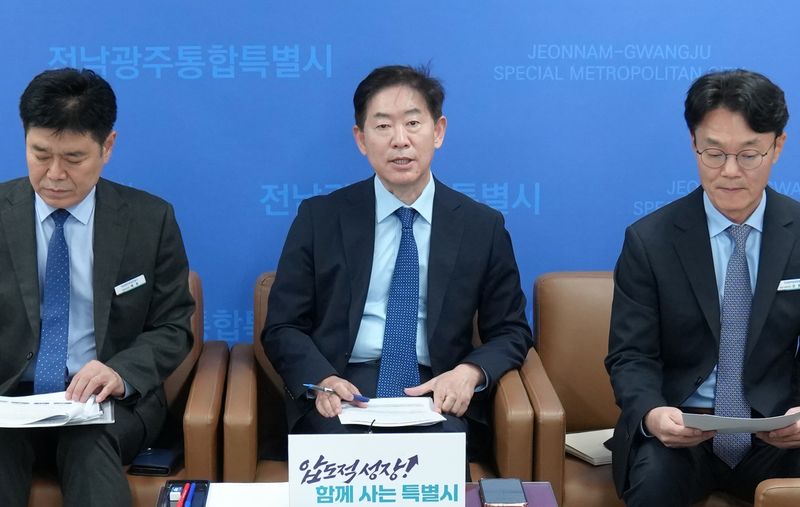
【Financial News, Jeonnam-Gwangju = Hwang Tae-jong, reporter】Baek Seung-ju, vice mayor for balanced development of Jeonnam-Gwangju Integrated Special City (Gwangju Special City), said on the 5th, “We will devise a rational way to allocate resources that reflects the fiscal needs and regional characteristics of each city, county and district, and establish an effective fiscal support system to leverage each region’s strengths and achieve specialized development.”
Baek Seung-ju held a press briefing on fiscal innovation that day and said, “Fiscal innovation must begin with an accurate assessment of each region’s fiscal conditions and development potential, and with supporting balanced growth through fiscal assistance tailored to regional characteristics.”
Baek Seung-ju also presented 12 fiscal innovation tasks and four key priority tasks.
Earlier, on the 4th, Gwangju Special City held a “Financial Innovation Task Force agenda-sharing session (kickoff meeting)” chaired by Vice Mayor Baek Seung-ju, finalized 12 tasks to be pursued, and discussed the direction for the first task.
The tasks finalized that day had been discussed at the “Financial Innovation Task Force Task Selection Review Committee” held last October. They comprise 12 tasks in total: six on fiscal strategy (including measures to strengthen city, county and district finances and support specialized development; a comprehensive plan for managing 20 trillion won in integrated local government support funds; and measures to restructure spending and manage the issuance and repayment of local government bonds); two on balanced development (the size of a balanced development fund and ways to secure its financing, and ways to operate the fund to promote balanced regional development); and four on revenue expansion (analyzing the local tax revenue base and measures to increase tax revenue, and ways to use available assets, including shared property).
Gwangju Special City decided to prioritize four urgent tasks: measures to strengthen city, county and district finances and support specialized development; a comprehensive plan for managing 20 trillion won in integrated local government support funds; measures to restructure spending and manage the issuance and repayment of local government bonds; and the size of a balanced development fund and ways to secure its financing. The remaining eight mid- to long-term tasks will be pursued in stages, taking policy conditions and other factors into account.
Gwangju Special City also formed a Financial Innovation Task Force to carry out the work, led by Vice Mayor Baek Seung-ju and comprising three working groups covering fiscal strategy, balanced development and revenue expansion. It will also establish separate, task-specific subcommittees in each group with private-sector experts participating, to strengthen implementation.
In particular, the city will work with the departments responsible for each task, the Jeonnam-Gwangju Research Institute and regional finance experts to develop detailed implementation plans, and will discuss the remaining fiscal innovation tasks in stages according to their priority.
The city also decided to review progress on each task at monthly regular meetings and draw up key improvement measures within the year, among other steps, to improve the efficiency and autonomy of fiscal management and strengthen the fiscal foundation supporting balanced development across regions.
[email protected] Hwang Tae-jong Reporter