“The Evolution of Biocosmetics: Skin Resilience Is a Promising Field”
- Input
- 2026-11-05 16:05:56
- Updated
- 2026-11-05 16:05:56
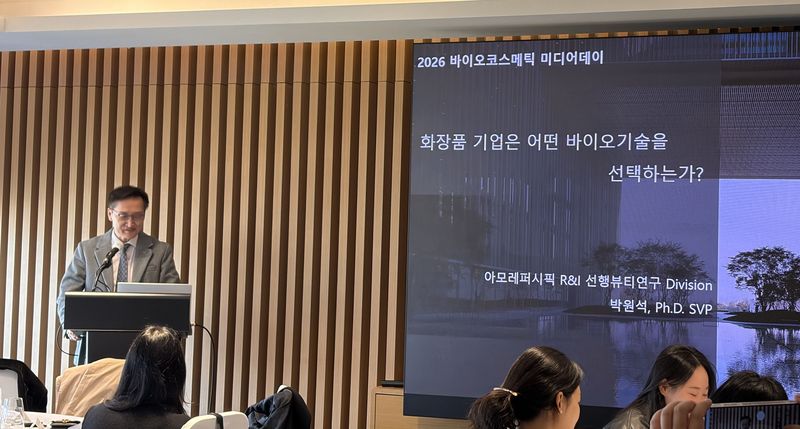
[Financial News] As interest grows in functional cosmetics that address skin concerns, forecasts suggest that cosmetics that strengthen the skin’s own resilience will become even more popular.
Park Won-seok, executive director of the Advanced Beauty Research Division at Amorepacific Corporation’s Research & Innovation (R&I) Center, spoke about promising areas in biocosmetics at the 2026 Biocosmetics Media Day, held at Novotel Hotel Dongdaemun in Jung District, Seoul, on the 5th, under the theme “How Biology Is Rewriting the Future of Cosmetics.”
Daewoong Pharmaceutical Co., Ltd., which was the first in the world to commercialize epidermal growth factor (EGF) as a drug, is a prominent example of a company entering the cosmetics market. “EGF is one of the leading substances that can boost the skin’s own resilience,” Executive Director Park said. “Many startups and researchers are conducting research from the perspective of skin recovery.”
Research into aging at the cellular level is also drawing attention. “After related concepts began to take shape in the 2010s, nine characteristics of aging were identified at the cellular level,” he said. “The concept of longevity emerged alongside the proposal that we should view aging not as a fate we must accept, but as a disease.” Research in the field is progressing actively; last year, 14 characteristics associated with symptoms of aging were published in academic circles. He also identified Gold Bio, a concept combining biology and artificial intelligence (AI), and “neurocosmetics,” which affect emotions, as directions in which the cosmetics industry will evolve.
Amorepacific Corporation has used biotechnology grounded in scientific evidence from the product development stage onward. “Amorepacific distinguishes technologies and products that are merely interesting from those with practical promise,” Executive Director Park said. “We check for clear objectives and mechanisms of action, human skin data, manufacturability, including formulation, safety for long-term use, and differentiated efficacy.” Since 2008, Amorepacific Corporation has used ex vivo cultures of human skin, as an alternative to animal testing, to identify mechanisms of action.
Ginsenomics, the patented technology used in Sulwhasoo, is an example of maximizing specific beneficial components in ginseng. The key ingredient, Compound K, was extracted from among 30 ginsenosides (saponins), the main components of ginseng, and its concentration was raised to 30%. “Biotechnology enabled us to identify an active ingredient present at one part per million,” Executive Director Park said. “We have demonstrated four benefits related to the characteristics of aging, including suppressing chronic inflammation and alleviating cellular senescence.”
Examples were also presented of drug developers entering the cosmetics business. NovMetaPharma developed a skin booster with enhanced anti-inflammatory and mitochondria-improving effects using synthetic peptides. NovaCell Technology, which developed peptides that promote the resolution of inflammation, launched acne cosmetics following its work on developing a treatment for atopic dermatitis. “Global interest in Korea is high, but considering sustainability, I thought it was better to enter the market with science-based cosmetics,” CEO Lee Tae-hoon said.
[email protected] Kang Myeong-yeon Reporter