Debate over delivery-platform regulation follows sanctions on Coupang, raising concerns about Korea-U.S. trade friction
- Input
- 2026-11-05 15:23:12
- Updated
- 2026-11-05 15:23:12
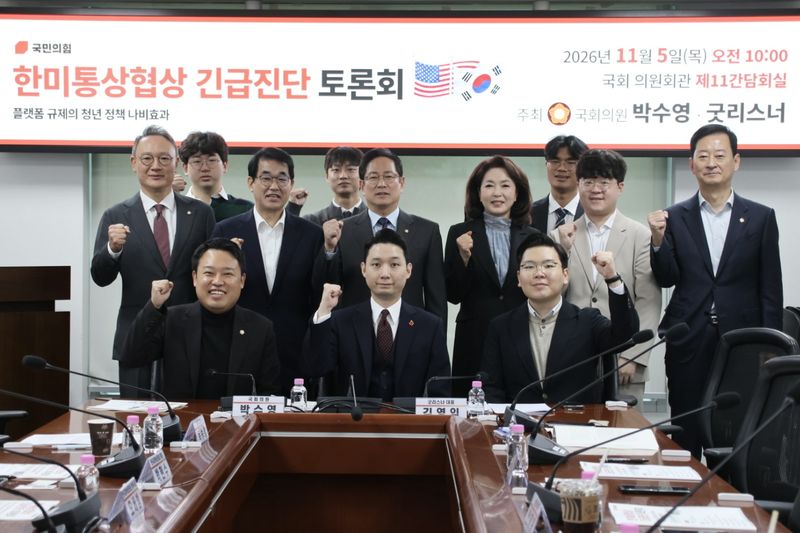
[Financial News] Opposition figures have raised concerns that the Online Platform Act and a cap on delivery-platform fees could harm Korea-U.S. relations if implemented. Indeed, as government and parliamentary sanctions and pressure on Coupang intensified, the issue emerged as a potential factor in Korea-U.S. trade negotiations. The opposition has also proposed establishing a standing coordination mechanism for the two governments to consult in advance on digital trade issues.
Park Soo-young, a People Power Party lawmaker, and Good Listener, a youth-policy think tank, jointly held an emergency forum on Korea-U.S. trade negotiations at the National Assembly Members' Office Building on the 5th. The forum took an in-depth look at the burden of investment in the United States arising from Korea-U.S. trade negotiations, the impact of online-platform regulation on bilateral trade, and the potential effects of a delivery-platform fee cap on domestic industries and youth employment.
Lawmaker Park stressed that domestic online-platform regulation could bring about a trade crisis. In response to the Democratic Party of Korea's moves to push an Online Platform Regulation Act, he said, "At a time when we should be doing all we can to build trust between Korea and the U.S., our
own ranks have instead kindled trade friction and handed the U.S. negotiating team an excuse," adding, "This 'policy butterfly effect,' in which a single domestic regulation triggers a trade crisis and erodes young people's future, must be stopped."
Good Listener stressed the need to assess domestic legislation that affects U.S.-based companies. Kim Young-ik, CEO of Good Listener and a visiting professor at the Graduate School of International Studies at Yonsei University, noted that the Office of the U.S. Trade Representative (USTR) views Korea's platform regulatory policies as discriminatory non-tariff barriers against U.S. companies. He said he sympathized with the policy goal of protecting small businesses, but warned that the policies could become a factor in negotiations over tariffs on semiconductors, automobiles and steel, as well as the terms for carrying out investment in the United States.
He proposed making a "trade impact assessment" mandatory for legislation that could affect U.S.-based companies. He also said a standing coordination mechanism should be established so the two governments can consult in advance on digital trade issues. Kim urged a shift away from politics that pressures businesses and toward policies that protect jobs, mutual prosperity and trust in the alliance.
Concerns also poured in over regulatory bills, including a cap on delivery-platform fees discussed recently during a parliamentary audit by the Climate, Energy, Environment and Labor Committee. Oh Young-taek, head of the Unification Korea Network, criticized the bill, saying, "The delivery-platform regulation bill claims to protect small businesses, but in reality it is a price-control measure that infringes on private companies' right to set prices." He also warned that if free delivery were discontinued, orders would fall, hurting small businesses' sales, while riders' incomes would also plunge. He stressed as well that worsening Korea-U.S. relations could increase losses for businesses and lead to fewer jobs for young people.
Ok Seung-cheol, a Paju-si council member from the People Power Party, cited examples from overseas. He explained that New York introduced a fee cap in 2020, but the regulations were eased last year after concerns arose over declining sales at independent restaurants and the shifting of delivery fees. He said the European Union (EU), too, has focused less on uniform fee caps and more on institutional measures to ensure transparency in platform transactions and protect businesses operating on the platforms.
Some also highlighted the issue's connection to Korea-U.S. trade negotiations. Ahn Je-wook, vice president of Cheongram, said, "U.S. companies cannot be exempt from the application of domestic law." He added, "But if the joint Korea-U.S. fact sheet pledged a principle of non-discrimination for digital services, the government has an obligation to explain that the targets of regulation and the level of sanctions were determined according to objective and proportionate standards."
[email protected] Lee Hae-ram Reporter