People preparing for a dignified farewell ... 3.2 million advance directives refusing life-sustaining treatment
- Input
- 2026-11-05 15:01:51
- Updated
- 2026-11-05 15:01:51
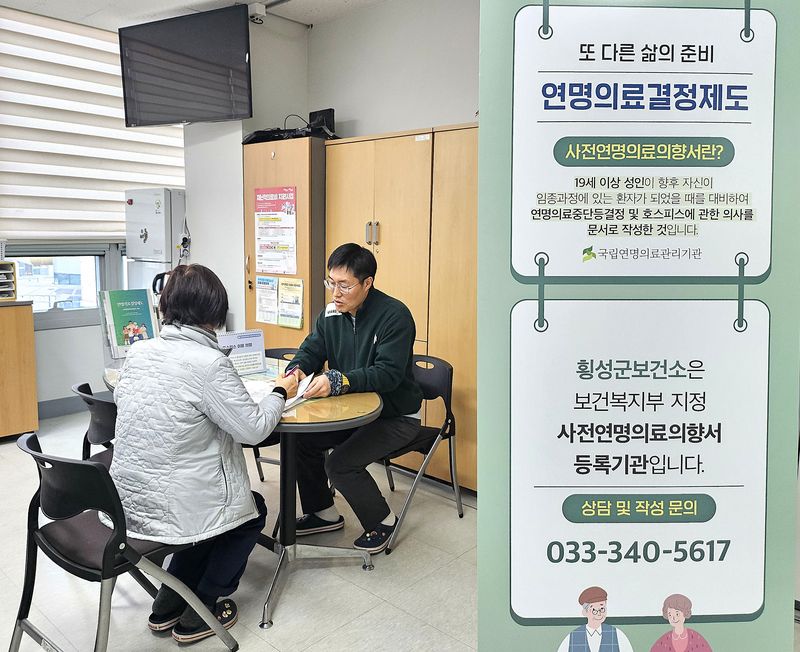
[Financial News] More people are preparing for the end of life on their own terms. The cumulative number of advance directives stating that people do not wish to receive futile life-sustaining treatment has surpassed 3.2 million, while more than 26,000 patients sought hospice care for the first time last year.
The Ministry of Health and Welfare, the Central Hospice Center and the National Agency for Management of Life-Sustaining Treatment released key operational data and achievements for the two systems in the “2025 National Annual Report on Hospice and Palliative Care” and the “2025 Yearbook on the Life-Sustaining Treatment Decision-Making System.”
According to the yearbook, 499,961 advance directives were registered in 2025, bringing the cumulative total to 3,201,958 since the system was introduced in February 2018. A total of 29,557 life-sustaining treatment plans, drawn up by terminally ill and dying patients in consultation with a physician, were registered in 2025, bringing the cumulative total to 185,952.
The life-sustaining treatment decision-making system establishes the criteria and procedures for not initiating or discontinuing life-sustaining treatment that merely prolongs the dying process without providing a therapeutic benefit, helping people bring their lives to a dignified close.
The proportion of decisions on discontinuing life-sustaining treatment that reflected patients’ own wishes also increased. In 2025, 81,220 decisions to discontinue life-sustaining treatment, among other decisions, were implemented. In 52.2% of those cases, the patient’s wishes were confirmed through a life-sustaining treatment plan or an advance directive, up 19.7 percentage points from 2018, the first year the system was in place. In more than half of the cases, the patients themselves made the decision rather than their families.
The infrastructure for accessing the system also expanded. The number of institutions registering advance directives rose by 59 in a year to 819, while the number of medical institutions with registered institutional ethics committees increased by 40 to 513.
Hospice use has also continued to grow. In 2025, 26,020 patients used hospice care for the first time, an increase of 1,662 (6.9%) from 24,318 the previous year. The figure has risen every year since 22,394 in 2023. Introduced in 2003, hospice and palliative care is a specialized medical service that comprehensively assesses and addresses not only the physical pain of terminally ill patients but also their psychological, social and spiritual difficulties.
At the end of 2025, there were 194 hospice institutions, six more than a year earlier (188). By type, 104 provided inpatient care, 44 consultation-based care, 40 home-based care and six care in nursing hospitals.
Public awareness and satisfaction also increased. In a nationwide survey, 83.2% of respondents said they had heard of hospice care, up 2.8 percentage points from the previous year (80.4%). A total of 89.9% said hospice care was necessary, and 93.1% said they were willing to use it. Satisfaction with hospice care at specialized institutions was 94.7%, up 0.4 percentage points from the previous year (94.3%).
The two reports provide a comprehensive overview of the status and trends in hospice and palliative care and the life-sustaining treatment decision-making system in South Korea, and will serve as foundational data for future system improvements. The annual report on hospice and palliative care is available on the Central Hospice Center’s website, while the yearbook on the life-sustaining treatment decision-making system can be found on the National Agency for Management of Life-Sustaining Treatment’s website.
Kwak Sun-heon, director general for health and medical policy at the Ministry of Health and Welfare, said, “As we enter a super-aged society, public interest in ending life with dignity is growing.” Kwak added, “We will continue to support and improve the life-sustaining treatment decision-making system and hospice and palliative care services so that they operate smoothly, enabling everyone to fully express their wishes about the end of their life and have those wishes respected.”
[email protected] Jung Myung-jin, Medical Correspondent Reporter