Airline stocks rally as oil prices retreat...Jeju Air up 13.18%
- Input
- 2026-11-05 16:19:59
- Updated
- 2026-11-05 16:19:59
[Financial News] Airline, utility and chemical stocks are rising in tandem as international oil prices plunge. Buying flowed into sectors expected to see relief from fuel and raw-material costs, as hopes for an end to the war in the Middle East grew after the Democratic Party’s landslide victory in the U.S. midterm elections.
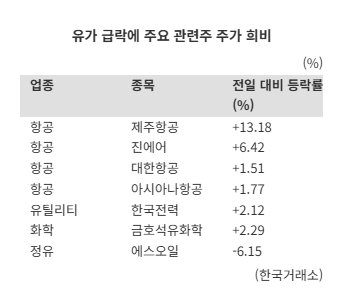
On the 5th, Jeju Air closed up 13.18% at 6,610 won on the Korea Exchange. The buying surge is seen as reflecting a combination of falling oil prices, the won’s recent strength and a third-quarter earnings surprise. Other airline stocks have also continued to rise day after day. Korean Air closed up 1.51% from the previous trading day at 30,200 won, while Asiana Airlines gained 1.77% to close at 8,060 won. Both companies have risen for eight consecutive trading days. Jin Air also posted a strong gain, climbing 6.42% from the previous day.
The sharp drop in international oil prices is behind the rebound in share prices. On the 4th (local time), January Brent crude futures closed at $94.62 a barrel on the ICE Futures Exchange in London, down $8.98 (8.67%) from the previous trading day. That was the lowest level in about two months. The market reflected hopes that the Democrats’ securing majorities in both chambers of the U.S. Congress would rein in military action against Iran and allow negotiations to end the war to advance.
Lower jet fuel prices can ease airlines’ fuel-cost burden. Park Soo-young, an analyst at Hanwha Investment & Securities Co., Ltd., said, “Macroeconomic factors are moving in airlines’ favor, and robust demand has been confirmed, drawing greater market attention recently.” He added, “Outbound demand from Korean travelers remains solid, while inbound demand from foreign visitors is rising sharply, and the domestic airline industry is structurally improving in terms of both demand and supply.”
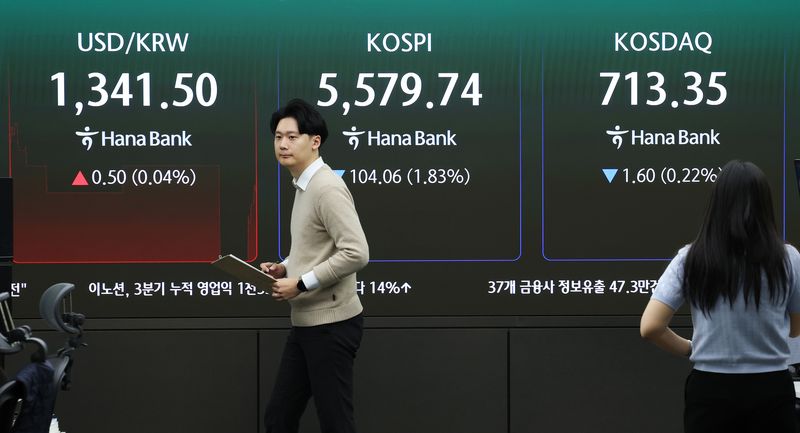
KEPCO, another major utility, closed up 2.12% at 31,250 won. It is also benefiting from expectations that lower oil prices could stabilize the cost of power-generation fuels such as liquefied natural gas (LNG) and ease the burden of electricity-purchase costs. The strength in airline and utility stocks contrasts with the recent trend in the broader market. From the 28th of last month through the 5th, while the KOSPI fell 10.46%, Korean Air and Asiana Airlines rose 15.71% and 15.47%, respectively. KEPCO also gained 9.08% over the same period.
Among chemical stocks, Kumho Petrochemical Co., Ltd. also closed up 1.73% from the previous day at 111,600 won. Petrochemical companies that use naphtha and other products derived from refining crude oil as feedstocks can lower their raw-material procurement costs when oil prices stabilize.
By contrast, refiner S-Oil closed down 6.48% from the previous day at 108,300 won. Refiners may face greater inventory losses if the value of crude oil and petroleum products acquired at high prices falls. Yoon Jae-sung, an analyst at Hana Securities, said, “In the short-term downturn in oil prices, refiners may face concerns about inventory valuation losses and narrower refining margins, but a fall in oil prices as the Strait of Hormuz issue subsides is positive over the medium to long term.” He added, “The chemical sector can expect wider spreads as cost pressures ease and operating rates at competing facilities decline.”
[email protected] Joo Won-gyu Reporter