“South Korea must overhaul its university admissions system to cultivate future talent”
- Input
- 2026-11-05 14:26:48
- Updated
- 2026-11-05 14:26:48
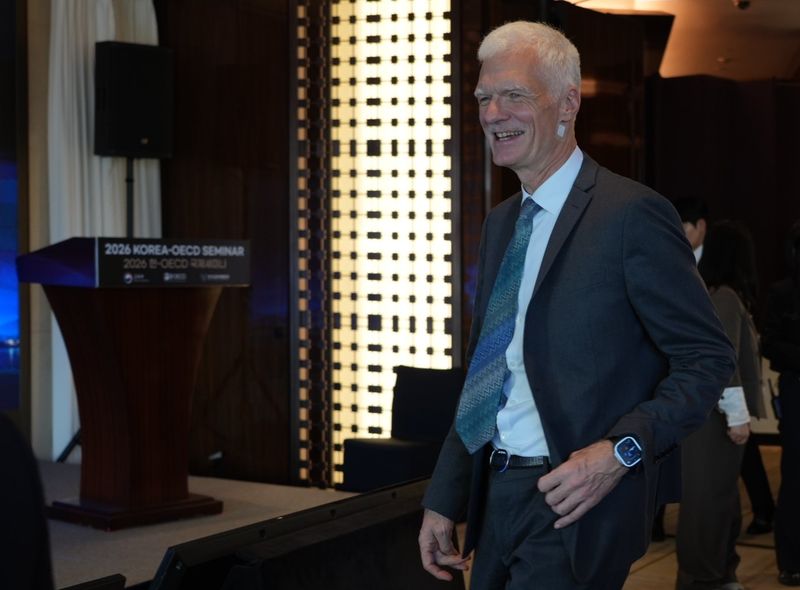
[Financial News] The OECD has recommended that South Korea fundamentally overhaul its university admissions system—not just its curriculum—to cultivate future talent capable of leading in the AI era while maintaining world-leading academic achievement. There are concerns that the college entrance exam, which has helped drive the success of Korean education, remains focused on assessing knowledge from the past and is acting as an obstacle to strengthening students’ self-direction and future-ready skills.
Andreas Schleicher, OECD Director for Education and Skills, made these remarks on the current state of Korean education and reform of the university admissions system during a Q&A session following his keynote address at the 2026 Korea-OECD International Seminar, held on the 5th at The Westin Josun Seoul.
Director Schleicher said, “South Korea’s college entrance exam has helped make the importance of education widely understood throughout society and provided a fair standard regardless of family background, contributing significantly to national development.” However, he said, “A system that places excessive emphasis solely on academic achievement is showing its limitations in developing students’ emotional resilience and capacity for self-directed learning.”
He pointed in particular to the reality in South Korea that when the curriculum and the college entrance exam conflict, the exam ultimately takes precedence. Director Schleicher said, “Changing the curriculum alone will not help,” adding, “The real solution is to reform the entrance exam itself so it can assess the skills that Korean society and the labor market will need in the future.”
The seminar highlighted both the achievements of Korean education over the past 30 years and its limitations. In his congratulatory remarks, OECD Deputy Secretary-General František Růžička said, “Fifty-eight percent of South Korea’s economically active population has completed higher education, and just 1% of young people aged 25 to 34 have not completed secondary education, placing the country among the OECD’s top performers.” He also noted, “In the Programme for International Student Assessment (PISA), 23% of South Korean students attained the highest level in mathematics, more than three times the OECD average of 8%.” The absence of unfilled teaching vacancies and underqualified teachers, as well as a teacher turnover rate of 1.9%—well below the OECD average of 6.4%—were also cited as strengths.
However, a paradox also emerged: outstanding academic results were not translating into future career choices or greater agency in life. According to Director Schleicher, only 54% of South Korean students with top-level science achievement hoped to pursue a science-related career. The analysis attributed this to a lack of interest in and inspiration from science, despite their high grades.
A shift in the education system to develop the information-verification skills and critical thinking essential in the AI era was also urged. Citing an analysis of PISA data, Director Schleicher said, “The students with the highest digital literacy scores were not those who spent the most time using devices, but those who had read printed books of 100 pages or more.” He explained that reading experiences that help students understand and verify complex concepts in context form the foundation of AI literacy.
It was also emphasized that, even amid technological advances, the essence of education lies in human connection. Director Schleicher said, “AI tools that provide only the right answers can actually hinder cognitive thinking,” and noted that “the key factors determining student performance are teachers’ attention and support, and personal interaction with parents.”
Lee Nan-young, Director-General for International Education Planning at the Ministry of Education, who attended as the government representative, said in opening remarks read on behalf of the minister, “Education has been an important driving force behind South Korea’s growth, and we will continue efforts to reform education on multiple fronts, including building an innovative ecosystem for local education and providing AI education for all.” Korea Educational Development Institute President Ko Young-sun added, “Amid structural changes such as a declining school-age population and the development of AI, we will actively pursue education reform for a sustainable society.”
[email protected] Kim Man-gi Reporter